Marie-Pier Berman brings a front-line Canadian safety perspective to international aviation discussions
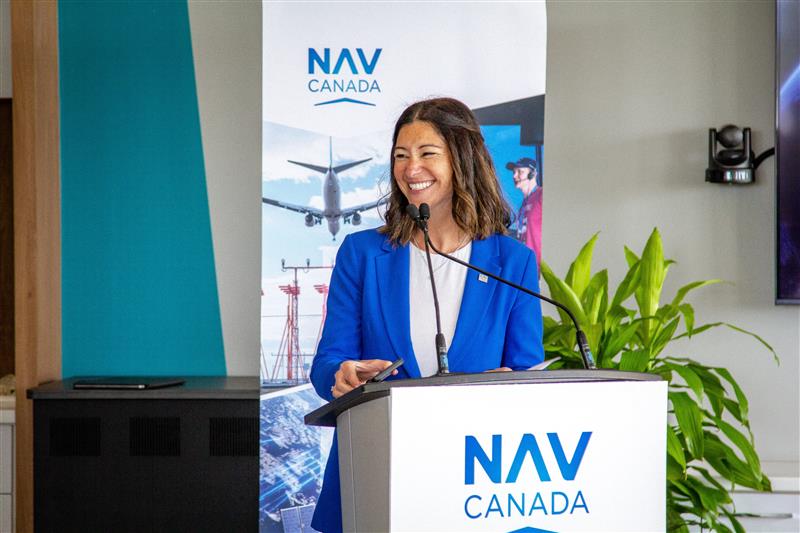
NAV CANADA’s vice-president and chief of operations, Marie-Pier Berman, has been named to the International Civil Aviation Organization’s (ICAO) first cohort of Global Ambassadors, a group of aviation leaders from around the world tasked with promoting the sector and inspiring future talent.
New ambassador role targets engagement and talent pipeline
Berman says the new program brings together aviation leaders from around the world, including roughly two dozen representatives from different ICAO member states. Its mandate is “really about encouraging engagement, helping with education about aviation and inspiring the next generation of talent to come into aviation,” she explains, with a particular emphasis on women and youth.
A former commercial pilot and air traffic controller who rose through operational and leadership roles across Canada, Berman views the ambassador role as both an honour and a chance to inject front-line operational experience into global conversations about aviation’s future. “It is both an honour, but also a great opportunity to bring some of the operational perspective that I have from the different roles that I’ve had,” she says.
She notes many people see only the most visible jobs at the airport, such as pilots and flight attendants, and may not realize the breadth of career paths available behind the scenes. That lack of visibility, combined with persistent perceptions about instability and constant travel, can deter young women from considering aviation. “There are so many other jobs within the aviation industry where you do have that flexibility and you are able to be in positions where you are home every night,” Berman says, citing air traffic services as a prime example.
Bringing a Canadian operational safety lens to ICAO
For occupational health and safety leaders, Berman stresses that safety in aviation “is never static” and remains at the forefront of decision-making. She points to Canada’s reputation for strong safety performance and deep collaboration with domestic and international partners. Canada operates one of the largest and most diverse airspaces in the world, from very remote northern operations to dense traffic in the south, and maintains “one of the best safety records in the world,” she says.
That scale and complexity, along with close coordination with other air navigation service providers and regulators such as the U.S. Federal Aviation Administration, have driven a culture of partnership. “Aviation works best when it’s collaborative,” Berman says. “That strong coordination across countries, with operators, with regulators is what keeps the system safe and is what helps us grow.”
Representation, workforce and the future of aviation
Representation around these global tables, she adds, is critical. While progress has been made, women remain significantly underrepresented in many technical and operational roles. On the pilot side, Berman notes women account for only about 5–7 per cent of licence holders, while women make up less than 20 per cent of air traffic services personnel and an even smaller share of aircraft maintenance engineering roles.
“From my perspective, it is about diversity of thought and experience, and representation matters because it is opening the doors to more to see themselves within this industry,” she says. “Every person brings a different perspective and different lived experiences over the course of their lives, and I think that representation and having those voices at the table is extremely important.”
Reflecting on her own path, Berman grew up around aviation – both of her parents were pilots and her grandfather ran an airport – and she entered the profession early, becoming a commercial pilot at 19 and an air traffic controller at 21. Even so, she says, “you have to work that much harder… to be able to show that you belong at the table.” Mentors, curiosity and the willingness to “take your seat at that table” have been essential in navigating difficult decisions and staying on course.
Looking ahead in her ambassador role, Berman highlights three priorities with clear implications for safety professionals. First, deepening international collaboration remains fundamental to a safe, efficient system. Second, she argues operational experience “does matter when we’re shaping the future of aviation,” ensuring policies and standards are grounded in how systems work in practice.
Third, people and workforce sustainability are central. Many parts of the aviation ecosystem are grappling with staffing shortages. “The future really depends on attracting, training and supporting the next generation that’s going to be coming in and helping them see that diversity and different types of people have opportunities within this sector,” Berman says.
For Berman, serving as an ICAO Global Ambassador is ultimately about opening those doors: raising awareness of the full range of aviation careers, bringing an operational safety lens to international discussions, and helping more people – especially women and underrepresented groups – see a place for themselves in the industry.