

UBC evaluation of WSIB's Health and Safety Excellence Program finds improvements, but reaching small business remains a challenge
Five years after its launch, WSIB's Health and Safety Excellence Program is producing measurable reductions in workplace injuries, according to the most comprehensive evaluation of the program to date. But the researchers behind that finding say the harder work is still ahead: getting the program into the hands of the small businesses that need it most.
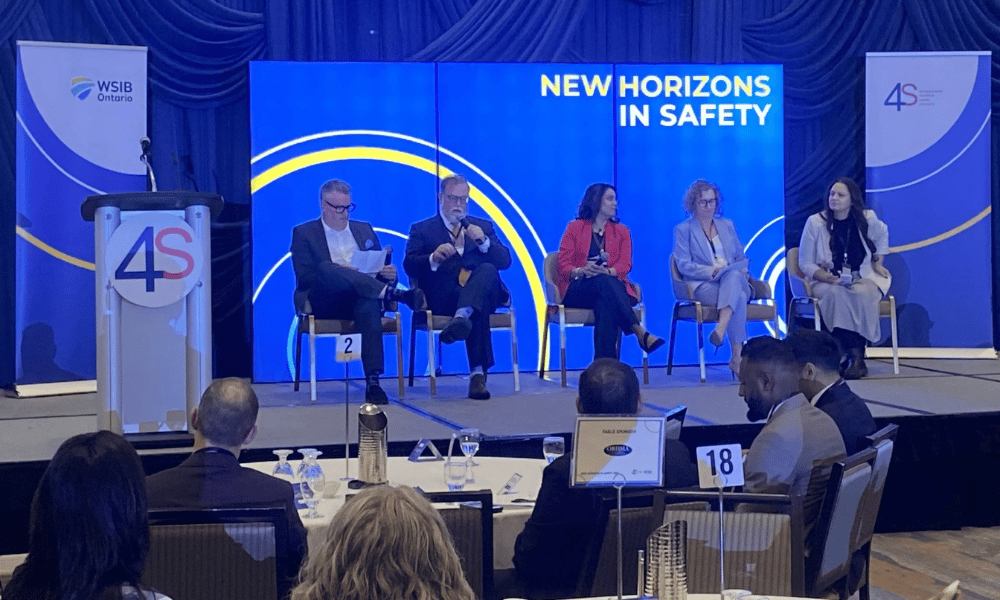
The findings were presented at the New Horizons in Safety Summit 2026 by Dr. Chris McLeod, Associate Professor and Director of the Partnership for Work, Health and Safety at the University of British Columbia, followed by a roundtable discussion with Rod Cook, Vice President of Health and Safety Services at WSIB, along with Sobi Ragunathan of 4S Consulting, Jody Young, President and CEO of Workplace Safety and Prevention Services (WSPS), and Carrie Briley, Director of Health and Safety Program Design at WSIB.
What the research found
The UBC team began evaluating the Health and Safety Excellence Program at its launch in 2019, tracking firms that enrolled in the first two years and comparing their safety performance over five years against matched firms that did not participate.
The results were meaningful. In manufacturing, lost time injury rates fell by nearly 20 per cent among participating firms. High-impact injury rates, those with the greatest burden in terms of cost and disability, also declined, though not uniformly across all sectors.
McLeod identified three factors that drove outcomes. The first was commitment, the act of signing up and engaging with the program as a signal of organizational intent. The second was progression, with firms that completed more topics showing more durable safety effects. The third was relevance, choosing topics that matched a firm's specific risk profile rather than following a generic path.
"These are real people talking about the program at its best," McLeod said, referencing participant feedback. An HR director at a medium-sized manufacturing business described the program as an infrastructure for keeping health and safety at the forefront of organizational priorities.
The evaluation also found that participation led to greater leadership commitment, with executives more involved in health and safety decisions after seeing early results. On the shop floor, employees reported more awareness, more safety conversations, and more participation in decision-making.
"They're feeling more open now to email and call," one participant told researchers. "I get calls after work, I'll get emails which I wouldn't probably get before."
A program designed to evolve
What made the UBC partnership distinctive, McLeod emphasized, was that it started at the program's genesis rather than after the fact. Findings were delivered to WSIB each year as the program ran, allowing changes to be made in real time.
"To the WSIB's great credit, they were patient," McLeod said. "Decision makers often are not patient, and in this case they were willing to wait for those results."
Carrie Briley, who oversaw program design at WSIB, said the ongoing research allowed her team to identify and fix problems without disrupting what was already working. "I like to find problems. Tell me the good things, but tell me the problems, because that's where the magic is."
The research helped WSIB understand that 97 per cent of its customers have fewer than 100 employees. That finding drove a series of targeted changes: a recommended pathway was designed for smaller businesses who found the program's flexibility overwhelming; foundational topics were broken into smaller, more manageable pieces; validation and evidence submission processes were streamlined; and the rebate structure was simplified so any business could clearly understand what they would receive.
Briley also noted that when research flagged limited impact in the healthcare sector around mental health topics, WSIB developed two new topics on psychological health and safety to better meet that sector's unique needs.
The cumulative effect of those evidence-based changes is visible in customer satisfaction data. When the program launched, satisfaction sat at 77 per cent. Five years later, it is at 86 per cent.
More than compliance
For the providers and sector organizations on the panel, the program's value goes beyond the data.
Ragunathan, whose firm 4S Consulting has guided close to 1,000 clients through the program, described it as a bridge between basic regulatory compliance and full management system certification. "It's not one size fits all," she said. Clients work through five topics at a time, typically over nine to ten months per cycle, building a safety management system incrementally rather than attempting the full commitment of COR or ISO 45001 certification, which can require 20 to 25 topics over one to two years.
Some of 4S's larger clients, including firms with more than 1,000 employees, have completed multiple cycles without pursuing formal certification, using the program as a continuous improvement vehicle while continuing to receive rebates. "They are perfecting their programs and making continuous improvement while tapping into actual rebates," Ragunathan said.
Jody Young of WSPS framed the business case plainly. "Businesses that invest in safety early experience fewer disruptions. They retain their talent, they create a better culture, and the return on investment economically is there."
Young added that for many small businesses, the program's entry point is less philosophical than practical: the rebates, regulatory readiness, and the ability to demonstrate due diligence when bidding on municipal contracts or working for large organizations.
The scale challenge
Despite five years of strong results, Cook acknowledged that the program currently reaches only five to ten per cent of Ontario businesses. That leaves the vast majority, particularly those under 50 employees, outside the reach of evidence-based safety programming.
"The challenge is scaling learnings to reach the broader swath of businesses, especially those under 50 employees, who may be leading in injury rates," Cook said.
McLeod said this is the defining challenge not just for Ontario, but for the country. "The conversations I have with people across the country are: how do we really move the dial in terms of smaller businesses?"
He said ongoing collaborative research between WSIB, WSPS, and UBC is focused on that question, looking not only at the Excellence Program but at the broader suite of services available to small firms.
Young offered a practical closing thought. "Meeting businesses where they are is my absolute mantra. How do we appeal to the younger generations of leaders? How do we make our safety messages resonate with them? And how do we encourage small businesses to tackle the harder topics, the ones that are actually driving their injury and illness rates?"
The WSIB Health and Safety Excellence Program has distributed more than $102 million in rebates since 2019 and currently covers more than 1.2 million Ontario workers at enrolled businesses.
This article is part of our Monthly Spotlight series, which in May focuses on safety culture.