Most lone worker programs look fine on paper. ProTELEC's Rial Black on the question that separates the ones that hold up at eleven on a Sunday night from the ones that do not
I want to start with the people who read this magazine, because most of the lone worker programs I have seen exist for one reason: a safety manager fought for it.
By now most businesses know the compliance risk and the human risk of having no lone worker safety check system, so most have something in place. What that something looks like depends on the question the business asked when it chose it.
If the question was "what do we legally have to do," an app that sends automated safety checks is a reasonable answer, and on a normal day it works fine. If the question was "what actually protects our people when something goes wrong," the answer starts to look different, and the difference shows up at eleven on a Sunday night, when a missed safety check goes to a supervisor who may or may not be looking at their phone.
The rest of this is about that second question, and it starts with a scene I picture often. A custodian on a ladder in a gymnasium, gloves on, changing a fixture. His phone buzzes in his pocket. It is the tenth notification of the hour and the third that looks important. Somewhere in there is a safety check that wants him to climb down, take a glove off, unlock the phone, open an app, and tap a button that says he is fine. He is fine. He keeps working. By the end of the month that phone has been on silent for three weeks, and the program on paper is still perfect.
I do not say that as a criticism of the custodian, or of whoever chose the app. Our own safety checks are still phone-based for most of the workers we monitor, and they work. But the feedback we kept getting from the people in gloves, on ladders, or in the middle of something was consistent: the check itself was fine, it was reaching for the phone that got in the way.
So our newest option does not require the worker to use the phone. It is a small button, about the size of a key fob, that clips on a belt or a lanyard. When a safety check is due, one press confirms it. If the phone rings for the check, one press answers that too, without picking up. No unlock, no app, no glove off. And if something goes wrong, pressing and holding that same button calls for help right then, without opening a phone and without waiting for the next safety check to be missed. Security staff at one airport client wear it clipped on through whole shifts for exactly that reason. It is the easiest safety check we have ever offered, and the logic is simple: a check that costs one motion instead of five is one fewer reason to skip it.
That is half of it. The other half is what happens after a missed safety check, and I have come to think this is the whole product, because it is the part workers actually notice.
Picture the same custodian, except this time he did fall. The safety check comes due and nothing happens, because he cannot reach his pocket. With a lot of apps, that is where the story ends: a text to a supervisor, one of forty that day.
With ours, his phone rings and a real person says his name. If he does not answer, that person is a trained operator in our Emergency Monitoring Centre in Winnipeg, sitting with his last known location and the contact list his employer wrote, and she works it, in order, until someone picks up. Here is the part that surprises people when they compare providers: many lone worker apps do not include a monitoring centre at all, or offer one as a paid add-on, and that detail is easy to miss on a pricing page. It is the reason I describe CheckMate as a safety monitoring service, not an app. The app is a tool workers use to manage their safety checks and reach us. Behind it are trained operators in our 24/7/365 Emergency Monitoring Centre who respond when a safety check is missed or a worker needs help. The two work together.
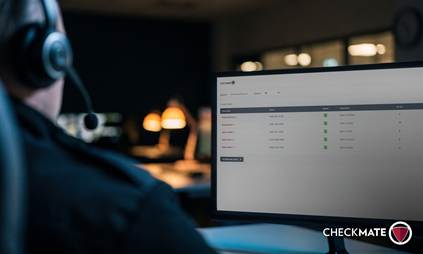 A trained operator responds when a safety check is missed.
And lately we have added one more step for the situation that used to keep me up: the night nobody on the list picks up. When designated contacts cannot be reached, a guard can be dispatched to the worker's location for a wellness check. Not police, not an ambulance, because nobody knows yet what is wrong. A person, sent to find out. Workers complete their safety checks more often when they believe someone is on the other end.
The law, for what it is worth, is on the side of the check that works. Most provinces with a working alone rule ask for much the same thing in slightly different words: a way of checking on the worker, at intervals that fit the risk, and in several provinces it has to be written down. None of them mention an app. And the risk of getting it wrong is not really the inspector. It is the seven hours between a fall at ten at night and the morning shift finding him, and the conversation with his family afterward about why nobody called.
The businesses that have moved past "are we compliant" tend to ask their provider three questions, and I will end on those, because they are better than anything I could pitch.
How many of my workers actually completed their safety checks last month, and can you show me? Who, by name or by role, answers a missed safety check at two in the morning? And what happens when the people on my contact list do not pick up?
If you like the answers, you have a program that will hold when it is tested. And your people will know it. Workers show up differently when they know someone is actually paying attention, and that is the part no regulation can require.