A BNSF freight train passed a stop signal and struck another train, rupturing a fuel tank and spilling 8,000 litres of diesel
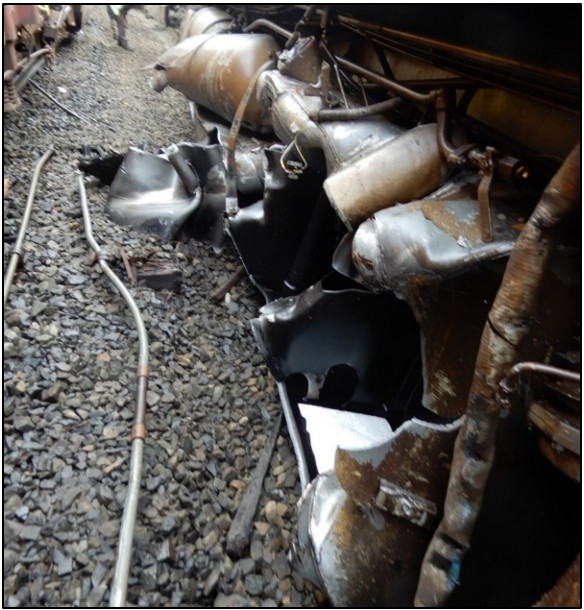
A Transportation Safety Board of Canada (TSB) investigation has found that a BNSF freight train that derailed near Delta, B.C., in November 2023 passed a stop signal before striking another freight train in a busy transportation corridor.
Collision spilled thousands of litres of diesel but no injuries
The investigation report says northbound train 804 “passed a Stop signal indication and collided with southbound BNSF Railway Company freight train M‑VBCEVE1‑18T” at Oliver siding on the New Westminster Subdivision on 19 November 2023. On the southbound train, two intermodal cars derailed. On the northbound train, two locomotives and five cars came off the track, including three tank cars that were carrying or had carried liquefied petroleum gas.
No dangerous goods were released from the tank cars, but the fuel tank on the lead locomotive was “extensively damaged, resulting in the release of approximately 8000 litres of diesel fuel. There were no injuries,” the TSB notes.
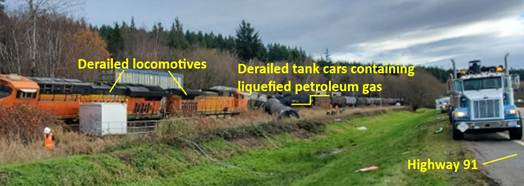
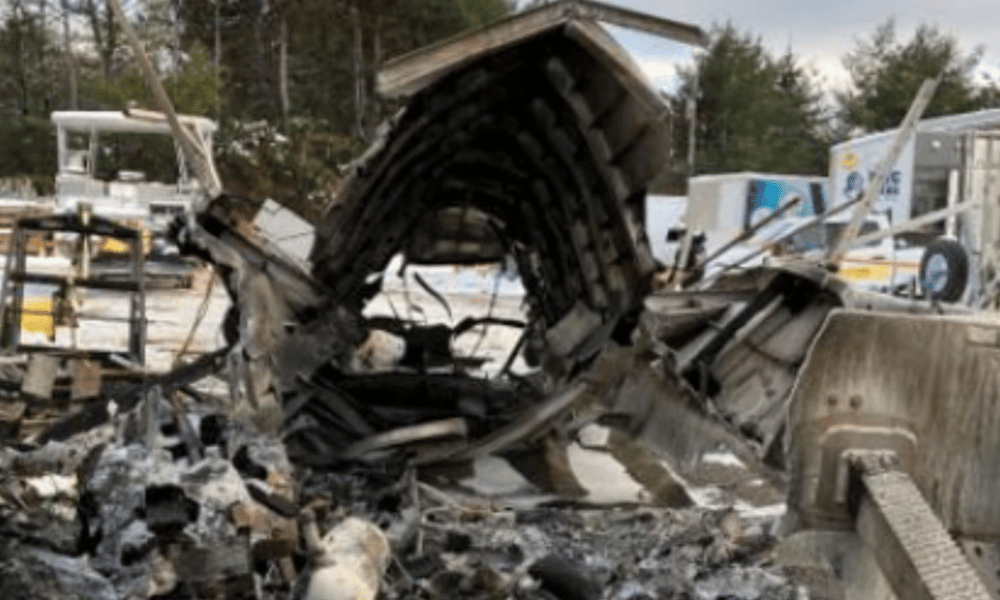
Derailed rolling stock after the collision (Source: TSB)
The derailment occurred beside Highway 91 and near a regional greenway and underground sewage pipeline, underlining the potential consequences for workers and the public if the outcome had been worse.
Distraction, weak signal discipline and limited experience
Using forward facing camera footage and event recorder data, investigators reconstructed the final minutes before impact. The train received an “Approach Medium” signal, then a “Diverging Approach” signal that required crews to be prepared to stop at the next signal. Instead, train 804 accelerated to 37.5 mph.
The report also highlights evidence that a crew member was using a flashlight from the cab “to spot wildlife in the darkness on the right‑of‑way to the east side of track while the train was in motion.” Investigators concluded that the light’s angle and movement were “most consistent with it emanating from just outside the LE’s side window on the right side of the operating cab.”
Crew communication did not meet rule requirements. Within the cab of the lead locomotive, “the crew members … did not call the signals or engage the brakeman by radio with the indications displayed,” and there were no required radio broadcasts of the advance signal.
The TSB also points to relatively limited experience on the subdivision. The locomotive engineer qualified in February 2023 and “had completed several trips on the New Westminster Subdivision” by the time of the occurrence.
Emergency call not made and 911 not contacted
The report raises concerns about the response immediately after the collision. Canadian Rail Operating Rules require an emergency radio broadcast, and BNSF rules specify that “Emergency calls will begin with the words ‘Emergency,’ ‘Emergency,’ ‘Emergency.’” In this case, “an emergency call was not made by the crew of train 804 immediately after the collision.”
While BNSF’s control centre notified company personnel, a dangerous goods officer and a contractor, it “did not contact local 911 emergency services in BC; consequently, Metro Vancouver emergency first responders were not immediately contacted.” Local fire services were not notified until around 1000, hours after the 0222 collision.
TSB renews focus on human limits and fail safe technology
Beyond this single event, the Board situates the occurrence in a broader pattern of missed signal indications. It warns that “these inherent limitations in human cognition are involuntary and cannot be entirely mitigated through training or procedural reinforcement.” When attention is diverted or memory fails, “signal indications may be missed, misinterpreted, or incorrectly recalled,” weakening the primary safety defence.
Canada has not yet mandated advanced train control systems that automatically slow or stop trains, even though BNSF has voluntarily implemented positive train control on the New Westminster Subdivision. The TSB notes that administrative defences such as rules and procedures “remain vulnerable to the inherent limitations of human cognition,” and it reiterates its long standing call for physical, fail safe backstops when crews do not respond correctly to signals.