A misplaced survey stake caused a Fort St. John gas pipeline to be punctured during construction
A construction crew working near Fort St. John, British Columbia, punctured an operating natural gas pipeline in November 2025 after relying on a survey stake that had been placed in the wrong spot, according to a new investigation report from the Transportation Safety Board of Canada (TSB). The incident released roughly 47,310 cubic metres of gas but caused no injuries and did not require evacuating nearby residents, the TSB said in its report on pipeline damage investigations, released 29 June 2026.
The occurrence happened on 15 November 2025 at around 12:10 p.m. local time, when a 16-inch pipeline operated by Westcoast Energy Limited Partnership, an Enbridge Inc. affiliate, was struck by a 20-inch pipe that crews were using to shore up a hole they had dug to check the position of underground boring equipment. The seven construction workers within 25 metres of the site evacuated immediately, and other crews working nearby were also moved away as the area was secured. No fire or explosion occurred.
How the mix-up happened
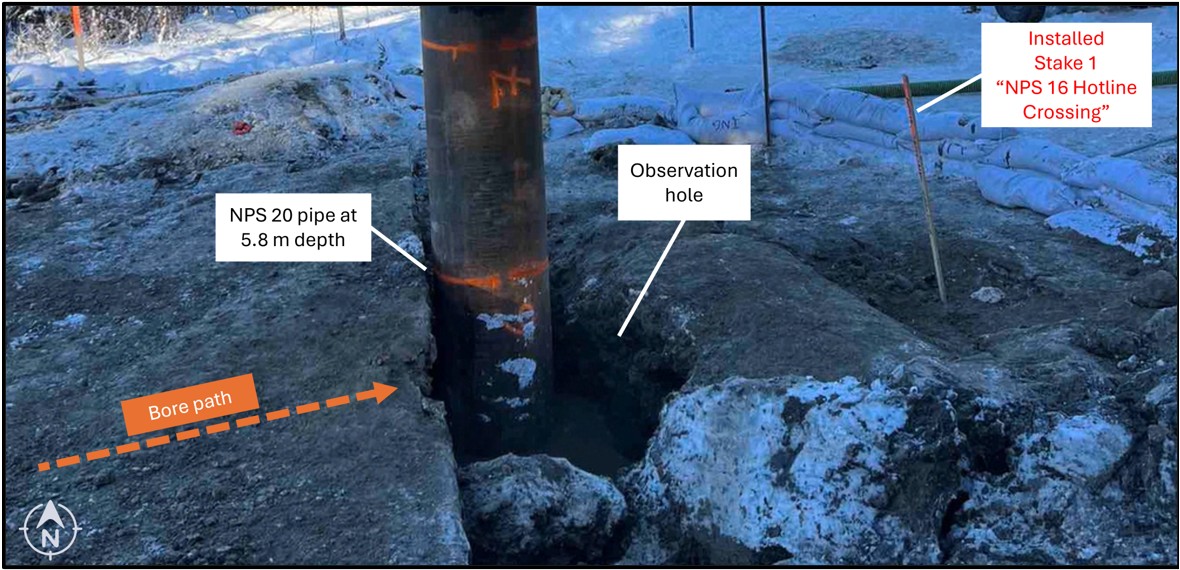
The crew had been installing a new pipeline using a boring method that lets pipe be pushed underground without digging a full trench, crossing beneath two existing Westcoast pipelines at four separate points. Before the final crossing, the path of the operating 16-inch pipeline had been confirmed back in September 2025, when it was exposed and measured at a depth of 5.8 metres. A wooden stake was driven into the ground at the time to mark that exact spot.
That marker was destroyed in mid-November during clean-up of drilling mud that had spread into the area, and with it went what the TSB calls the crew's "positive identification" of where the pipeline actually sat. When a surveyor came back to re-stake the site on 14 November, the original coordinate was sitting inside a mud hole still being cleared out. The surveyor placed a new stake about 1.4 metres east of the true crossing point instead, relying on older recorded data, and labelled it as the pipeline crossing.
Crews were never told the new stake had been shifted from the pipeline's real position. Believing it marked the correct spot, they dug their observation hole roughly two metres to the west of it, as originally planned, not realizing this put them directly above the pipeline rather than safely beside it.
When the team hit something solid 5.8 metres down, they assumed it was wood, since other holes on the same job site had turned up tree trunks and logs during digging. To push past the obstruction, they drove a 20-inch pipe down through it. Lab analysis later confirmed there was no wood there at all. The "obstruction" was the gas pipeline itself, and the damage matched an impact from a 20-inch-diameter object, leaving a tear about 61 millimetres long.
TSB's safety message
In its report, the TSB stated plainly why the incident matters beyond this one job site: "This occurrence highlights the importance for construction crews to positively identify buried facilities before conducting ground disturbance activities in close proximity. Not doing so can lead to injuries and damage to the environment and infrastructure."
The damaged section of pipe, about 6.2 metres long, was cut out and sent for lab testing. The line was repaired and put back into service on 5 December 2025.
Regulator orders, company response
The Canada Energy Regulator issued separate inspection orders to Westcoast and to the construction contractor on 5 December 2025, directing both to address how they identify buried pipelines and manage ground disturbance work. The regulator confirmed in a notice closing out the orders' required actions that both companies had satisfied the measures, in February 2026.
Westcoast has since updated its ground disturbance procedures and retrained its construction inspectors. The contractor updated its own job hazard procedures and competency evaluations, and gave refresher training to personnel working on the project.
The case adds to a broader pattern the TSB continues to track around ground disturbance incidents in pipeline construction, where losing track of a buried line's exact location, even briefly, can turn a routine excavation into a serious safety event.