‘If there is anyone, or any entity, operating in this city that bears responsibility for what happened, we will hold them fully accountable’
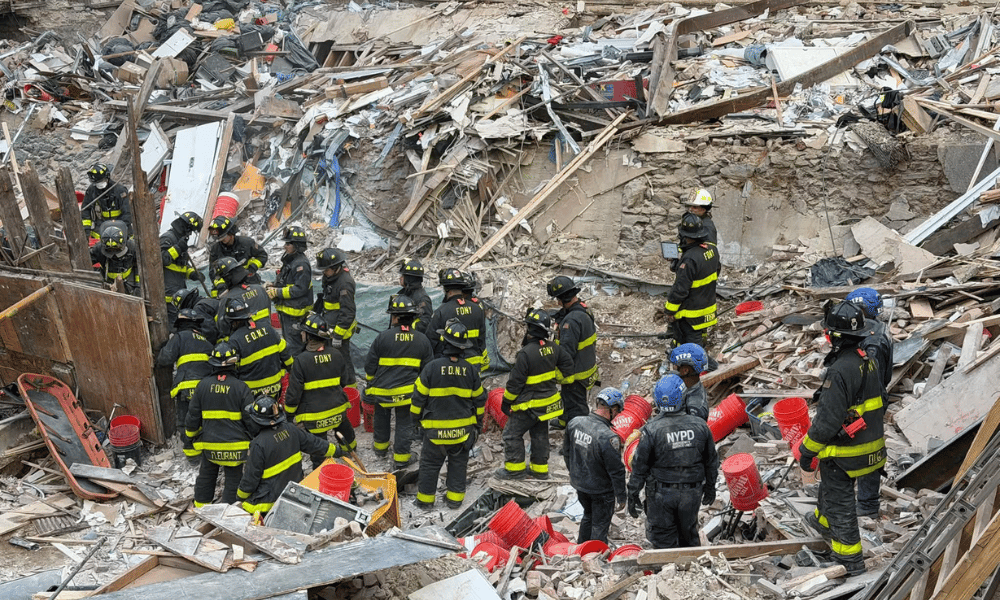
An excavation shoring failure at a Brooklyn, N.Y., construction site brought down an adjacent three-storey residential building on Nov. 11, 2026, killing eight people — including two children — and injuring 18 others, in a collapse that exposes the life-safety stakes of protecting neighbouring structures during deep urban excavation.
The dead included two construction workers among the building’s occupants.
Construction workers were actively excavating the empty lot next to the building when it gave way, confirmed New York City Buildings Commissioner Ahmed Tigani. Permit applications showed plans to dig below 4.5 metres — work that records indicate was to include rock blasting — and engineering drawings submitted with those applications showed various plans to brace the walls at the edge of the site.
Mayor Zohran Mamdani, who ordered inspections at approximately 100 building sites connected to companies involved in the project, did not mince words. “If there is anyone, or any entity, operating in this city that bears responsibility for what happened, we will hold them fully accountable,” he told the Associated Press.
Excavation work at centre of investigation
Construction safety expert Glenn Corbett of John Jay College in New York told the AP that investigators had not yet pinpointed a cause, and cautioned against early conclusions. “It could be a design flaw, it could be a construction flaw, or it could be some kind of work that was going on,” Corbett said. He added that it appeared shoring of the excavation had failed, but that confirming why would require further investigation.
Witness James Williams, who works at a deli across the street, told the AP he heard loud banging at the site all day and watched bricks falling from the building in the minutes before it came down. “Two minutes later, the building collapsed,” Williams said. Emergency crews used power saws and pickaxes to extract victims from the rubble, with excavators later removing larger debris to allow searchers deeper access into the site.
Investigators had not formally determined a cause as of Nov. 12. Messages left for contractor Mordechai “Marty” Waisbrod, project engineer Jieming Wang, and a listed site inspector had not been returned as of the time of reporting. The pattern will be familiar to Canadian OHS professionals: COS has documented comparable outcomes closer to home, including a Toronto trench collapse that killed one worker and seriously injured two others after a wall failed during water pipe repairs on Nov. 6, 2024.
Prior stop-work orders issued
What makes the Brooklyn collapse particularly significant from a regulatory standpoint is the documented compliance history that preceded it. New York City’s Department of Buildings issued a stop-work order in March after inspectors found that demolition of the previously existing one-storey structure was proceeding without adequate overhead protection — including netting — to shield neighbouring buildings.
By April, inspectors found that demolition had resumed in violation of that order. Work was eventually allowed to continue after the department said the violations had been corrected. Whether the corrective measures were adequate will form a central thread of the investigation — a question that resonates under Canadian frameworks as well, where Ontario’s Construction Projects Regulation (O. Reg. 213/91) explicitly requires a licensed professional engineer to specify in writing all precautions taken to protect adjacent structures during excavation work.
Resident Dervie Mapp, who lives next to the construction site, told the AP that residents had raised concerns about the project for months before the collapse. Her landlord brought engineers into the building in response, but residents said they never received an inspection report — a gap in communication that safety professionals will recognise as a recurring vulnerability in densely built urban environments.
For OHS practitioners tracking how Canadian workplaces are managing pre-incident risk signals, COS’s most recent annual guide examines how AI and analytics are transforming incident prevention in high-hazard industries, including construction. The collapse also sits within a broader pattern of building and construction hazards reported by Canadian Occupational Safety across Canadian worksites.