Contractor was aware something was happening on site well before the collapse, says OHS expert
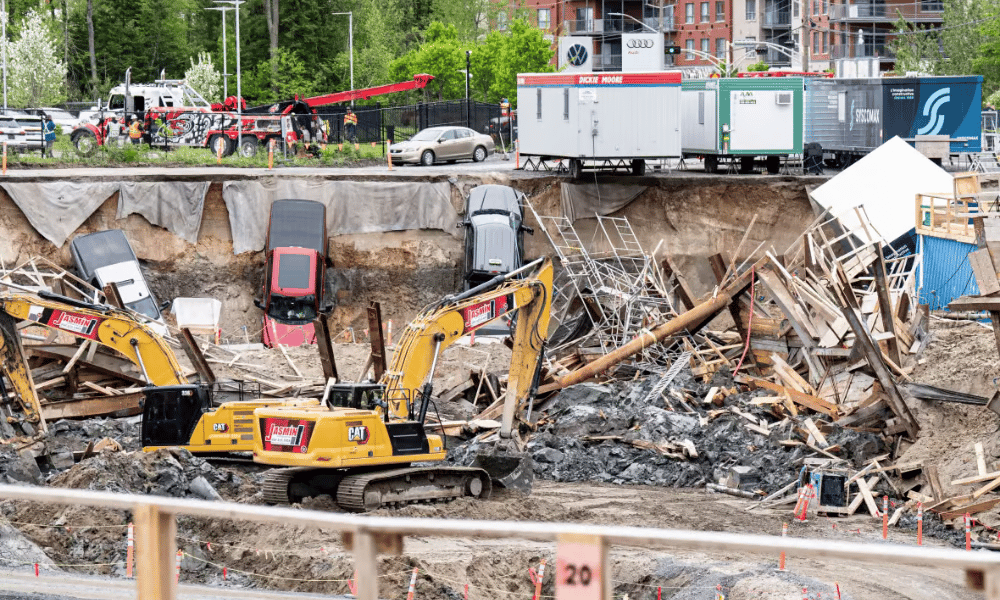
A Quebec coroner has ruled that the death of construction worker Alexandre Paris, 31, in a retaining wall collapse was accidental, according to a report cited by CityNews, closing out one of the province's most closely watched workplace fatality cases of 2025.
Paris was working for a subcontracting firm on a two-storey underground parking garage excavation about 10 metres deep in Blainville, Que., when a section of the retaining wall failed around 11 a.m. on May 20, 2025.
He was buried in the collapse; firefighters did not recover his body until shortly after 8 p.m. that evening, a delay CityNews attributed to the site's continued instability.
Coroner's and CNESST's findings
Coroner Steeve Poisson attributed Paris's death to suffocation and mechanical asphyxia from chest compression after he was trapped beneath the collapsed wall.
Quebec's workplace safety board, the CNESST, found the collapse stemmed from an underestimation of earth pressure behind the wall combined with an overestimation of the soldier piles' structural capacity, per CityNews.
The regulator also determined that the pre-collapse risk assessment was inadequate, since workers were permitted to work near and at the bottom of the excavation despite visible signs of instability beforehand.
Two other workers were partially buried in the collapse and survived; vehicles, a trailer, and tools on site were also buried, according to the publication. A separate police investigation into the incident concluded without any charges being laid.
Regulatory response
The CNESST ordered work halted at the site on the day of the collapse, pending an engineer's certification that remaining wall sections were safe.
The regulator also required an engineer to develop written procedures for securing standing wall sections, removing debris, and governing reconstruction and the resumption of work.
Coroner Poisson stated in his report that because safety measures had already been implemented following the collapse, he did not consider further formal recommendations necessary.
The recovery operation itself required a specially devised rescue procedure, since the excavation site remained unstable well after the initial wall failure, CityNews reported.
Signs of abnormal pressure
Félix Ferland, vice-president and occupational health and safety lead for CSN-Construction, told Radio-Canada in the days after the collapse that the site's health and safety representative had noticed signs of abnormal pressure on the retaining wall as early as 6:30 a.m. that morning, hours before the fatal failure.
According to Ferland's account, cracks appeared in the ground along the top of the wall and support timbers at the bottom of the excavation had begun to bulge; he said the site representative — whose role is limited to making recommendations rather than halting work — flagged the danger to the project's prime contractor, who reportedly moved workers back roughly 15 to 23 metres rather than stopping the job outright.
"Donc, il était conscient qu'il y avait quelque chose qui se passait," Ferland said, according to Radio-Canada — meaning the contractor was aware something was happening on site well before the collapse occurred around 11 a.m.