Amazon's next-gen Proteus robot follows orders like a colleague — while real colleagues protest mass layoffs
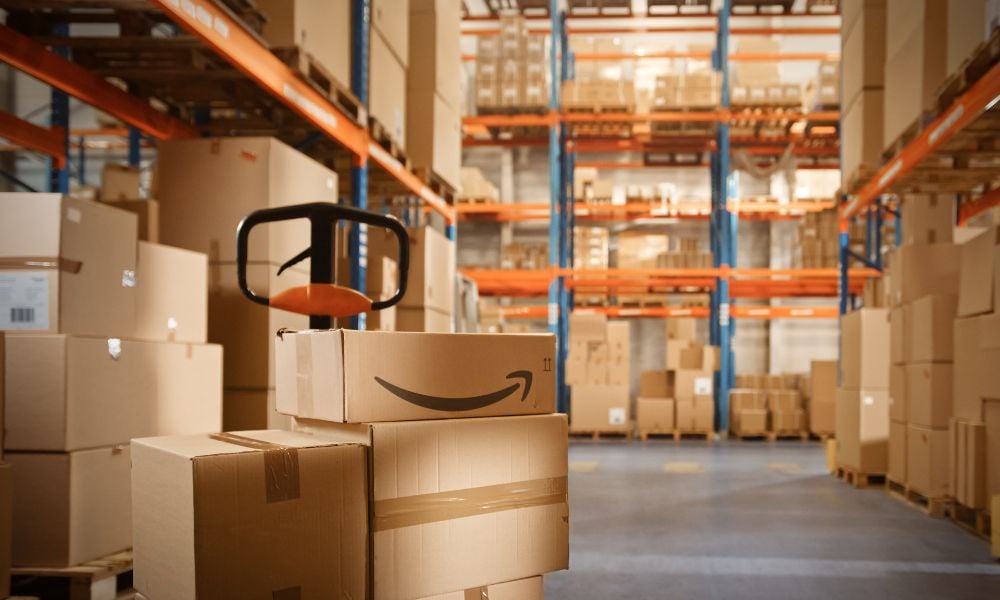
Amazon on Thursday unveiled a warehouse robot that workers direct using plain conversational language, the same way they would ask a colleague to move something. There are no technical commands and no programming interface. The employee states the task; the robot handles the rest: priority, route, timing.
"You tell it what needs to be done. It figures out the priority, the route, the timing," said Scott Dresser, vice president of Amazon Robotics. "It becomes your assistant for material movement."
The announcement came at Amazon's "Delivering the Future" event in Dartford, England, as part of a €10 billion ($11.6 billion) investment in its European fulfillment network. The new Proteus, currently in lab pilots, is planned for European deployment in the first half of 2027. It expands on the existing model — deployed at 25 U.S. sites but confined to dock areas — by operating across entire warehouse floors.
Amazon also showcased STARK, a tote-handling system first piloted in Barcelona set to expand to 15 European sites by 2027, and Vulcan, its first robot with a sense of touch, able to pick and stow approximately 75% of stored items at speeds comparable to frontline employees.
The job architecture problem nobody is talking about
When a robot is controlled by specialist software, only trained operators can interact with it. The job boundary is clear. When a robot responds to plain language, every worker on the floor is a potential operator. That changes the competency profile for entry-level warehouse roles immediately, and the pay grade and job architecture will need to follow.
The skill that was once scarce — technical ability to interface with automation — is no longer the constraint. The skill that now matters is supervisory judgment: the ability to assess whether the robot has understood correctly, prioritized appropriately, and responded safely to unexpected situations. That is not a skill that appears in most current warehouse associate job descriptions, and it is not one that standard induction training covers.
Randstad's Workmonitor 2026 research confirms the pressure this creates: early-career logistics workers say they want to feel prepared, not left behind, and when organizations introduce digital tools in structured ways, they report stronger engagement and better retention. The gap between what workers experience and what HR has designed for them is where turnover happens.
Amazon's own workforce research found that its fulfillment center in Louisiana, launched in late 2024, required 30% more employees in various roles because of advanced robotics — more people, differently skilled, in roles that did not previously exist. That is the pattern conversational robotics accelerates. HR teams that are still updating job descriptions reactively, after technology deploys, are already behind.
The tension the announcement cannot resolve
The same day Amazon unveiled Proteus, three of its own engineers appeared before Seattle's Land Use and Sustainability Committee to support a one-year moratorium on new large-scale AI data center construction — approved unanimously by the committee on Wednesday.
"It's been reported that this year, Amazon is spending $200 billion on capital, with most of it going to data centers and AI," Patrick Schloesser, a software engineer at Amazon Web Services, told the hearing. "Microsoft is spending $190 billion. Meanwhile, the leaders at my company have laid off 30,000 corporate employees in the last eight months."
Amazon said it respects its colleagues' right to voice their opinions.
The 30,000 figure is Schloesser's characterization. What is not disputed is the structural dynamic it describes: the same capital expenditure cycle funding next-generation robotics is also the one producing workforce reductions. CEO Andy Jassy has previously told employees directly that AI adoption is expected to reduce Amazon's total corporate workforce in the near term, even as new types of roles emerge.
Amazon is pairing Thursday's robotics announcement with a $1 billion commitment to its Career Choice upskilling program — part of a broader $2.5 billion Future Ready 2030 pledge — focused on cybersecurity, software development, logistics, renewable energy, and mechatronics.
"We couldn't find enough skilled people for the roles we need, so we made a decision: we're going to develop them ourselves," said John Boumphrey, Amazon UK Country Manager.
Amazon says it has helped more than 700,000 employees globally through Career Choice since 2019 and plans to grow its European fulfillment workforce by 25,000 in the coming years. HRD America's reporting on AI redundancies found that 32.7% of organizations that conducted AI-led layoffs had already rehired between 25% and 50% of the roles they eliminated within six months — suggesting displacement decisions frequently outrun the technology that justifies them. The upskilling investment and the workforce reduction are both real. HR's job is to manage the gap between them, internally, with the people sitting in teams today.
Three things to act on
Audit your warehouse job architecture now, not when Proteus arrives. If a robot can be directed in plain language, the role of a warehouse associate shifts from executing physical tasks to supervising, evaluating, and correcting robotic task allocation. That is a different person, a different pay grade, and a different career pathway than the current entry-level profile. Companies that redesign roles before deployment retain workers through the transition. Companies that redesign after it lose the people who could have adapted. Amazon's own workers are already gaming the AI productivity metrics HR built — the measurement architecture matters as much as the technology.
Get ahead of the regulatory disclosure requirements. Colorado's Artificial Intelligence Act takes effect June 30, requiring employers to use reasonable care to protect against algorithmic discrimination in employment decisions, including decisions shaped by robotic task allocation systems. The bipartisan AI Workforce PREPARE Act, if passed, would require companies to specify when AI was a substantial factor in a mass layoff. Neither of these is hypothetical. The legislative landscape is accelerating faster than most HR teams are tracking it, and the compliance window for preparation is shorter than it looks.
Treat the upskilling commitment as a floor, not a ceiling. Amazon's $1 billion Career Choice program covers cybersecurity, mechatronics, and software development. For the workers on a warehouse floor today — the ones who will be directing robots using plain language in 2027 — what they need is not a cybersecurity certification. It is a structured, paid pathway from associate to robot fleet supervisor that recognises and rewards the new skill set. That pathway does not yet exist in most logistics HR architectures. Building it is the immediate practical task.