From harmonized standards to AI governance, speakers kept circling back to one problem: inconsistency across Canada’s safety system

Every session at the Canadian Safety Summit, held October 22 in Toronto as part of COS Live, circled back to the same diagnosis: Canada's safety system is inconsistent, from the patchwork of provincial regulations down to the credentials safety professionals carry. Speakers proposed different fixes at different levels throughout the day, but the underlying complaint rarely changed.
Fourteen sets of rules, one hazard
The afternoon panel "Breaking Down Borders: The Industry Case for Harmonized Safety Standards," which I moderated, captured the fragmentation problem in miniature. Kevin Brown, CEO of Cobalt Safety, argued the push to harmonize training is getting ahead of the law itself: "We're putting the cart before the horse here," he said, noting Canada still has 14 versions of fall-protection law for the same hazard. Troy Winters of the Canadian Union of Public Employees countered that harmonization "has to raise all boats," not average standards down, a response to Ottawa's push to harmonize safety regulations nationally earlier this year, while Emily Larose of the Electrical Safety Authority pointed to the century-old Canadian Electrical Code as proof that alignment works when provinces agree on outcomes first.
A fuller account of that panel is coming in a separate piece.
The profession's own patchwork problem
The closing session, "The Future of the Safety Profession: Why Regulation Can't Wait," turned that same argument inward. Moderator Peter Sturm, president and CEO of STURM Consulting, framed it bluntly: "If there isn't consistency in the legislation, there isn't consistency in the standards, how is there going to be consistency in the profession?"
Larry Masotti, chair of the Board of Canadian Registered Safety Professionals (BCRSP), laid out the numbers behind that problem. The BCRSP counts a little over 6,000 Canadian Registered Safety Professionals (CRSP) nationally and roughly 700 to 800 Canadian Registered Safety Technicians (CRST), a newer designation that has grown faster since gaining ISO 17024 certification in 2019. He outlined three priorities: market outreach to employers and schools, micro-credentials in areas like artificial intelligence, and a possible broader membership role. Title protection, which would legally restrict who can call themselves a safety professional, is furthest along in Ontario, Alberta, British Columbia, Saskatchewan and the Atlantic provinces, though changes in provincial government keep resetting a conversation that has been building for several years.
Sturm was blunt about the pace. "We've been talking here for 20 years and we haven't gotten anywhere," he told the room, adding that with hundreds of thousands of Canadian workplaces, the country should have 50,000 to 60,000 certified safety practitioners rather than a few thousand.
AI needs trust before it needs data
The midday panel, "AI at the Operational Edge," moderated by Jimmy Vassilopoulos, director of national health and safety at Purolator, showed the same fragmentation playing out at the technology layer: safety teams adopting AI tool by tool, with no shared framework tying the data together.
Roshan Varghese, senior director of environmental health and safety at 4Refuel, made the case that sequencing matters in technology adoption just as it does in regulatory harmonization. His company spent six years building driver trust in AI-enabled dashcams, framing them as coaching tools rather than disciplinary ones. "We don't want AI to make everything safer. We don't expect that," he said, describing a shift toward investigating near-miss precursors rather than after-the-fact incident reviews.
That points to a broader bottleneck: safety data at most organizations still sits in separate systems, scheduling here, training records there, incident reports somewhere else, with no single engine turning it into a prioritized risk picture for safety leaders.
What one survivor's resilience adds
The day had opened with a counterweight to all this systems-level talk. Kaleb Dahlgren, assistant captain of the Humboldt Broncos hockey team and one of 13 survivors of the April 6, 2018 bus crash that killed 16 of his teammates, delivered the opening keynote on resilience, built around a simple framework: shift your perspective, choose your response, then take action, paired with a daily habit of aiming to improve by one per cent. A friend's advice stuck with him after the crash, he told the room: "Win the day. We can't hold on to the past. What happens in the past is in the past. We can't hold on to the future because we don't know what's there. We just have to focus on winning the day today." He closed by putting a question to the room: "What kind of legacy do you want to leave this world?"
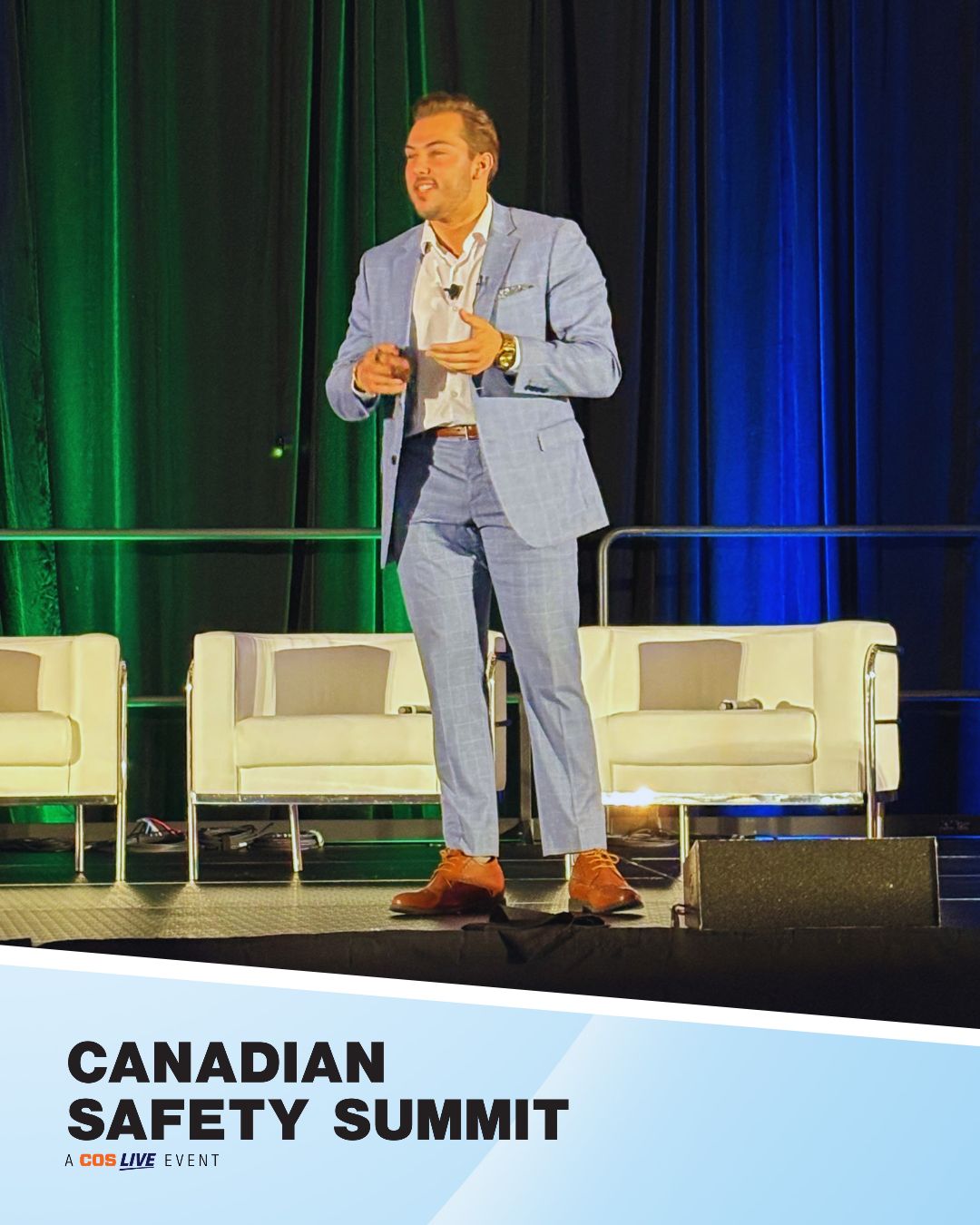
(Kaleb Dahlgren delivers keynotes speech at the Canadian Safety Summit in Toronto on October 22, 2026)
It landed on the same underlying point from a different angle. Regulators, employers and labour can align the external system of legislation, standards and credentials, and several speakers made the case that Canada is overdue to do so. What none of them can legislate is whether an individual safety leader actually walks the floor or owns a bad decision rather than disciplining it away. Systems can set the floor, but consistency still has to be chosen, person by person, every day the floor isn't high enough yet.