Cobalt Safety's supervisor due diligence course draws repeat attendees as criminal negligence charges under the Westray law keep rising

On Nov. 18, in Vaughan, Ont., roughly 25 supervisors, consultants and health and safety managers spent a day working through a single question: could they defend their own paperwork in court. The session was Cobalt Safety Consulting Inc.'s Supervisor Due Diligence course, taught once a month by founder and CEO Kevin Brown, a former Ontario Ministry of Labour inspector who estimates he has been involved in 282 critical fatality investigations over his career.
The timing is not incidental. Canadian courts have sharpened their focus on who answers for a workplace death, and it is rarely the executive in the head office. Canadian Occupational Safety has documented the pattern of criminal negligence charges increasingly aimed at supervisors under the Westray law, the 2004 Criminal Code amendment that made it easier to prosecute criminal negligence in workplace deaths and injuries. In 2025, an Ontario court handed a supervisor the harshest sentence yet seen under that law: five years in prison after a dump truck's front tire exploded and killed a worker.
The business case comes first
Brown opens every session with a number, before he gets anywhere near the law. That number comes from the course's own injury cost formula: stack a lost-time injury's indirect costs, legal fees and fines and penalties against a company's profit margin, and the average bottom-line loss from a single accident, as Brown's own materials put it, comes to $480,000. "I start off with the business case for safety because we always work in the world of production," he said. "We're always out there making money, making money, making money. So the supervisors themselves are literally talked to in the form of money in their positions. So I also say, well, let's take a look at safety from a money perspective. What it actually costs to take a risk or take a shortcut."
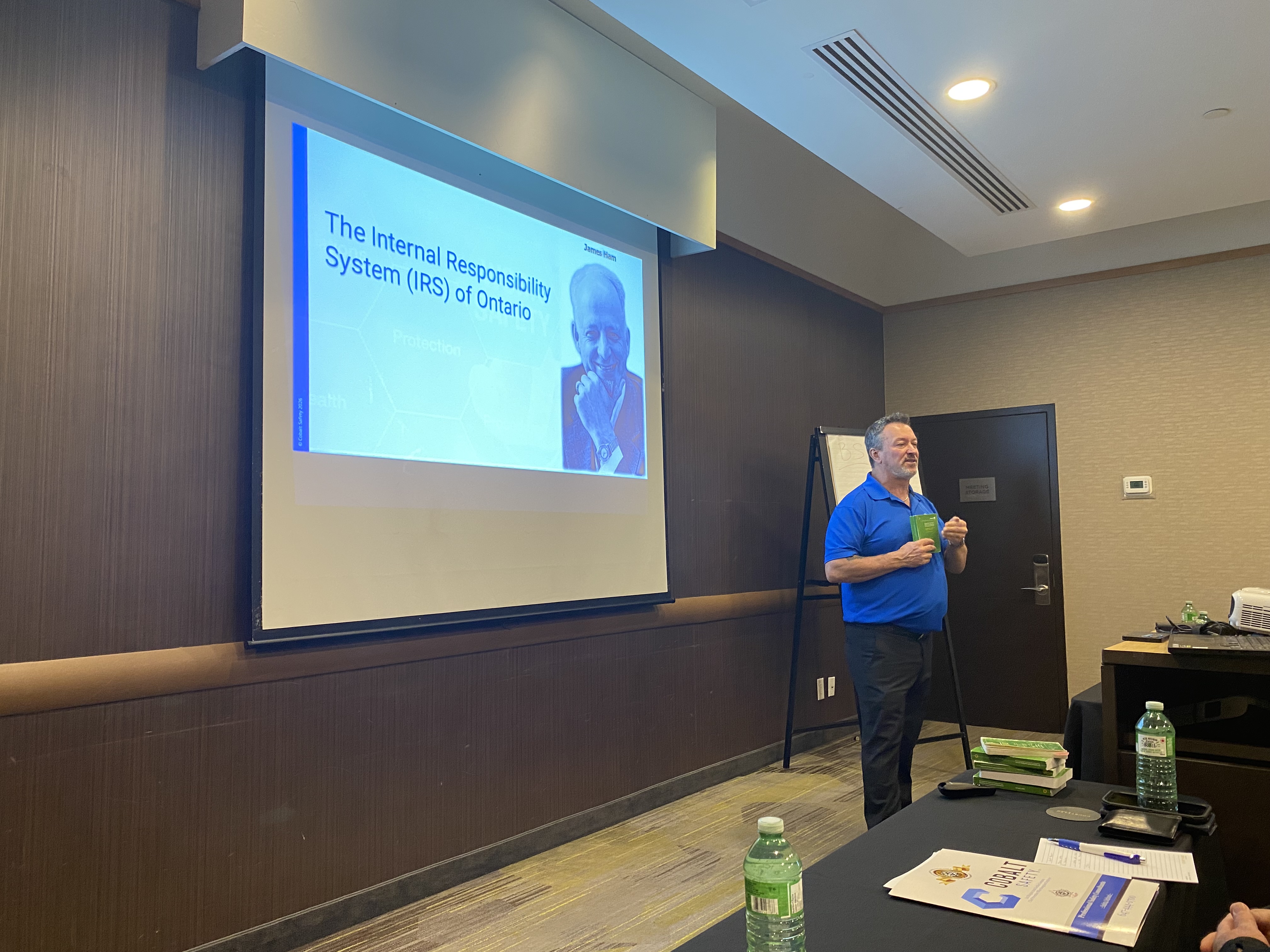
(Kevin Brown presenting during the Supervisor Due Diligence course on Wednesday November 18, 2026 in Vaughan, Ontario)
From there, Brown walks the room through the Occupational Health and Safety Act's internal responsibility system, where supervisors carry legal duties set out at Section 27 while absorbing pressure from above, from the side and from the workers who follow their lead. He said the gap he sees most often is not negligence but a lack of communication about what changed when a worker became a supervisor. "That role change changed and the responsibilities changed at a legal level," he said. "It's not just a paycheque, a truck, and stuff like that. It's the responsibility that the legislation has put on you in this role that is not clearly communicated well."
Brown runs the course monthly, drawing anywhere from two dozen attendees in slower months to as many as 100 in January, when job sites tend to pull more supervisors off the tools at once. Over 12 and a half years, he estimates roughly 6,500 to 6,600 supervisors have come through it.
What due diligence looks like in court
The afternoon turned to the mechanics of a due diligence defence, and Brown's central argument is that the standard courts apply gets misread after the fact. "Reasonable precaution isn't what you would have done after the accident," he told the room. "An expectation of reasonability is what reasonable people ought to have known, therefore ought to have done, before the incident occurred, not with 20/20 hindsight."
That argument tracks with what Canadian Occupational Safety has reported on the blurring line between regulatory compliance and criminal liability in recent prosecutions, where lawyers describe "the risk profile" for employers as different than it once was.
Brown's framework for a defensible safety system rests on two purposes: protecting workers through information, instruction and supervision, and protecting the company through proof that those things happened. "A safety program has two purposes," he said. "To protect the workers, and protect the liability of the organization." He warned against generic, copy-and-paste manuals built to pass an audit rather than reflect what a company actually does on site, and against policies nobody enforces. "Shiny binders not implemented are just shiny binders," he said.
Why the same people keep coming back
Several attendees in the room had taken Brown's course before. Anoop Sarao, a consultant with Cobalt Safety, first went through it seven years ago and returned at Brown's suggestion to see it with more field experience behind him. "Over the years, I've talked to a lot of supervisors who don't take their own journals, who don't write their stuff down," he said, pointing to daily field-level hazard assessments as a requirement many supervisors do not realize applies to them.
James Vis, vice-president at Fergus, Ont.-based Avertex Utility Solutions Inc., was there for the same reason: to decide whether to put his supervisors and managers through the course again. "You become complacent," he said. "After seven years of doing this, you do the same thing day in, day out. Everything goes well until it doesn't." Vis said Avertex shuts down for a week every January to run its workforce through safety training, and supervisors and managers will retake Brown's course during that week.
Lyndsay Murray, Avertex's health and safety manager with 35 years in the field, said what sets the course apart is that it treats the pressures on a job site as real factors in a safety decision, not noise to filter out. "A lot of courses don't touch on that," she said. "They touch only on expectations and rules and procedures. But the reality is there's so much more to that that goes on every day in a workplace." She said the attitude she still hears most often from supervisors is that a serious incident "won't happen to me," and that staying open to what they do not yet know matters as much as any checklist.
Protecting workers also protects the company
Brown said the message he wants every attendee to leave with is simple. "Ones and zeros are just ones and zeros on the bottom line, but loss of life is permanent," he said. "We have to realize we're out here making money, but we shouldn't be doing that at the cost of anyone."
That framing, of a safety program built around a company's actual work rather than a template, echoes this year's recognition of Canada's top workplace safety cultures, where the organizations singled out built prevention into daily operations rather than treating it as paperwork for an inspector.