A WSIB-funded Workplace Safety North initiative is teaching mine and sawmill workers to assess their own exposure risks
Some Northern Ontario mine and sawmill sites had never had an industrial hygienist on-site before Steve Gore arrived. “There are several clients way up north that I would have been the first hygienist to ever step foot on site,” says Gore, an industrial hygiene specialist with Workplace Safety North, the health and safety association for Ontario’s mining and forestry sectors, headquartered in North Bay. It is a gap that has left workers exposed to silica, diesel exhaust and noise for years with no one qualified to measure the risk, and it is the gap a provincially funded Workplace Safety North project, now in its second year, is trying to close.
Teaching workers to see what they can’t
The initiative is called the Occupational Illness and Disease Prevention Research Project. It grew out of a multi-year partnership Workplace Safety North (WSN) signed with the Workplace Safety and Insurance Board (WSIB) in December 2024, with the Institute for Work and Health (IWH) as research partner. WSIB publicly unveiled the funding the following spring at WSN’s Mining Health and Safety Conference in Sudbury: a $6.78-million investment announced for mining and forestry safety across Ontario’s natural resources sector.
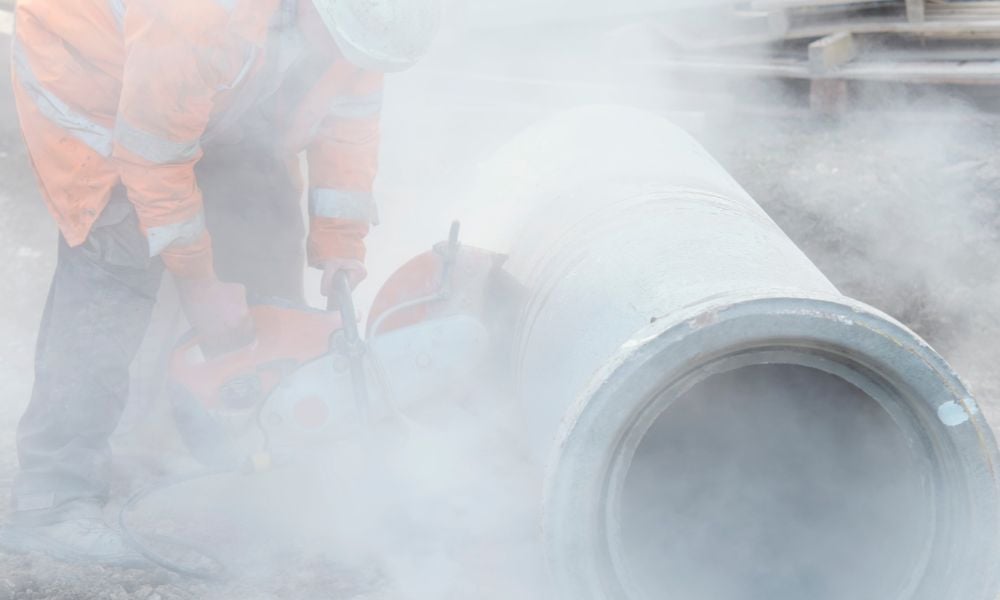
Gore, who holds both the Registered Occupational Hygienist (ROH) and Canadian Registered Safety Technician (CRST) designations, says his job is to teach workers, supervisors, joint health and safety committee members and sometimes HR staff to recognize hazards and take basic measurements themselves, rather than wait for a specialist who may never arrive. “We’re trying to teach them how to fish on their own for basic type of assessments, because industrial hygienists are very few and far between, especially in Northern Ontario, which is where the majority of our clients are,” Gore says. A new small mining client, for instance, might be crushing rock for silica while running diesel equipment and working around heavy noise all at once; Gore trains staff to recognize each hazard, take air or instrument readings, and compare results against the exposure limits in Ontario’s Occupational Health and Safety Act (OHSA) before deciding where controls are needed.
A severe shortage of specialists
The scarcity Gore describes is measurable. The Canadian Registration Board of Occupational Hygienists (CRBOH), as cited in a WSIB-WSN presentation to the International Social Security Association’s (ISSA) Mining Safety Conference in September 2026, counts 316 active ROH and Registered Occupational Hygiene Technologist (ROHT) members in Canada. A 2020 survey by the American Board of Industrial Hygiene (ABIH) and the Board for Global EHS Credentialing (BGC) put just 448 of the world’s 6,940 certified industrial hygienists (CIH) in Canada, against 6,225 in the United States. That scarcity reflects the shrinking pool of registered occupational hygienists in Canada, leaving large stretches of the north reliant on guesswork instead of trained assessment.
Cost compounds the problem. “There’s no way they’re going to afford someone from Southern Ontario to be able to fly to their site, rent a car, drive there,” Gore says. “You’re looking at 20, 30 grand for a couple-day site visit a lot of the times.” WSIB funding covers Gore’s visits directly, removing a barrier he says has left many Northern Ontario sites relying only on a joint health and safety committee’s best guess. “Illness and disease claims are through the roof for noise-induced hearing loss and silicosis and things like this from miners and people working in sawmills, and we have to do something about this,” he says.
Early results, and the limits of the approach
The project trained 10 firms in its first phase and is targeting 50 in its current one, reaching the workplaces of more than 5,200 full-time equivalent workers across mining and forestry, including upwards of 3,200 directly exposed to hazards, per the ISSA Conference presentation. The same presentation reported between 79 and 100 per cent of trained workers showing a significant hazard-specific knowledge gain, and 90 per cent reporting greater confidence applying what they learned. The dust monitors and noise dosimeters behind those field assessments fall into the same category of gear singled out in this year’s readers’ choice awards for best safety suppliers, where Canadian safety professionals rated the vendors making that technology more accurate and easier to use. IWH, for its part, is surveying participants before and after training and following up months later to see whether controls such as upgraded ventilation actually reduced exposure.
Gore frames the project as a stopgap, not a replacement for certified expertise. “We are not removing the need for an ROH or a CIH to be involved in the process,” he says. “We are just trying to bridge the gap and enable basic skills in industry.” The harder question, he says, is why so few hygienists choose to work in the north at all, and whether Ontario’s health and safety associations can jointly reshape how specialists are deployed. “Why is that the case, and how can we figure out how to recruit more people to be willing to work in Northern Ontario and serve these industries?” he asks. For now, the answer running through Northern Ontario’s mines and sawmills is to teach the people already on site to do more of the recognizing themselves.
This article is part of our monthly spotlight series, which in November focuses on industrial hygiene & occupational health.