

High-voltage battery systems are changing how technicians service electric school buses, and Canada's training system hasn't caught up
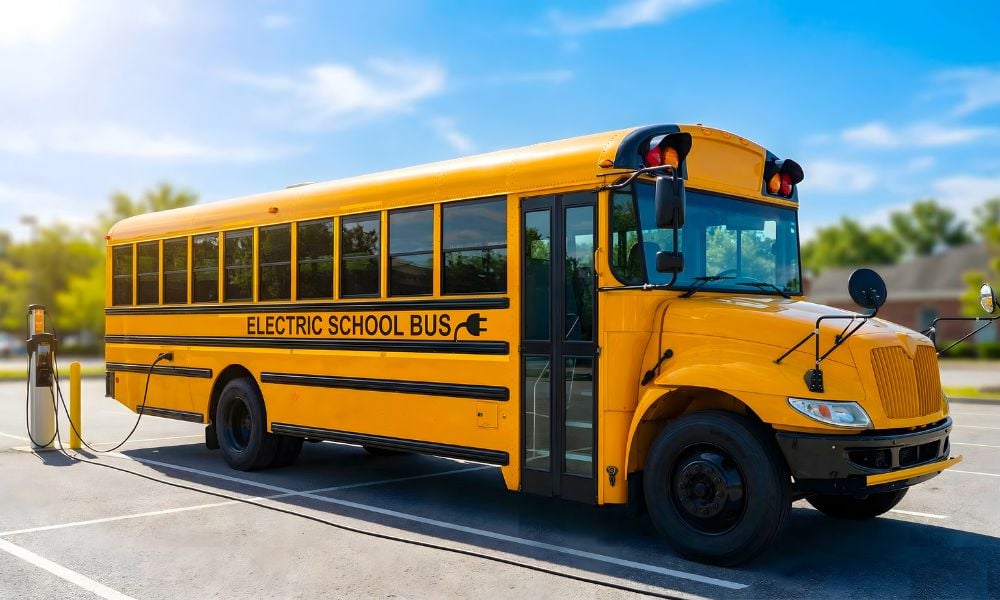
Canada's rollout of electric school buses (ESBs) is exposing a gap between vehicle deployment and technician safety training, according to a new report from Pollution Probe and Mobility Futures Lab, released in June 2026.
The report, titled Amped Up: Upskilling Canada's Heavy-Duty Vehicle Mechanics to Support the Transition to Electric School Buses, found that while most mechanical skills carry over from diesel to electric buses, the shift to high-voltage systems introduces hazards many technicians have never had to manage.
"There are some mechanical aspects that are the same, so the skills for the technicians are transferable," Marc Saleh, Director of Transportation at Pollution Probe, said in an interview. "But then there are other things that are new, completely new, which is just the whole engine goes away. You have a high voltage battery that comes in."
High voltage brings new hazards
Electric school buses run on battery systems of up to 800 volts DC, according to the report, replacing the internal combustion engine and eliminating diesel emissions components entirely. That shift moves maintenance work from mechanical repair toward electrical and software-based diagnostics.
"The main [hazard] is at the end of the like with electric school buses, you have a high voltage system, the battery, the main battery," Saleh said. "So technicians need to go through a very specific procedure to service the buses, which is called essentially lockout, tagout."
Under that lockout/tagout (LOTO) procedure, technicians de-energize the battery system before performing any service, combined with personal protective equipment (PPE) such as insulated gloves and arc-rated clothing. Saleh said no technician should attempt to service a bus without this training.
"That's not safe," he said. "Every technician that is servicing electric school buses has to go through just the most basic lockout, tagout, knowing what's high voltage and what's not."
Training still leans on manufacturers
The report found that original equipment manufacturers currently carry most of the training load, delivering instruction as part of procurement contracts. Saleh said that's expected to shift as colleges and universities build out dedicated electric-vehicle programs, but progress varies widely by region.
Technicians can also pursue certification through bodies such as the Canadian Standards Association or the U.S.-based Automotive Service Excellence organization, though the report notes those programs remain far more developed for light-duty vehicles than for medium- and heavy-duty ones like school buses.
Saleh pointed to a lack of a Red Seal endorsement specific to electric vehicle work as a structural gap. "We have a red seal certification for technician training today, but it's not specific to EVs," he said, adding that a dedicated endorsement would let technicians carry recognized qualifications across provinces.
Quebec leads, others lag
Provincial support for training has been uneven. Quebec, which paired purchase incentives with an electric school bus mandate, also committed $7 million over three years to a 196-hour training curriculum reaching roughly 240 mechanics through a "train-the-trainer" model involving 20 master trainers, according to Electric Autonomy Canada.
"Quebec is ahead," Saleh said. British Columbia and Ontario offer funding tied to broader workforce upskilling or vehicle-purchase pilots, he said, but neither has a program built specifically around electric school bus maintenance. Most other provinces have no dedicated technician funding at all.
Saleh said the priority now is keeping training capacity aligned with where buses are actually being deployed. "We will need to make sure that wherever school bus, electric school bus deployments are growing, the sort of technician and colleges and programs grow in parallel and at the same scale," he said.
For fleet operators, the report's authors argue that closing this gap will require provinces to fund upskilling for existing technicians, not just new entrants, while standards bodies accelerate heavy-duty EV certifications.