
A federal rail investigator says Canada's aging wheel fleet needs smarter data use, not new inspection technology, to cut derailment risk
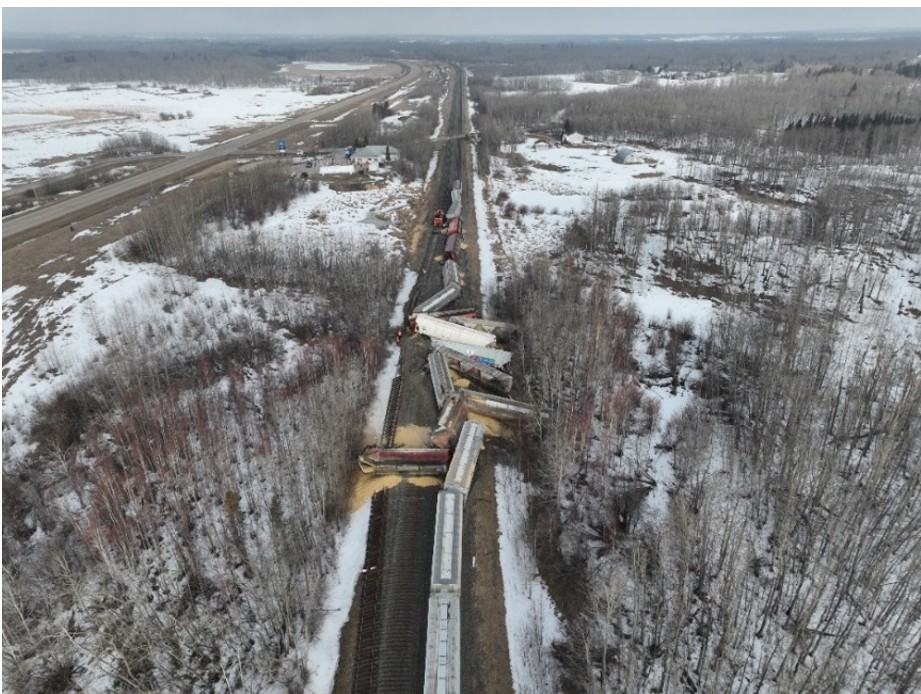
A newly released Transportation Safety Board of Canada (TSB) investigation into an 18-car grain train derailment near Uncas, Alberta, has concluded that Canadian railways do not need new inspection technology to catch failing wheels before they derail trains. They need to make better use of the wheel condition data they already collect.
The TSB's Sept. 24, 2026 investigation report, R23E0029, examined the April 5, 2023 derailment of a Canadian National Railway Company (CN) grain train on the Wainwright Subdivision, in which a wheel manufactured in 1991 developed a shattered rim and broke the rail beneath the train. Eighteen hopper cars derailed and spilled grain. No injuries were reported.
Robert LeBlanc, a senior rail investigator with the TSB's Western Region, based in Edmonton, Alberta, and the investigator in charge of the file, said the wheel had passed every scheduled inspection before it failed.
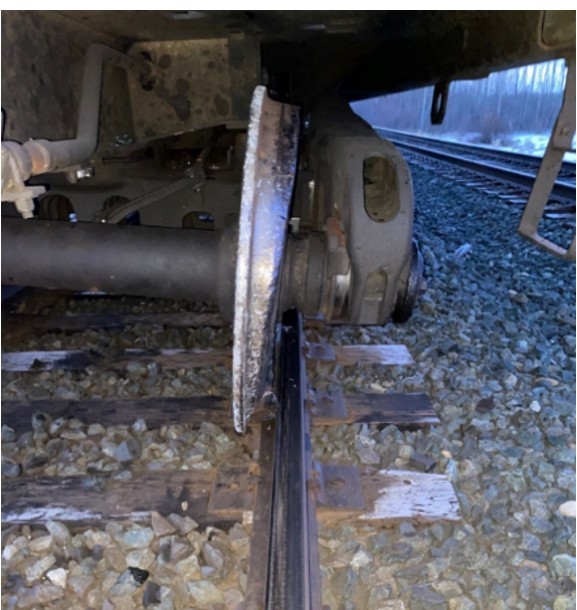
The L4 wheel on car FURX 841817 derailed to the gauge side of the south rail of the north track, with extensive damage (Source: Canadian National)
Visual checks were never built to catch this
Visual inspection remains a valuable, frequently used safety check, LeBlanc said, whether performed by mechanical staff watching a train leave a rail yard or by a crew inspecting a passing train on the mainline. But it was never designed to catch every kind of wheel defect.
“Even as good as visual inspections can be, they'll never detect what we call subsurface defects,” LeBlanc said. “Those are the things inside the wheel that potentially may or may not develop into cracking that eventually gets to the tread surface.”
Inspectors also face real constraints, including limited time, inconsistent lighting and, in busy rail yards, hundreds of cars to check in a single shift. Subsurface flaws can only be reliably caught through ultrasonic testing, which happens at manufacture and, for wheels designed to allow it, when a worn wheel is reprofiled.
A single threshold missed a wheel that was already failing
Canadian railways monitor wheel health through a network of trackside wheel impact load detector (WILD) sensors, which measure the force each wheel exerts on the rail as a train passes. Under a standard set by the Association of American Railroads (AAR), a wheel registering an impact of 90,000 pounds, or 90 kips, is flagged for removal at the next certified inspection point.
That threshold worked as designed in this case. The wheel exceeded 90 kips shortly before the derailment and was automatically flagged for removal in Edmonton. It failed 25 miles short of getting there.
“Under CN's policy, everything was done correctly,” LeBlanc said. “However, just due to the rapid nature of how these deteriorating wheels progress, the wheel actually failed in a manner that caused the rail to break underneath the train.”
The gap, LeBlanc said, is that railways assess each WILD reading against a single go/no-go threshold rather than tracking how a wheel's impact force changes over time. “There's a story in the data,” he said, “and maybe you should be surfing the data and doing better data mining,” an approach Canadian EHS software providers have begun applying to predictive workplace-injury analytics more broadly. It echoes a finding in the TSB's investigation into a 2022 Canadian Pacific derailment near Bassano, Alberta, where degrading track inspection data existed but was never analyzed for trends before the track buckled.
About 1 million wheels predate 2003 cleanliness standards
The failed wheel was manufactured in 1991, more than a decade before the AAR introduced its first formal steel cleanliness standard in 2003. The rail industry does not track wheel age systematically, LeBlanc said, so the TSB's own estimate, which he described as a back-of-envelope calculation, puts the pre-2003 wheel population at roughly 1 million across North America, with an estimated 250,000 of those old enough to soon come due for reprofiling.
Rather than calling for those wheels to be pulled from service immediately, the safety concern noted in the TSB's newly released investigation report suggests railways consider retiring pre-2003 wheels opportunistically, as they come due for routine maintenance, instead of reprofiling and returning them to service.
“They've given good service. They're at the end of their economic life anyway,” LeBlanc said, adding that age alone does not doom a wheel to failure. “It's very possible that many of them will live a long life and never fail.”
A precedent already exists in bearing failures
Abe Aronian, a senior rail investigator with the TSB's Prairie Region and deputy investigator on the file, said trend-based monitoring is not new to the rail industry. North American railways adopted it for wheel-bearing temperatures after a 2023 Norfolk Southern derailment in East Palestine, Ohio, where a bearing had been gradually overheating for miles before a single-threshold wayside detector caught it too late. That derailment, which released hazardous chemicals and forced a community evacuation, ultimately cost Norfolk Southern more than US$1 billion.
“The industry quickly understood the need to develop bearing temperature trending,” Aronian said. “We're indicating that something similar should also be done for wheel impact levels.”
That recommendation, R26-02, calls on Transport Canada's rail safety oversight program to work with the rail industry to develop and evaluate enhanced WILD analytics and use the results to guide the timely removal of deteriorating wheels. It follows a string of TSB recommendations pressing Transport Canada on rail safety gaps; the board warned in 2025 that Canada's railways remain vulnerable to a separate signal-compliance risk after a Montreal incident. Under the Canadian Transportation Accident Investigation and Safety Board Act, Transport Canada must formally respond within 90 days.
LeBlanc said the industry has discussed better use of safety data for at least a decade and is broadly receptive, though railways remain wary of analytics that flag false positives and pull functioning wheels from service unnecessarily. “The objective is not to lower thresholds,” he said. “It's to make better use of the data they're already collecting.”