
Derek Nighbor says mill closures are taking a mental health toll on workers as new U.S. tariffs test the forest sector's safety culture
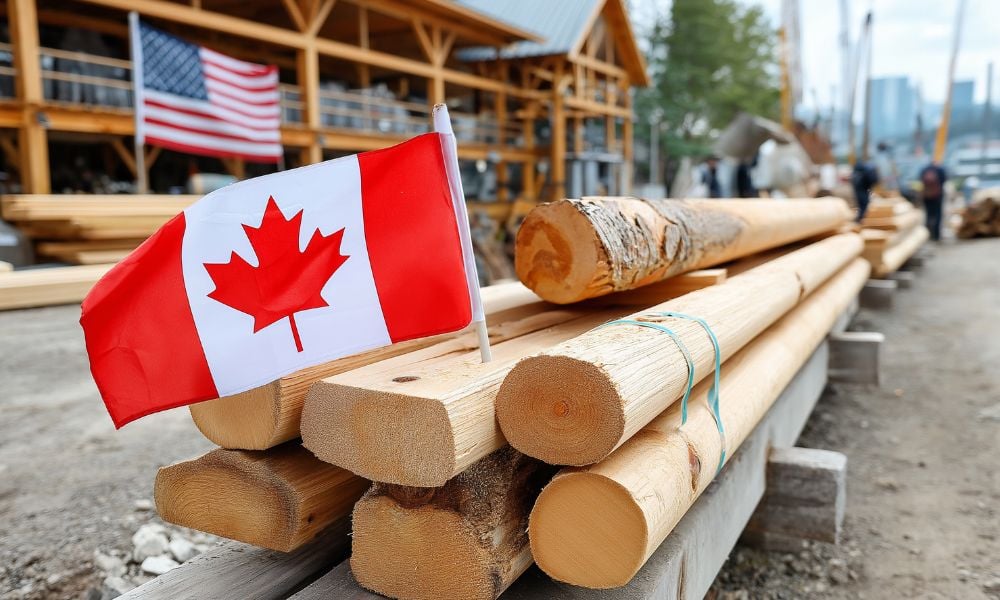
New U.S. tariffs on Canadian wood and paper products, some reaching as high as 95 per cent, are pushing forestry companies into mill closures and cost-cutting, but health and safety will not be where the industry cuts corners, says the head of Canada's largest forest sector association.
Derek Nighbor, President and CEO of the Forest Products Association of Canada (FPAC) and the Canadian Wood Council, spoke with Canadian Occupational Safety this week about how the trade dispute with the United States is playing out on mill floors and in logging operations.
Duties now span nearly the entire wood products line
An August 25 press release from FPAC put the industry's exposure at duties ranging from 25 to 85 per cent. Nighbor corrected that in the interview, putting the true span at 25 to 95 per cent once every affected category is counted.
Softwood lumber carries a 35 per cent duty plus a 10 per cent Section 232 tariff, a combined rate Nighbor said now tops 45 per cent on roughly $6.5 billion in annual exports, more than the tariffs on China and Russia. Kitchen cabinets and wood furniture, worth about $1 billion a year, face a 25 per cent Section 232 tariff, while a newly announced 50 per cent Section 338 tariff covers roughly $4 billion in paper and wood-fibre exports. Wood moulding is caught by all three layers at once.
"We have seen some mill closures in Canada already, and a number of cost-cutting measures in operations as well, whether that's temporary downtime or a thinning of staff," Nighbor said.
Mill closures are taking a toll on worker mental health
British Columbia has borne the brunt of the closures, Nighbor said, echoing mental health training resources developed for Northern Ontario forestry workers during past downturns.
"British Columbia for sure is a region that has been hit really, really hard by mill closures, and that takes a toll on mental health and how people are feeling in the industry," he said. "It takes a toll on the ability to recruit and retain people in the industry as they're seeing nothing but bad news."
Finance Minister François-Philippe Champagne announced a $7.5-billion relief package on August 25. Nighbor said roughly $3.5 billion of that is aimed at employee-focused programming: measures to keep workers connected to their employers, shorter Employment Insurance (EI) waits for those who lose their jobs, and retraining funds. He said the sector's priority is keeping people attached to their workplaces first, then leaning on EI and retraining, and urged safety leaders to get familiar with the programming, arriving amid broader industry warnings that trade uncertainty risks becoming a distraction in high-hazard workplaces.
Safety culture won't bend under cost pressure, Nighbor says
Asked whether staffing, training or safety budgets could become casualties as companies look for savings, Nighbor pointed to a culture he described as entrenched.
"Especially in forestry, we are an industry deeply rooted in making health and safety a priority," he said. "When I'm visiting with companies, even at corporate board meetings, the first thing on the agenda is a safety message. That's really ingrained, and the leaders I work with, including union reps at Unifor and the Steelworkers, share that commitment. It's not an area where you're going to be cutting corners."
He flagged one near-term pressure point: rising costs for paper-based facility supplies, squeezed between the new Section 338 tariff and Canada's own countermeasures. "That pales in comparison to the urgency of getting the health and safety piece right," Nighbor said, "but expenses in the health and safety space, especially paper products, are going to be in profile in the weeks ahead." The concern tracks with a recent overview of the top safety risks facing forestry crews, where budget strain has been linked to slower equipment upgrades and less training.
Personal roots, and a long fight ahead
Nighbor's connection to the sector runs through his own family. His grandfather and father both worked at successor plants of the McMillan Bloedel corrugated box facility in Pembroke, Ont., where he and his brother also worked summers to help pay for school. Cousins now work at a fibreboard plant in rural Eastern Ontario, just outside town.
"We hear a lot about tariff codes and tariff rates, tariffs are on, tariffs are off, but these are real people's lives here in the balance," he said. "It's those individuals that are the innocent bystanders as this global trade stuff unfolds."
His biggest worry is a prolonged dispute that outlasts Ottawa's current support. "If this drags out, the supports that the government launched yesterday are not going to be sufficient enough," he said. "We are dealing with somebody on the other side of the table that is not a rational thinker who is not looking for win-wins. We've never encountered this before."
Still, Nighbor pointed to bipartisan pushback in Washington and frustration among U.S. homebuilders and pulp-and-paper counterparts as reasons for cautious optimism, alongside weaker U.S. housing starts compared to Canada's. "We need to gird ourselves that this is going to be drawn out," he said, adding that FPAC will keep working with federal and provincial governments to secure funding for affected workers.