
Crown counsel does not get desired $1-million fine
Langley, B.C., excavation contractor J. Cote and Son Excavating Ltd. has been fined more than $575,000 after a 2012 trench collapse in Burnaby killed one worker and seriously injured another during a storm sewer replacement project, according to report.
The employer was sentenced in B.C. Supreme Court after being found guilty of criminal negligence causing death and criminal negligence causing bodily harm in relation to the Oct. 11, 2012 incident on Edinburgh Street, CBC reported.
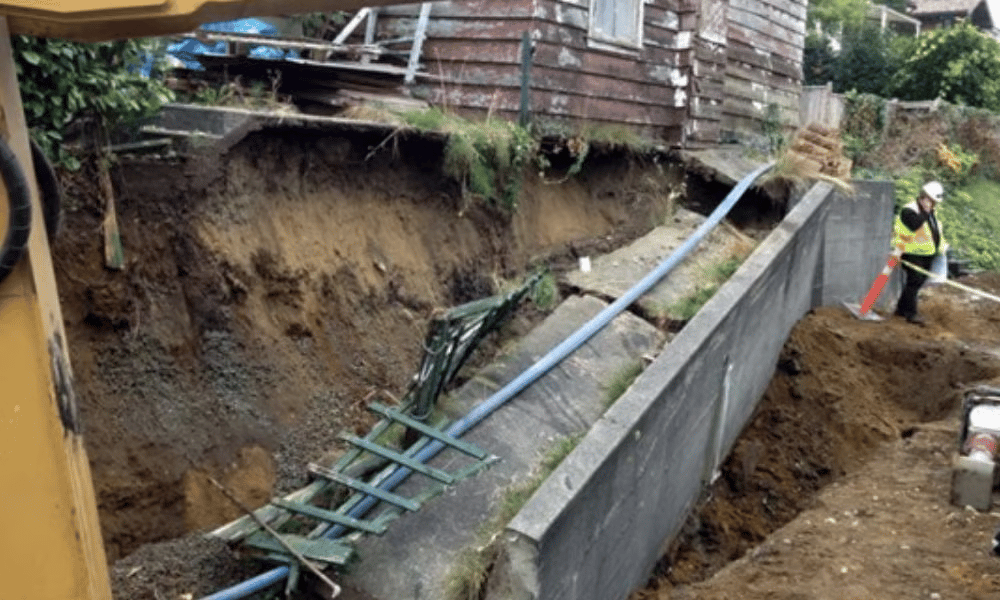
Pipe layer Jeffrey (Jeff) Caron, 28, was killed when a concrete retaining wall toppled into an approximately 2.4‑metre‑deep trench. Co‑worker Thomas Richer suffered fractured ribs, chronic back pain and long‑term psychological impacts arising from the collapse.
Justice Michael Brundrett imposed a corporate fine of $575,000 and ordered the company to pay more than $6,200 in restitution to Richer, according to the report. The decision followed a conviction delivered in Dec. 2025, more than 13 years after the fatal collapse, and concludes one of B.C.’s longest‑running criminal cases arising from a workplace incident.
Court’s findings on safety failures
In his reasons for sentence, Brundrett rejected the company’s attempt to shift responsibility onto a geotechnical engineer and the original construction of the retaining wall, according to CBC. He found that a reasonable contractor focused on worker safety would have recognised the danger posed by the wall’s proximity to the deep excavation and the potential for collapse without proper controls in place.
The court heard that the trench had near‑vertical faces with no effective means of egress, leaving workers with no easy escape route if the wall or surrounding soil failed. Brundrett described the excavation plan as containing “ominous signs” and concluded that the risk of serious harm was evident given the depth of the trench and the mass of the retaining structure and backfill, according to the report.
The judge found that J. Cote and Son lacked core elements of an effective safety management system on the four‑person crew assigned to the project. He determined there were no regular formal safety meetings and no meaningful safety policies in place to govern the sewer replacement work. The company’s reliance on an engineering certificate was also found to be overly broad, treating the document as an effective clearance to excavate near adjacent structures without additional protective measures such as shoring or trench boxes, according to CBC’s account of the decision.
Regulatory findings and safety documentation gaps
A WorkSafeBC investigation into the collapse, completed in 2014, identified multiple failures by the employer that contributed to Caron’s death, including shortcomings in hazard assessment, supervision and control of excavation risks. The agency issued several orders requiring improvements to training, formal hazard assessments and the employer’s overall health and safety programme. WorkSafeBC has since stated it will not pursue further enforcement action in light of the criminal conviction and sentencing.
Evidence reviewed at trial and during sentencing also highlighted gaps in safety documentation and worker concerns about trench stability, COS previously reported. A retired WorkSafeBC fatal and serious injury investigator testified that the company produced little in the way of written training records, excavation procedures, hazard assessments or joint health and safety committee minutes when requested by the regulator.
Richer told the court he had raised concerns about the stability of the trench with his foreman several times before the collapse and felt pressure to keep working despite those misgivings, according to COS’s previous report. He described hearing a warning that the wall was falling moments before the collapse and said “all hell broke loose” as the retaining wall and soil came down into the trench.
In earlier sentencing submissions, Crown counsel asked the court to impose a $1‑million fine, arguing that a penalty of that magnitude — roughly two years of the company’s net earnings — was necessary to denounce the conduct and deter similar offences by other employers. Prosecutors also sought additional amounts to cover Caron’s funeral costs and Richer’s hospital expenses.