
‘Because employers do not experience stigma the same way individuals do, the fine itself must be meaningful’
Crown prosecutors are asking the B.C. Supreme Court to impose a $1‑million fine on J. Cote & Son Excavating Ltd. after the company was found criminally negligent in a 2012 trench collapse that killed one worker and injured another, according to a report.
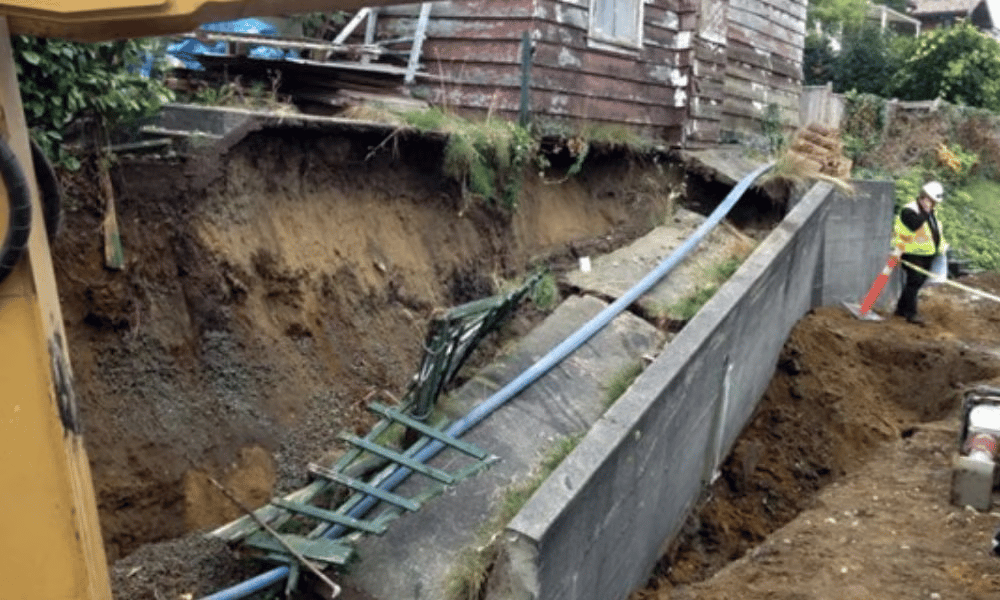
The Oct. 11, 2012 incident occurred during a City of Burnaby storm sewer replacement project when a retaining wall collapsed into a newly dug trench, as previously reported by Canadian Occupational Safety. Twenty‑eight‑year‑old pipe layer Jeff Caron was crushed and killed, while co‑worker Thomas Richer suffered serious injuries that later developed into chronic back and leg pain and post‑traumatic stress disorder.
On Dec. 11, 2025, the B.C. Supreme Court convicted the Langley‑based firm of criminal negligence causing death and criminal negligence causing bodily harm. The corporate maximum is a fine at the court’s discretion. Justice Michael Brundrett is expected to deliver his sentence on 15 April, The Tyee reported.
A penalty that ‘hurts’
During the sentencing hearing, Crown counsel argued that a $1‑million penalty — roughly equal to two years of the company’s net earnings — is necessary to deter similar failures by other employers, The Tyee reported in the article, which was also posted in the Prince Albert Daily Herald. Prosecutors have also requested about $10,000 to cover Caron’s funeral costs and $6,000 for Richer’s hospital expenses.
Crown lawyer Emmanuelle Rouleau told the court that for corporations, the fine itself must carry the weight of condemnation. “Fines are supposed to hurt,” she said, according to the report. “Because employers do not experience stigma the same way individuals do, the fine itself must be meaningful.”
Rouleau said the company’s ability to pay should not drive the outcome, even if the sanction forces it to seek additional financing or risks insolvency. Crown prosecutor Louisa Winn warned that if large fines were ruled out whenever they cause “financial discomfort,” deterrence would “collapse.”
Meanwhile, defence counsel Bill Smart has asked the court to set the fine at $345,000 plus costs to the families, arguing that the company and its president, Jamie Cote, have already borne heavy financial and reputational consequences.
Ignored warnings, fear of reprisal
Trial evidence painted a picture of repeated concerns about trench stability and limited worker power to refuse unsafe work.
Richer told the court that “all hell broke loose” after he heard someone yell, “Get out of here, the wall is falling!” just before the collapse, Canadian Occupational Safety reported. He testified that he had raised concerns with foreman David Green multiple times — including roughly 10 minutes before the wall gave way — and said he felt compelled to keep working in the trench out of fear of losing his job. “It didn’t look very structural to me,” he said.
Defence lawyers challenged his credibility, drawing attention to his criminal record, inconsistencies in previous statements and his withdrawn claim that a WorkSafeBC interview transcript had been altered. Legal commentators noted that such credibility issues can complicate meeting the Criminal Code’s high threshold of “wanton and reckless” disregard needed to prove criminal negligence.
Thin paper trail on safety
Previously, a retired WorkSafeBC fatal and serious injury investigator, Lonny Bouchard, testified that after the fatality the employer provided little documentation to demonstrate due diligence.
Bouchard told the court that WorkSafeBC directed J. Cote to produce worker training records, health and safety procedures, excavation safety protocols, hazard assessments and joint health and safety committee minutes. “I don’t believe we received very much, if anything,” he said, according to Canadian Occupational Safety.
He explained that such directive orders are meant to give an employer “a chance to produce all this documentation to show they have done due diligence and something else has gone wrong.” Following the investigation, WorkSafeBC issued multiple orders under the Workers Compensation Act and the Occupational Health and Safety Regulation, requiring improved training and supervision, formal hazard assessments, young‑worker orientations, reporting of dangerous conditions and a formal OHS program, including regular health and safety meetings.
Engineer sanctioned over limited trench assessment
The court also heard evidence about the role of engineer Edward Yip, principal consultant for Earthbitat Engineering Inc., who had certified the trench as safe without shoring or sloping if certain conditions were met. His certificate was valid for 14 days.
WorkSafeBC rules require protective systems for trenches deeper than four feet unless an engineer certifies an alternative design. Burnaby Now and Canadian Occupational Safety reported that no trench box or cage was in place when the trench collapsed.
Under cross‑examination, Yip acknowledged that he had examined only a single test hole, had not assessed the full length of the excavation and had not evaluated adjacent structures. “I was expecting that when they come to an improvement or structure adjacent to the excavation then they will have to do a follow‑up because there were so many different improvement and structures,” he said.
Engineers and Geoscientists BC later fined Yip $10,000 and ordered him to pay $5,000 in costs after he admitted failing to inspect “the whole area in which the trench could reasonably be expected to have been excavated” and not considering nearby structures or specifying safe distances. He resigned from the regulator in 2022 and agreed never to reapply.