

At least nine buildings evacuated, a contractor with a documented pattern of prior violations, and a structural failure with no confirmed cause yet
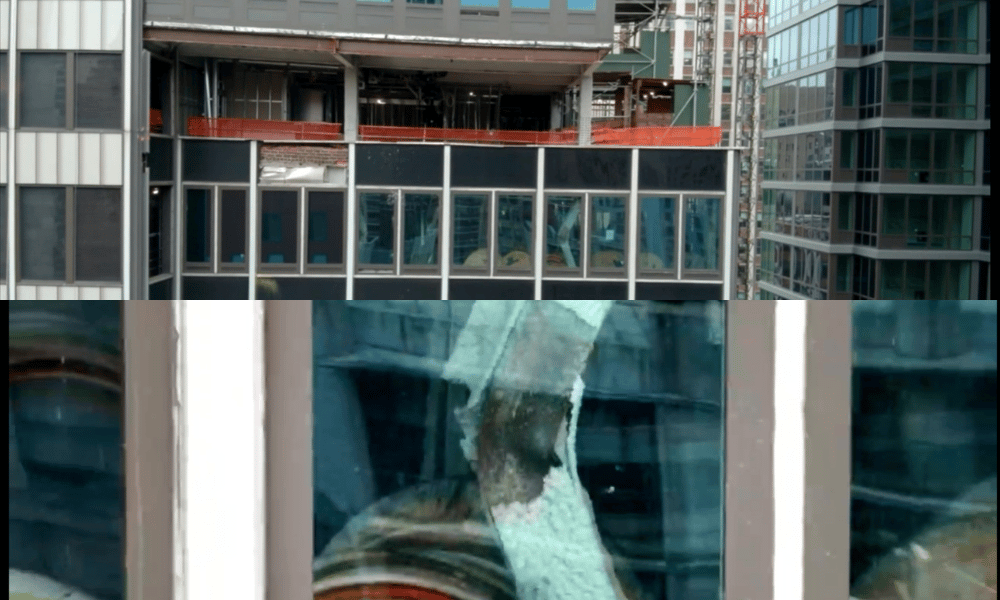
A 37-storey office tower undergoing conversion to residential use in Midtown Manhattan was left unstable Tuesday after two support columns buckled, forcing the evacuation of the site and surrounding buildings and prompting New York City officials to establish a formal collapse zone. No injuries have been reported, and all construction workers have been accounted for. But the incident is a useful case study for Canadian safety professionals as cities across the country pursue the same office-to-residential strategy at scale.
Fire officials said the columns buckled on the 21st and 22nd floors of 235 East 42nd Street, the former Pfizer headquarters, shortly before 8 a.m., causing floors between the 21st and 26th to sag, according to the New York City Fire Department (FDNY) and ABC News. Construction workers self-evacuated after noticing the columns beginning to fail, before officials arrived on scene. FDNY Chief of Department John Esposito said the concern was for a localised collapse rather than a total one, given the building's steel-frame construction, and Fire Commissioner Lillian Bonsignore established a formal collapse zone around the site. The initial 911 calls reported falling bricks, but city Buildings Commissioner Ahmed Tigani later said officials had not found evidence that anything actually came off the building, according to CBC News.
Media reports on the number of evacuated buildings varied through the day. Mayor Zohran Mamdani said seven buildings near the tower were evacuated, per ABC News, while NBC New York and Fox News reported at least nine, including a private school with roughly 400 students, a Hampton Inn, and the Episcopal Church Center. The NYPD instituted a frozen zone from 40th to 45th Streets between First and Third Avenues, closed to pedestrians and vehicles.
Where things stood Tuesday evening
By late afternoon, the Department of Buildings (DOB) said its assessment team had completed an initial review of the damaged section and cleared on-site contractors to install temporary shoring, with no additional movement of the damaged columns since the morning, according to amNewYork and CNN. A six-person team from the FDNY, the DOB and the contractor entered the building to confirm shoring could safely begin; by Tuesday evening, prep and staging were complete and installation of the temporary shoring was set to begin, with the operation expected to last into the night and additional stabilisation work to continue in the coming days, per ABC7 and city officials. Tigani said workers will need to add emergency beams and columns to stabilise the compromised ones, per CBC News.
Residents of one evacuated building, 222 East 44th Street, were told Tuesday evening it was safe to return, while the frozen zone remained in place as officials assessed the surrounding buildings block by block, according to ABC News and amNewYork.
Officials have not determined what caused the structural failure. A representative of Steamfitters Local 638, whose members perform fire-protection work at the site, alleged publicly that insufficient steel had been installed to carry the project's added load, a claim that has not been confirmed by investigators. DOB officials said the conversion had gone through an extensive plan review over the past two years, and that investigators would compare the failure against those prior reviews, per amNewYork.
A documented pattern before the failure
Public records reviewed by several outlets show the site's general contractor, identified as 235 GC LLC, had accumulated seven construction-safety violations in 2025, including a temporary stop-work order issued after a metal panel fell from the 33rd storey in August 2025, according to CBS News New York and city Buildings Department records. The City Reporter put the associated penalties at $32,530, and reported complaints about unsafe conditions at the site dating to spring 2025; some outlets, reviewing longer time windows, cite higher violation counts. Notably, The Real Deal reported that records show no money was actually paid on the 2025 violations: each was resolved when the department accepted certificates of correction, with all but one of the infractions classified as immediately hazardous.
A spokesperson for the developer, Metro Loft, said in a statement that the company was "working closely with the Department of Buildings to understand the full scope of the situation," adding that "the safety of our workers and the public has always been, and remains, our top priority."
For occupational health and safety (OHS) professionals, that pattern is the more instructive part of the story than the near-collapse itself. A string of violations at a single site, each individually resolved on paper and none severe enough to halt the project for long, is a familiar shape for how warning signs get normalised rather than escalated on complex, multi-year construction sites.
Why this matters here
Canadian cities have embraced office-to-residential conversion as aggressively as anywhere in North America, and Calgary leads the country. The city's Downtown Office Conversion Program (formerly the Downtown Calgary Development Incentive Program) has backed 21 projects since 2021, which together remove 2.7 million square feet of vacant office space from the market. Eight of those projects are complete, converting 925,000 square feet into nearly 800 homes and 226 hotel rooms in downtown Calgary, according to the City of Calgary. The City estimates $805 million in partner investment across the program, with every public dollar leveraging roughly $4 in private investment, per the City of Calgary's program materials; independent reporting by Culture Alberta has cited a somewhat more conservative figure of roughly $3 in private investment per city dollar and total private investment exceeding $567 million.
CBRE Canada data cited by CBC News shows Calgary accounts for almost half of all vacant office space converted to other uses across the country between 2021 and 2025, even as its downtown office vacancy rate (the highest of any major Canadian city) sat at 30.4 per cent in the fourth quarter of 2025. A new $25-million funding round opened for applications on June 15, 2026, with eligible uses expanded to include student housing, seniors' housing and life sciences space, according to the City of Calgary.
Every one of those projects is, structurally, the same undertaking as the Manhattan tower: adding new load, new systems and new occupancy types to a structure engineered decades ago for office use.
The Canadian regulatory lens
Canadian OHS legislation gives safety professionals a sharper tool than most American jurisdictions for managing exactly this kind of multi-employer risk: the prime contractor designation. Under Alberta's and British Columbia's OHS legislation (the equivalent role is called the "constructor" in Ontario), a construction work site with two or more employers must have a party legally responsible for coordinating health and safety across every employer on site, not just their own workers, though the exact triggering thresholds and designation mechanics vary by province.
Enforcement has been getting tougher. In December 2025, WorkSafeBC announced more than $1.2 million in combined fines against EllisDon Corp. across three separate crane-related incidents in B.C. in 2024 and 2025, including a fatal 2024 dropped-load incident at Vancouver's Oakridge Park site. WorkSafeBC found the firm, acting as prime contractor, had not conducted regular reviews of its subcontractor's safe work procedures at Oakridge; a separate penalty covering two 2025 incidents specifically cited EllisDon for a "repeated and high-risk violation" of its duty to maintain a compliance system as prime contractor, according to WorkSafeBC and CBC News.
That framework doesn't prevent a structural failure like Tuesday's. But it does put a legal onus on someone specific to be tracking the cumulative pattern of near-misses across a whole site (glass falling from one floor, a panel falling from another, a stop-work order months later) rather than letting each incident get resolved and filed separately.
As Canadian cities push harder into office conversions to solve housing shortages, the Manhattan tower is a reminder of what that pattern can look like just before it stops being a pattern of paper resolutions and starts being a structural emergency.