NFPA engineer Brian O’Connor on thermal runaway, dense battery racks and the fire risks facing Canadian data centres
Lithium-ion batteries are increasingly powering Canada’s expanding data centre sector, replacing older lead-acid systems as the backup energy source that bridges outages until generators kick in. But the same energy density that makes lithium-ion attractive also makes it a distinct fire hazard, one that data centre operators, builders and health and safety leaders need to plan for from the design stage onward, says Brian O’Connor, a professional engineer and senior engineer at the National Fire Protection Association (NFPA).
Inside a battery fire: from short circuit to blowtorch
Lithium-ion cells are made of combustible materials, including an anode, a cathode, a separator and an electrolyte, and heat is a natural byproduct of charging and discharging. The hazard begins when that separator breaks down.
“If that battery becomes damaged, that separator that kind of separates your positive and negative terminals, if that somehow degrades, breaks down, cracks, gets a little too thin, then you can have a small short circuit within that battery,” O’Connor said. “Inside a lithium-ion battery, this generates heat pretty quickly depending on the degradation or damage inside that battery.”
That heat converts the internal electrolyte into a flammable, toxic gas, which pressurizes the cell until it escapes through a weak seam, producing the blowtorch effect and the firework-like popping associated with battery fires, he said. If the gas does not find an ignition source, it can build up in a confined space and become an explosion hazard.
Because cells are typically packed densely, a single failure can cascade to its neighbours within seconds, a process known as thermal runaway. “The six to nine battery cells all around that first one have already started to fail because that first battery cell generated enough heat to kind of knock its neighbours over into this self-heating cycle,” O’Connor said. “It’s kind of like a domino effect from there.” Some higher-end batteries include heat sinks between cells to interrupt that chain reaction, though the feature isn’t universal, he said. The same protective casings that make batteries physically durable also make it difficult for firefighters to get water onto the cells themselves once they ignite.
A different hazard profile inside the data hall
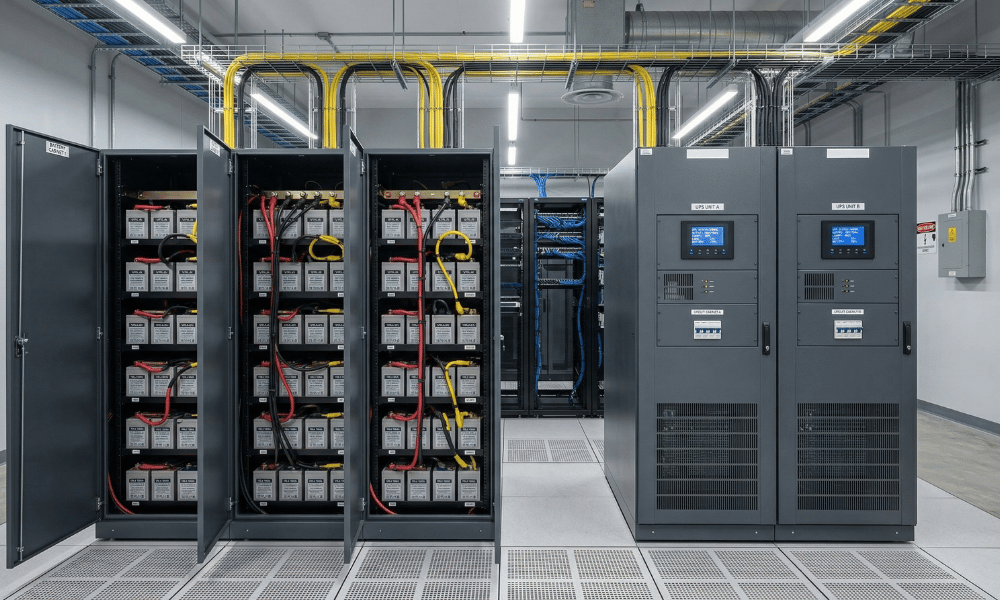
In data centres, lithium-ion batteries most often serve as uninterruptible power supplies (UPS), bridging the gap between a utility outage and backup generator start-up, O’Connor said. Some facilities use large, centralized battery banks in place of a generator entirely; others distribute smaller units throughout individual server racks, with safety considerations shifting depending on the design.
Data centres already manage significant heat and electrical risk before batteries are introduced, since a large share of their infrastructure is dedicated to drawing heat away from chips and servers, O’Connor said. Most are also low-occupancy buildings staffed by workers familiar with the layout, which affects how egress rules apply, though facilities are still required to meet building and life safety codes that support first responders, including lighted egress routes and functioning suppression systems.
“They often have advanced detection systems and advanced suppression systems,” O’Connor said, noting that gaseous suppression alternatives to sprinklers are common where operators want to protect high-value equipment, an approach consistent with how NFPA 855, the association’s standard for installing stationary energy storage systems, directs facilities to separate and protect battery installations. Emerging liquid cooling technology is pushing storage density even higher, he added, which raises the value of equipment at risk if a fire does break out, a trend echoed in recent engineering research into AI data centre battery risks out of the University of Waterloo.
Planning across the full battery lifecycle
O’Connor’s core advice for employers, workers and health and safety leaders building or operating these systems is to treat fire safety as a lifecycle issue, not a one-time installation step.
“Make sure that safety is brought to the table very early on in the planning stages,” O’Connor said. “This change management is a big issue as well. We want to make sure that when things change, that if your fire safety plan or your emergency operations plan made assumptions based on something that’s changing, that those plans change as well.”
That includes planning for the end of a system’s working life, O’Connor said, since large lithium-ion installations lose charge capacity over time just as consumer batteries do. “You don’t want to end up with a big abandoned battery system somewhere,” he said, adding that organizations should bring as many stakeholders as possible into building out a facility’s fire and life safety plan, a lesson that also applies to the broader promise and pitfalls of new OHS technology adoption across Canadian workplaces.
Lithium-ion is not the first battery chemistry data centres have relied on, O’Connor noted. Lead-acid batteries, more familiar to firefighters, have powered backup systems for years and carry some of the same thermal runaway risk. What has changed is energy density: lithium-ion batteries are lighter and can deliver more electricity in less space than their lead-acid predecessors, which is driving adoption in new builds even as it adds complexity to fire planning, raising the kind of electrical infrastructure stakes already visible in a recent fatal switchyard incident involving a veteran electrician in Newfoundland and Labrador.