A Safety Summit panel explores whether training or legislation should come first while ministers plan to advance the efforts
Canada's drive to harmonize workplace safety rules across provinces faces its next test on December 14, 2026, when federal, provincial and territorial labour ministers hold a virtual, closed-door meeting, Maja Stefanovska, a media relations spokesperson for Employment and Social Development Canada (ESDC), confirmed to Canadian Occupational Safety. The date lands less than two months after a panel at the Canadian Safety Summit in Toronto exposed just how far apart stakeholders remain on how, and in what order, that harmonization should happen.
'We're stuck,' but at least talking
Kevin Brown, CEO of Cobalt Safety, a workplace safety consulting firm in Burlington, Ontario, didn't mince words when asked where harmonization efforts stand. "I think we're stuck," he said during the October 22 panel, Breaking Down Borders: The Industry Case for Harmonized Safety Standards, which this reporter moderated. "The concept is phenomenal. The execution is going to take forever. It's a heavy lift." Still, he called the fact that governments are discussing a national approach at all "the first time Canada has really started thinking about this perspective."
Troy Winters, national coordinator of health and safety at the Canadian Union of Public Employees (CUPE), agreed governments are finally talking, and pointed to why now. "A lot of the reason is the pressure we're feeling, the trade war, the need to get big projects done," he said, warning that any harmonization "has to raise all boats," not average standards down. Emily Larose, vice-president of regulatory affairs and general counsel at the Electrical Safety Authority (ESA), added that the accelerating pace of new technology is forcing the issue industry-wide, creating "new risks, new harms, but also potentially new tools and new opportunities."
The federal government's current timeline would harmonize working-at-heights and mobile-elevated-work-platform rules by January 1, 2027, with hoisting, rigging, trenching and shoring consultations underway and entry-level construction training to follow by May 2027, building on Ottawa's broader push to harmonize safety regulations nationally, a plan under which Ontario has already moved to meet its own safety training harmonization goals.
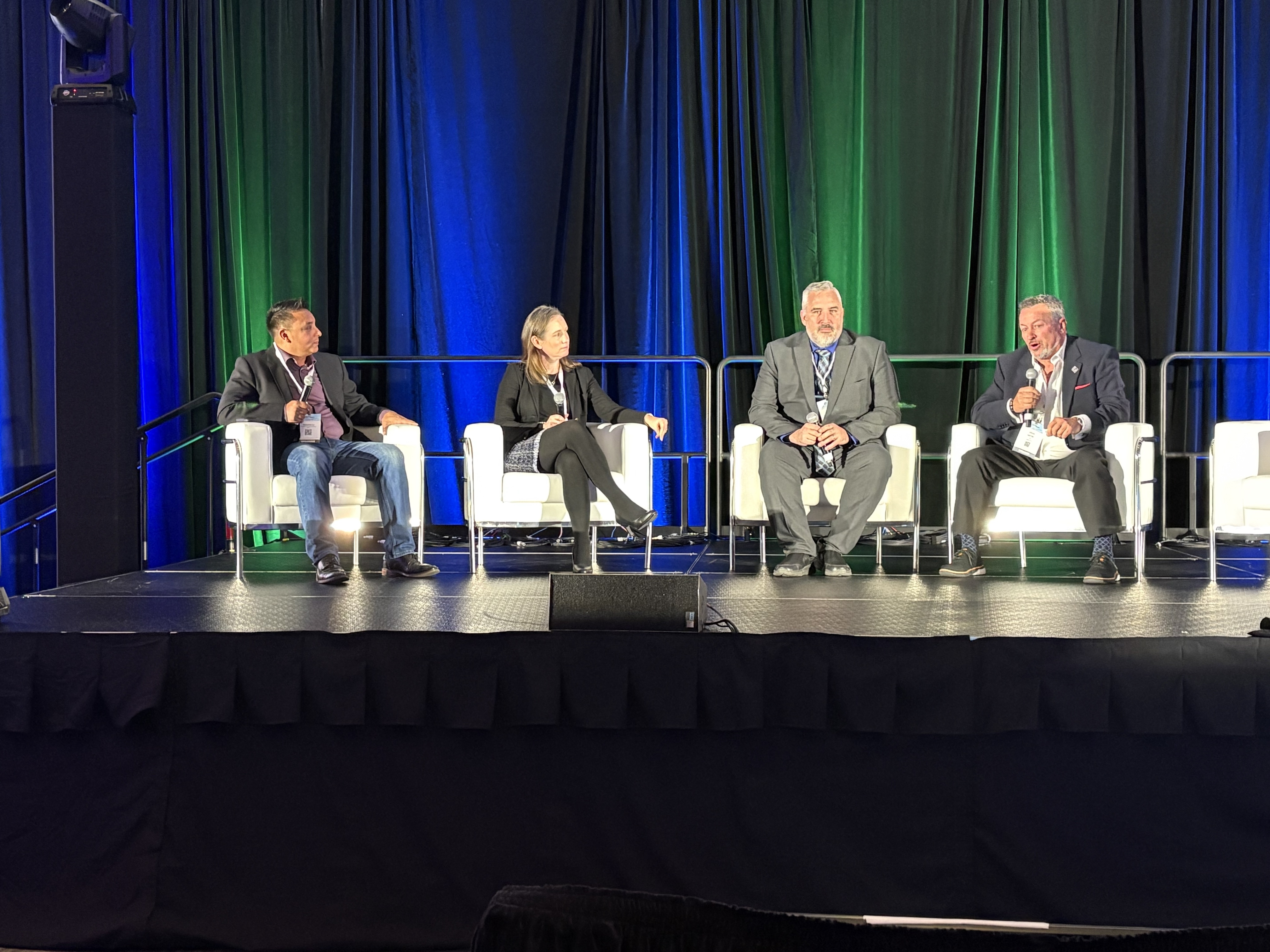
(Breaking Down Borders – The Industry Case for Harmonized Safety Standards Panel at the Canadian Safety Summit in Toronto on October 22, 2026. From left to right: Shane Mercer, Emily Larose, Troy Winters, Kevin Brown)
Training first, or the law first?
Brown argued the current sequence is backwards. "We're actually at step two before we've done step one," he said. "We can't harmonize training on divergent law... gravity is the same in every province, but we have 14 versions of the law for fall protection." He warned that a worker trained in Alberta who has an incident in Ontario still answers to Ontario's regulator, meaning standardized training without matching legislation "will add an additional burden to the employers."
Winters shared the concern but defended a role for standards bodies, citing the Canadian Standards Association's confined-spaces and asbestos-in-buildings work as models smaller jurisdictions can borrow from without a 12-year formal-adoption process. He also flagged a structural gap: "there are massive organizations that do their own training, and those aren't going to be captured" by curriculum changes imposed on outside training providers. Pointing to how long it took Canada to agree on national first-aid standards (roughly 14 years from the start of talks to Ontario's adoption this past summer), Winters said he would "be long retired" before British Columbia, Alberta and Ontario share identical health and safety legislation. A separate push already underway, in which Alberta's rigging sector is seeking its own national training standard, illustrates how piecemeal that road can be.
A framework first, Larose and Brown argue
Brown pointed to Australia's Commonwealth model, where states adopted a shared national framework before standards, as the template he thinks Canada should study. "We don't start with standards. We have to start with bigger picture, better vision," he said, describing what he called an "external responsibility system" that puts the duty on regulators and governments, not just employers, to get the underlying law right before asking workers to retrain. Larose pointed to the Canadian Electrical Code, updated on a three-year cycle and marking its hundredth year, as a working example of that approach: alignment succeeds, she said, "where the provinces can align on what the priorities are for their regulation" before anyone starts drafting the fine print.
The confusion problem, and Quebec's place at the table
An audience member who trains fall-protection workers pressed the panel on a concrete scenario: a tie-off point must meet a 4,000-pound standard in Prince Edward Island and a 5,000-pound standard in New Brunswick. If training is harmonized but the underlying law isn't, which number does a mobile worker follow? Brown called that gap "the actual risk that underlies the conversation," predicting employers will end up layering province-specific legislative training on top of any harmonized curriculum regardless.
An audience member who works in health and safety for Saulteaux First Nations communities in Treaty 7 territory, in Alberta, raised a complication the panel hadn't addressed. "First Nations are not covered under provincial [jurisdiction], but rather federal," she said, describing crews that cross daily between federal reserve operations and provincial worksites, with a third layer of community-level governance on top of that. "That is a huge why now, especially when we're looking at many First Nations reclaiming land back," she said. It's a jurisdictional wrinkle that doesn't fit neatly into any of the frameworks the panel had discussed.
Winters was blunt about the timeline pressure: reaching genuine harmonization, he said, will require a detailed, side-by-side comparison of every provincial rule to identify "the best of the best," a process he said "will not be complete by January 2027" and should be measured in years, not months. Whether the December 14 meeting moves that process forward, or simply restates the ambition, may be the clearest signal yet of how fast ministers are actually willing to go.
This article is part of our monthly spotlight series, which in October focuses on OHS law, regulations & standards.