New council wants minimum training and competency requirements for rigging and hoisting, with eyes on Canada-wide harmonization
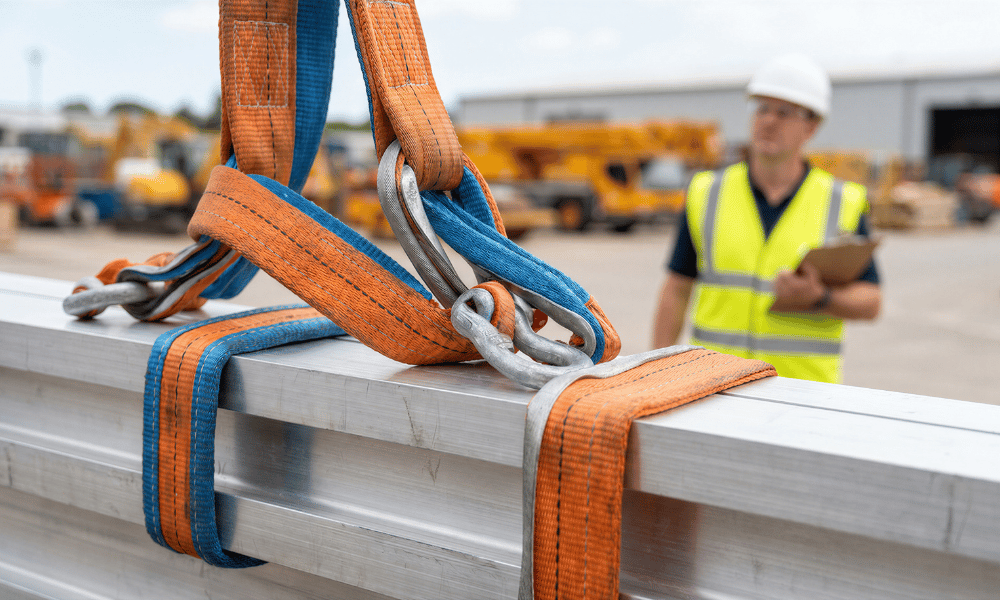
The newly formed Alberta Rigging Safety Council wants to set minimum training and competency requirements for anyone performing rigging and hoisting work, first in Alberta and eventually across the country. The judicial ruling that cleared the way for the council came down in late June 2026, and its first full board meeting is scheduled for July 8.
"The primary objective is to prevent fatalities and serious injuries due to rigging within the province of Alberta," says Jesse Johnson, board chair of the Alberta Rigging Safety Council and president of Connect Group, a heavy industrial general contractor based in Western Canada.
The council grew out of a $1.24-million creative sentence issued after the 2022 death of Brandon Nelson, a 26-year-old heavy duty mechanic killed in a rigging and hoisting incident. Three companies were found at fault. Thomas O'Neill, professor of industrial and organizational psychology at the University of Calgary, leads the creative sentence and headed the selection process that produced the council's 10-person board, chosen from 45 applications and 18 interviews.
A two-hour ticket and no oversight
O'Neill says more than 160 meetings, site visits and interviews with hundreds of workers revealed a systemic problem: rigging training in Alberta is entirely unregulated.
"I could get a basic rigger ticket on a two hour online web based training. I can print off that ticket. It's as valid as any other ticket because there is no accreditation body and there is no regulatory oversight around the qualifications needed to be allowed to go on a site and perform rigging and hoisting activities," he says, noting the gap sits below the hook and at the hook, not with Red Seal crane operators.
Site audit photos routinely show workers standing directly beneath suspended loads, even when they know they are being observed. Unlike crane operations, no Canadian Standards Association (CSA) standard exists for rigging and hoisting, and no professional body exists to answer questions about safe practice.
"Rigging and hoisting is a technical discipline and it deserves to be treated as such. But it's not," O'Neill says. "So where would you go if you had a question about safe rigging and hoisting? And the answer is there's nowhere to go."
Minimum requirements for anyone who rigs
Johnson says the short-term goal is a framework establishing baseline competencies for any worker involved in rigging and hoisting, manual or mechanical. Today, requirements vary site by site because, in his words, "there's no governance dictating" which standards training providers must teach to.
He stresses the problem is not Alberta's skilled metal trades. Pipe fitters, ironworkers and boilermakers largely perform rigging and hoisting "extremely well," a credit to the province's apprenticeship system.
"What we're focused on is making sure that everyone who touches rigging and hoisting does it that well, because it's the support trades, it's the people that don't necessarily work with this equipment every single day that we see as being the larger risk," Johnson says.
Who will own the standard?
The council does not intend to wait for a standards body to act. Johnson says the group met with Myles Morris, Alberta's deputy minister of safe, fair and healthy workplaces, to discuss ownership of a future standard, which could ultimately rest with a body such as CSA.
"It doesn't necessarily have to be this council, but we're not willing to sit and wait for someone to develop it. We're going to push development of it," he says. "We're going to be the catalyst to kickstart it. And if we have to own it, I think everyone on the board is okay with that."
Gold standard ambitions and harmonization
The timing matters. At their April 10, 2026 meeting in Québec, federal, provincial and territorial labour ministers agreed to consult on hoisting and rigging training by January 1, 2027, part of a broader push to harmonize construction safety training. WorkSafeBC, prompted by fatal crane incidents in British Columbia, has been developing its own rigging standards with what O'Neill describes as an 18-month head start.
"How would you harmonize when you don't have a standard and source of ground truth against which to harmonize," O'Neill says. The council has reached out to Ontario Labour Minister David Piccini, WorkSafeBC and John Zerucelli, federal Secretary of State (Labour), to coordinate.
"So we build a standard so robust, not difficult to achieve, but certainly robust in the sense of the framework of it, that it's harmonized across this country as the bar to reach for all standards across all provinces," Johnson says.
For O'Neill, whose network on the issue has grown to more than 300 regulators, trainers, trades and safety professionals across the country, the work comes back to Nelson, who died under a 5,000-pound load rigged with rags instead of certified edge protection.
"It was a misapplication of rigging and then it was getting under the load at the wrong time. And these are the two things that kill you in rigging and hoisting," he says. "It could happen to anybody and it's traumatic and we need to make sure this never happens again. And that's my mission."