The board recommends regular Transport Canada audits of railway medical fitness rules after a 2023 Alberta train collision
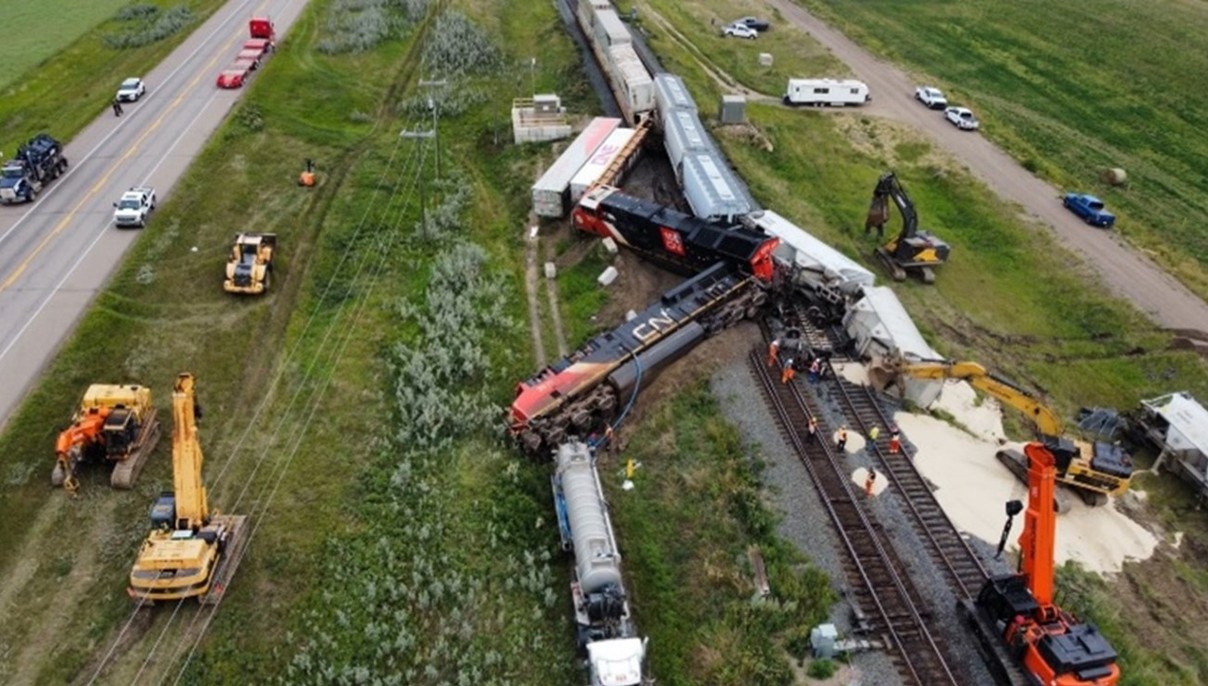
The Transportation Safety Board of Canada (TSB) says Transport Canada needs to start conducting regular oversight of how railways assess employees' medical fitness for duty, after an investigation into an August 8, 2023 collision between two Canadian National Railway (CN) trains near Wainwright, Alberta found a locomotive engineer had been cleared to work despite years of incomplete diabetes assessments. The collision derailed two locomotives and eight rail cars. Yoan Marier, chair of the Transportation Safety Board of Canada, told Canadian Occupational Safety the gap uncovered in the investigation may not be limited to CN.
"Even though it's not an issue that we see very often in our investigations, to us this points to an issue that may be systemic, because if you don't have oversight, then you have no assurance that the railways are complying with these rules," Marier said.
No Transport Canada audits in 12 years
The TSB's investigation (R23E0079) found that annual medical assessments the locomotive engineer was required to complete and submit to CN were either incomplete or missing entirely from his file for certain years. When investigators asked Transport Canada what oversight it had provided of railway compliance with the Railway Medical Rules, they found none had occurred in the 12 years preceding the collision, and not just at CN.
"There was no assessment and no oversight provided at all," Marier said.
As a result, the board issued Recommendation R26-01, calling on Transport Canada to establish regular oversight of railways' compliance with the Railway Medical Rules for Positions Critical to Safe Railway Operations, part of a broader pattern that includes dozens of outstanding safety recommendations spanning Canada's rail and marine sectors.
Symptoms consistent with hypoglycemia, no blood test conducted
Marier said the TSB did not conduct a blood test, so investigators cannot be certain the engineer's medical event was hypoglycemia. But a TSB medical expert reviewed the case and found his symptoms that day were consistent with the condition, which is associated with diabetes.
"We did have a medical expert go through our findings, and the symptoms that he exhibited on that day were consistent with hypoglycemia, which we know is associated with diabetes, a medical condition he was known to have," Marier said. He added that fatigue and alcohol consumed the night before could have worsened the episode.
The annual assessments cover more than diabetes, screening for any medical condition that could affect a locomotive engineer's ability to safely operate a train, Marier noted. Investigators found the train passed a Stop signal while a trainee operated under the engineer's supervision, and that a communication breakdown between the crew delayed braking, a scenario that echoes a similar Stop-signal violation the TSB investigated in 2024 near Aldershot GO station in Burlington, Ontario.
"If somebody has a cognitive decline at a critical moment, like when you're approaching a stop signal, it can lead to a collision," Marier said. "In this case, we saw property damage mostly, but if it had been two passenger trains, the situation could have been a lot different."
What meaningful oversight could look like
Marier said the board is open to multiple approaches to strengthen oversight. Transport Canada could add medical compliance to the checklist it already uses for regular audits, or verify it during surprise inspections, he said.
"We think that more oversight is better than no oversight at all, as we saw in this case," Marier said. "This is definitely something the regulator should look at while they are reviewing compliance with other rules that exist in the railway industry."
The gap traces back to how rail medical assessments differ from aviation and marine. In those sectors, Transport Canada directly manages and validates employees' fitness to work; in rail, the process is left entirely to the railways themselves.
"If there is no oversight that is provided by Transport Canada to make sure the railways are complying with these rules, well, the railways don't have a big incentive to comply with them, and things can slip through the cracks, as we saw," Marier said.
The safety concern also flags that the Canadian Railway Medical Rules Handbook's diabetes guidelines are inconsistent with Diabetes Canada's clinical recommendations and with medical certification standards used in aviation and marine, per the TSB's press release. Marier said he was unsure what enforcement tools Transport Canada holds to compel compliance, but that basic inspection would already mark a significant improvement.
"I'm not fully sure exactly what tool TC has to force compliance, but from our perspective, just having TC inspectors look at how railways are complying with these rules would be a big improvement compared to the current situation, which is essentially no oversight being provided," Marier said.
This same accountability gap surfaced in recently announced updates to railway crew training requirements, following years of TSB pressure over human-factors shortfalls in rail crew qualification.
Balancing employee privacy against fitness for duty
Asked how the case balances an employee's medical privacy against an employer's duty to confirm fitness for duty, Marier said the board weighed those considerations carefully while drafting the report.
"We are very sensitive to all of these privacy considerations, and it was a very important consideration for us, even when writing up this report, because we have to be careful about the information that we put in there," Marier said. "But we are talking about employees occupying safety-critical positions, positions that can have a major impact on safety, like operating a train. There is a need to follow up on medical issues to ensure employees are not put into a situation where they have a cognitive impairment that could lead to catastrophic consequences."
Federal ministers have 90 days to formally respond to TSB recommendations under the Canadian Transportation Accident Investigation and Safety Board Act, according to the board's website. Transport Canada has not yet issued a public response to Recommendation R26-01.