Charges allege confined space failures
Mowi Canada East faces eight workplace safety charges — several tied to confined space entry failures — following a worker’s death at a Newfoundland and Labrador salmon hatchery.
The provincial government announced the charges on Nov. 5, nearly 10 months after the fatal incident at the company’s Northern Harvest smolt facility in Stephenville on Jan. 20, 2025.
The charges were laid by Newfoundland and Labrador’s Occupational Health and Safety Division following a joint investigation with the RCMP and the chief medical examiner.
Police had been called to the hatchery that morning, where a 58-year-old worker was found dead.
The company’s first court appearance is scheduled for Nov. 19 at Stephenville Provincial Court. The charges remain allegations and have not been proven in court.
Eight charges detail confined space safety breakdown
The eight charges describe alleged failures across every layer of a compliant confined space safety programme. The company is alleged to have failed to:
- provide a safe workplace
- deliver adequate training and supervision
- ensure workers and supervisors were familiar with hazards.
COS has outlined the six critical confined space safety requirements every employer must address.
Four charges relate directly to confined space entry. These are alleged failures to:
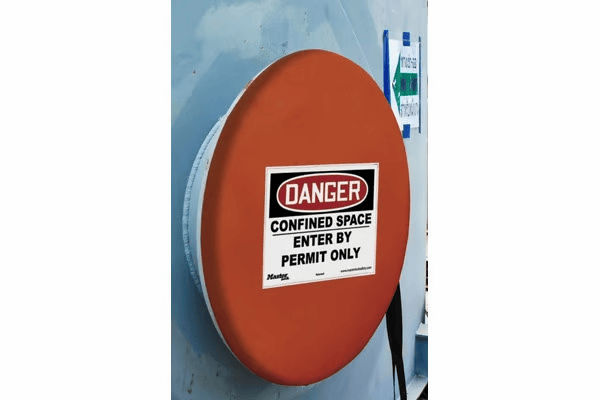
- post hazard signage
- establish written rescue and evacuation procedures
- conduct atmospheric testing for harmful gases and oxygen deficiency
- follow emergency rescue protocols
The absence of atmospheric testing is especially significant. The Canadian Centre for Occupational Health and Safety (CCOHS) warns that poor air quality — including insufficient oxygen and toxic gases — is among the most dangerous confined space hazards. COS has also outlined the 11 confined space hazards companies must address to build a compliant programme.
Rescue failures carry deadly consequences
The alleged failure to establish emergency rescue procedures carries consequences beyond the original victim. According to the CCOHS, an estimated 60% of confined space fatalities involve would-be rescuers — which is why rescue planning is a standalone legal obligation, not an optional addendum.
Doug Silver, division chief at Toronto Fire Services, told COS that misidentification compounds the danger. “Often the fellow worker who makes the emergency call doesn’t identify it as a confined space accident because it hasn’t been defined as one,” Silver said. “Confined space rescues are complex and require knowledge of hazardous materials combined with specialized rescue techniques.”
Silver also noted the value of effective regulation: “We’ve only had about 20 confined space rescues out of the 2,300 incidents we respond to every year. So based on our experience, standards do work to reduce them.”
Proceedings arrive as company prepares to exit Canada
The prosecution arrives as Mowi prepares to exit its eastern Canadian operations. The Norwegian producer agreed in June to sell Mowi Canada East — hatcheries, marine farms and processing facilities in Newfoundland and Labrador, New Brunswick and Prince Edward Island — to Cooke Inc. for C$225 million.
The transaction remained subject to regulatory approval as of Mowi’s third-quarter results. The OHS proceedings will continue regardless of the pending ownership change.