A construction worker fell through scaffolding onto concrete in Ottawa, triggering a 50-minute rope rescue and an Ottawa Police investigation

An Ottawa construction worker was rescued from a basement after falling through scaffolding and landing on concrete, in an incident that underscores the persistent fall protection risks faced by workers at Canadian residential build sites.
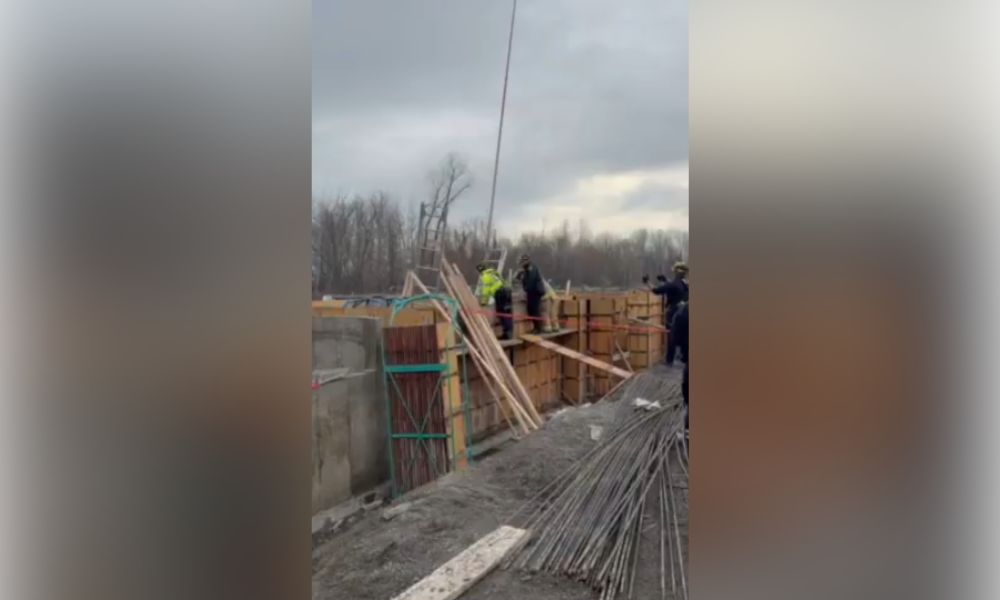
Ottawa Fire Services received the call at approximately 8:19 a.m. from Ottawa Paramedic Service, requesting assistance at a site near the intersection of Linseed Road and Alembic Crescent. Firefighters arrived three minutes after dispatch and confirmed the worker had sustained an injury that left them unable to exit the basement unassisted.
Ottawa Fire Services deployed a Rope Rescue Team while firefighters placed ladders into the basement to access and begin treating the worker. An aerial ladder provided the high anchor point. “Firefighters carefully secured the worker in a stokes basket, which was attached to the system, before lifting them out of the basement and lowering them to a safe location,” Ottawa Fire Services stated. Patient care transferred to Ottawa Paramedic Service, and the scene was cleared at approximately 9:09 a.m. — roughly 50 minutes after the initial call.
Scaffolding falls: a persistent OHS hazard in Ontario construction
The Ottawa incident reflects a broader pattern that has long troubled Canadian construction occupational health and safety professionals. Falls from height remain the leading cause of traumatic fatalities in Ontario’s construction sector, and scaffolding is among the most frequently implicated hazard types.
A November 2023 study by the Institute for Work & Health (IWH), published in the American Journal of Public Health, found that after Ontario’s mandatory working-at-heights training was fully standardised, targeted fall injuries causing lost time fell 19% compared to the 2012–14 baseline. “In our analysis, this reduction amounts to four deaths and 320 lost-time injuries avoided during the three-year period after the change went into effect,” said IWH Scientist Dr. Lynda Robson. That improvement contrasted with a concurrent 12% rise in falls not covered by the training, such as same-level falls.
The regulatory framework behind that progress begins with Ontario’s Construction Projects regulation, O. Reg. 213/91, which requires fall protection for workers at risk of falling more than three metres. Mandatory working-at-heights training was introduced under amendments to O. Reg. 297/13 on April 1, 2015, with a transition period for previously trained workers running until April 1, 2017.
Investigation and regulatory follow-through
Ottawa Police are now investigating the circumstances. Under Ontario’s Occupational Health and Safety Act, a critical injury at a construction site triggers mandatory notification to the Ministry of Labour, Immigration, Training and Skills Development, which may conduct its own inspection. For OHS professionals tracking developments in OHS law and legislation in Canada, incidents of this kind frequently result in charges months after the fact.
The employer and the nature of the worker’s injuries have not been publicly identified. The incident is a reminder that fall protection compliance at residential construction sites — where scaffolding failures are both common and largely preventable — remains an active enforcement priority for the Ministry of Labour.
For a full look at how Canada’s top safety suppliers are supporting stronger workplace programs, see COS’s Readers’ Choice Awards recognising Canada’s best safety suppliers.