

‘It’d be unheard of, of any other profession, that your patrons are able to verbally...physically assault you, and expect to have the services back’

Alberta classrooms are becoming higher‑risk workplaces, with teachers warning that rising aggression and “classroom complexity” are undermining safety and learning — concerns now echoed in a new provincial report on aggression and complexity in schools.
CBC News recently surveyed more than 6,000 teachers and education staff across Alberta, receiving hundreds of accounts of being kicked, punched, scratched and bitten, suffering concussions and other injuries, and routinely evacuating classrooms due to violent outbursts. Many respondents said the most frequent source of risk is their own students.
Those front‑line stories are reinforced by the Aggression and Complexity in Schools Action Team, a 25‑member group of superintendents, trustees, teachers, educational assistants and union representatives convened by the province in June 2025. In its November 2025 final report, the team concludes that student aggression “is not a singular or isolated issue” but a multifaceted problem rooted in family dynamics, socio‑economic pressures, mental health concerns and gaps in support systems.
The report describes a sharp rise in “growing student complexity,” with more students presenting significant behavioural, social‑emotional, linguistic and mental health needs, while access to assessments, specialized programmes and qualified professionals has not kept pace. Educators told the Action Team that overcrowded classrooms and limited space make it difficult to provide individualized support, leaving staff managing “reactive” environments where crises are frequent and instructional time is repeatedly disrupted.
Government response and systemic gaps
The concerns documented in CBC’s survey mirror the Alberta government’s own findings. The Action Team’s engagement with teachers, occupational health and safety officers, psychologists and community agencies identified five core challenge areas: growing student complexity, reactive school environments, educator well‑being and capacity, insufficient training and resources, and strained relationships between schools and families.
The province has earmarked $1.4 billion over three years to address class size and complexity, including $355 million this year, and committed “complexity teams” for 476 elementary schools to help manage disruptive students. The Action Team goes further, recommending a comprehensive Inclusive Education Policy Framework, updated standards for special education, and a tiered continuum of supports that can be activated based on predictors of need rather than waiting for formal diagnoses.
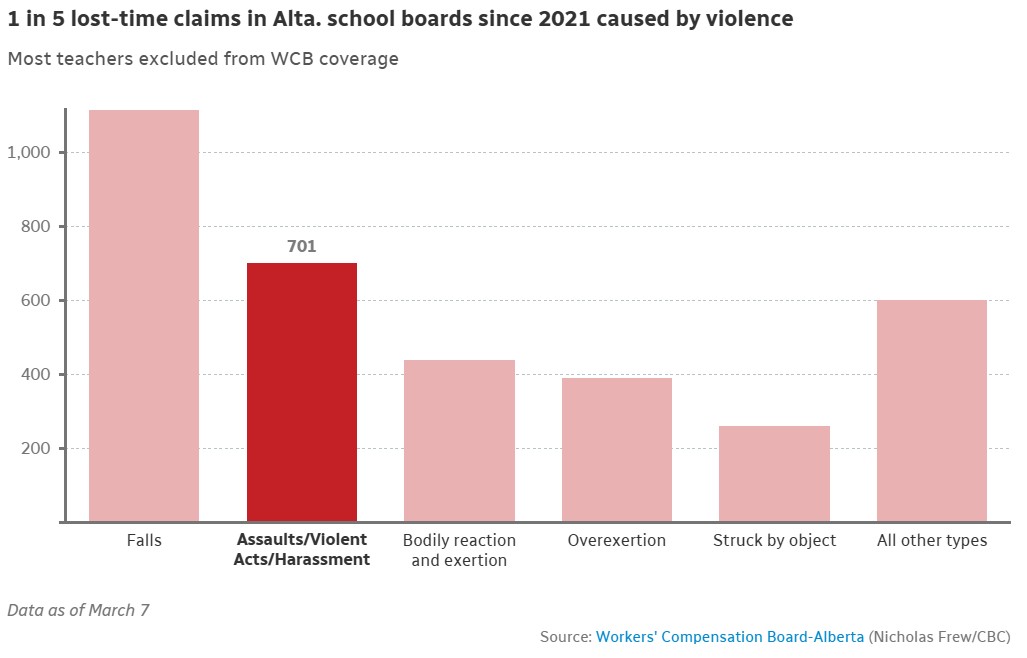
Workers’ Compensation Board–Alberta data cited by CBC show that from 2021 to 7 March this year, about 700 public and separate school board employees missed work due to “Assaults/Violent Acts/Harassment,” making such incidents the second‑largest source of lost‑time claims in that group. Yet most teachers remain outside mandatory WCB coverage, with current regulations generally limiting coverage to those teaching industrial education or home economics. The Action Team notes that chronic staffing shortages, rising injuries and refusals of unsafe work are straining an already thin workforce.
Occupational health and safety implications
For occupational health and safety professionals, the report’s recommendations signal a shift toward treating classroom aggression as a core workplace hazard rather than an unavoidable feature of teaching.
The Action Team urges the Government of Alberta to “begin exploration of health and safety protections targeted to education staff” through existing provincial injury‑prevention and safety programmes, and to examine legislation “to meet the needs and protections of the classroom environment for workplace safety protection.” It also calls for potential Occupational Health and Safety amendments or other instruments to advance crisis‑intervention training for school authorities, and for school boards to ensure school‑level guidance on managing violent student behaviour aligns with provincial OHS requirements.
Front‑line participants in the engagement sessions reported increased staff injuries, medical leaves, and instances of staff invoking OHS regulations to refuse unsafe work. They described “room clears” — evacuating an entire class because of one student’s behaviour — as increasingly common, alongside physical aggression such as hitting, biting and hair‑pulling, and, in extreme cases, weapons.
Limited injury data and uneven compensation coverage
Despite the mounting anecdotal evidence, public data on violence against Alberta teachers remains limited. Workers’ Compensation Board–Alberta figures cited by CBC show that from 2021 to 7 March this year, about 700 public and separate school board employees missed work due to “Assaults/Violent Acts/Harassment,” making such incidents the second‑largest source of lost‑time claims in that group, with claims rising since the pandemic.
However, most teachers are excluded from those statistics. Under Alberta’s Workers’ Compensation Regulation, only teachers in industrial education or home economics have WCB coverage, CBC reported — a gap that raises concerns about under‑reporting and inconsistent access to support.
Some experts interviewed by CBC say the risks teachers face would be unacceptable elsewhere in the labour market. “It’d be unheard of, of any other profession, that your patrons are able to verbally assault you and physically assault you, and expect to have the services back,” said Dr. Salvatore Durante, an Edmonton‑based registered psychologist and former teacher. He conducted doctoral research on educators in Western Canada who were assaulted by students after a student tried to stab him while he was substitute teaching.
Others warn that training and prevention efforts have not kept pace with day‑to‑day realities. Amy Klinger, director of programmes at the U.S.‑based Educator’s School Safety Network, told CBC that most safety training still centres on rare but catastrophic events such as active‑shooter situations, leaving staff less prepared for frequent aggression from students, parents and community members. “You’re preparing people for the least likely thing they are going to encounter — which you absolutely must do,” she said. “But you also have to be able to walk and chew gum at the same time.”
Teachers who spoke to CBC stressed that while trauma‑informed practice and understanding neurodiversity are essential, so are concrete supports, clear expectations and consistent consequences. Durante called for a firm but restorative approach: “We can’t have wishy‑washy restorative justice where the student says, ‘Sorry,’ and they’re back in the classroom.”