
A St. Catharines safety expert says clear communication and business continuity planning are essential before the next disaster hits
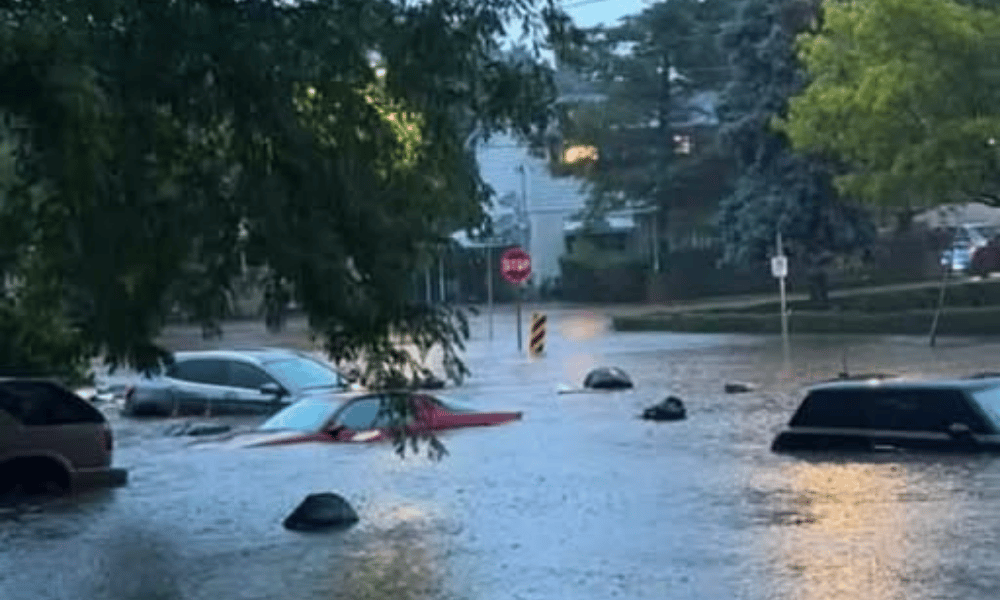
Back-to-back flash floods that struck St. Catharines, Ont. in late July and early August exposed how unprepared businesses, municipalities and workers are for the kind of climate emergency preparedness experts say will only become more necessary. Three separate storms dumped roughly 400 millimetres of rain on the Niagara region between July 21 and Aug. 2, more than double the roughly 167 millimetres the area typically sees over a comparable stretch, according to Dr. Sarah Wilson, owner and CEO of Canadian Safety Group (CSG), a St. Catharines-based emergency response and safety training firm.
"There were areas where it was so severe that cars were floating away," Wilson said in an interview with Canadian Occupational Safety.
St. Catharines Mayor Mat Siscoe declared a state of emergency on Aug. 3, following the second major storm in less than a week. "Many residents are reliving the devastating experience of flooding for the second time in less than a week," Siscoe said in a city statement. "This declaration underscores the severity of what our community has experienced and the need for continued support from our partners at all levels of government as we work through recovery."
Businesses had no plan for repeat flooding
Wilson said no one, not individuals, businesses or municipalities, was ready for flooding on this scale. "This level of historic type flooding is just that: historic," she said, noting the region was still bailing out from the first storm when a second, then a third, hit within weeks.
CSG, which also runs incident command and rescue training, built a public information hub to fill what Wilson saw as the biggest early gap. "There was lots of information, but it wasn't one source of truth for people, and they couldn't find it fast enough," she said. She pointed to the absence of a formal plan as the most common failure among the employers she works with, echoing what a business continuity plan should include: a single designated communicator, one channel of communication and a plan for keeping vital records accessible before disaster hits.
Emergency response takes a psychological toll on workers
Wilson said protecting workers during a climate emergency is as much a psychological hazard question as a physical one. "These workers are humans," she said. "They too are suffering. They don't put on their uniform, go to work, and stop being human beings." CSG rotates staff onto shorter shifts during emergency deployments, a response that mirrors how first responders are implementing PTSI programs elsewhere in the country, and accepts that recovery projects will run longer if that is what keeping workers safe requires.
Provincial disaster funding has been slow to arrive
While the city's state of emergency opened the door to provincial help, funding has moved slowly. A spokesperson for Ontario's Ministry of Municipal Affairs and Housing said the ministry was working with the city to determine whether flood-damaged properties could qualify under the Disaster Recovery Assistance for Ontarians (DRAO) program, which generally excludes sewer backup damage except for low-income households. As of late August, DRAO had not been formally activated for the Niagara region, and local members of provincial parliament, along with Ontario NDP Leader Marit Stiles, continued pressing the minister to expand it.
Wilson said that gap between what residents expected and what actually happened bred real frustration. "The state of emergency triggers funding based on flooding criteria, but that flooding criteria has exclusions, and some of that exclusionary wording is sewage," she said. "Well, our flooding included sewage." Left unexplained, she said, that kind of gap leaves residents feeling "abandoned by the system that they elected to protect them."
Wilson's advice for other safety leaders
Wilson urged other health and safety professionals to raise the subject with clients and municipalities before disaster strikes, pointing to how BC employers are building wildfire evacuation plans as a model: a single communications point of contact, a clear evacuation chain, and at minimum an informal continuity plan.
"Safety is not a trade secret," she said. "The only way we start to move the needle when it comes to worker safety is if we're open and transparent." Wilson, who was not personally flooded but lives in the community, said the same principle applies at home. "Have a plan in place," she said. "We hope it never happens, but practice this. You have to."