The Alberta Rigging Safety Council backs the initiative but argues operational standards must come before competency rules
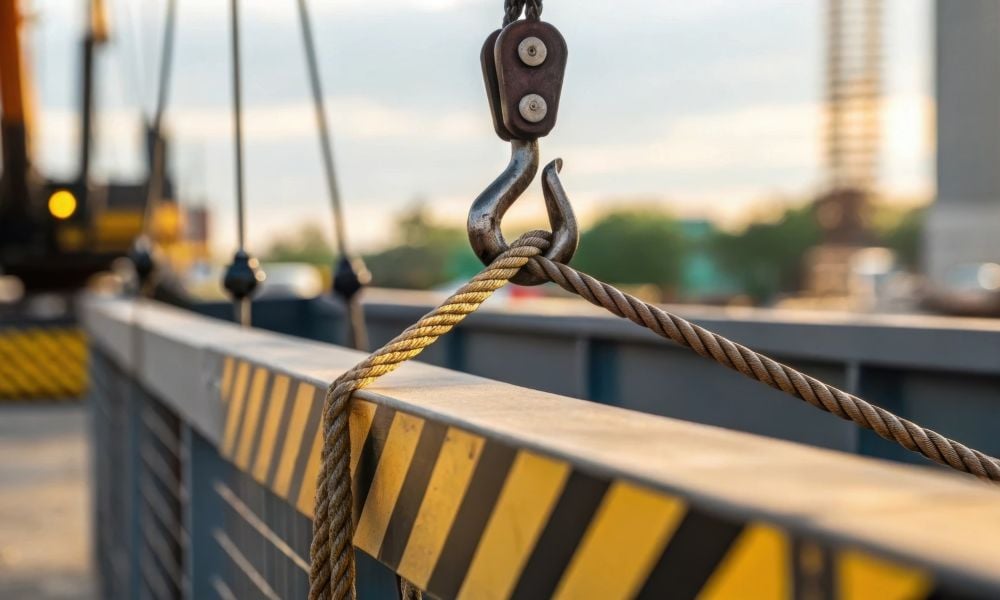
CSA Group and WorkSafeBC have signed an agreement to fast-track a national standard defining the competencies needed to safely perform rigging and hoisting work, the two organizations announced on October 28. No such Canadian standard currently exists.
The proposed standard would set a common, nationally recognized benchmark for the knowledge, skills and abilities required for rigging and hoisting across construction, manufacturing, transportation, energy and marine operations. CSA Group, an accredited standards development organization, will lead the drafting process, with work beginning this fall.
“National standards help create a common understanding of what safe work looks like,” said Kay Penn, director of health and safety standards at CSA Group, in the announcement. “CSA Group brings together experts from industry, labour, government and technical communities to develop practical, consensus-based standards that support consistent competency expectations across Canada.”
Why WorkSafeBC pushed for a national framework
The initiative grew directly out of a string of crane incidents in British Columbia between 2021 and 2024, beginning with the July 2021 Kelowna tower crane collapse that killed five workers during dismantling and continuing through a cluster of Metro Vancouver crane incidents in early 2024, including the fatal Oakridge Park load drop that killed Yuridia Flores. WorkSafeBC has logged 22 tower crane incidents in the province between 2019 and 2023 alone. That pattern, and the subsequent Crane Roundtable convened by British Columbia’s Ministry of Labour, is what pushed rigging onto WorkSafeBC’s agenda, according to Angelique Prince, director of prevention programs and services at WorkSafeBC.
“It did become pretty clear early on that rigging was a substantial source of injuries, and not just related to tower cranes,” Prince said in an interview. “We were seeing rigging injuries really anywhere where rigging occurred.” That finding coincided with a review of Part 15 of British Columbia’s Occupational Health and Safety Regulation, which covers cranes and hoisting and currently places much of the regulatory onus for rigging on crane operators, despite operators working from the cab rather than alongside the rigging itself.
WorkSafeBC’s prevention programs team began documenting rigging competencies in February, finding that existing frameworks were either non-Canadian or outdated. By early spring, the national push to harmonize hoisting and rigging training timelines across provinces made a national standard feasible, and WorkSafeBC brought the work to CSA Group along with seed funding and its own consolidated research. Prince said WorkSafeBC requested an expedited one-year timeline, calling it “exceptionally fast” for a technical standard, though she cautioned that beyond providing that research, WorkSafeBC’s role is now that of “any other participant,” since CSA Group alone selects committee members to avoid conflicts of interest.
She also stressed the project is deliberately scoped as a competency framework rather than a training standard, to avoid displacing training systems already embedded in multiple interprovincial Red Seal trades.
Alberta council presses for a different sequence
In a written statement responding to the announcement, the Alberta Rigging Safety Council (ABRSC), formed in 2026 after a creative-sentencing order tied to the 2022 rigging death of 26-year-old Brandon Nelson directed $1.24 million toward improving industry practice, welcomed the CSA Group and WorkSafeBC initiative but challenged its starting point.
“We believe we must distinguish between establishing the standards governing rigging and hoisting operations and establishing the competencies required to perform those operations,” the council wrote, in a statement signed by president Jesse Johnson and board member Thomas O’Neill, the University of Calgary professor who leads the creative-sentencing-funded research program that helped establish the council. “Our position is that the operational standard should precede and inform the competency standard.”
The council argues a national standard should first set consistent expectations for lift classification, hazard identification and decision-making authority before defining the competencies needed to meet them, and that competency requirements should scale with the complexity of the lift rather than apply uniformly. It also called for existing Red Seal qualifications, held by ironworkers, boilermakers, pipefitters, millwrights and operating engineers, to be factored into the framework to avoid duplicating training those trades already receive, a position that echoes the newly formed council’s own push for a national rigging standard earlier this year.
“The ABRSC has no interest in creating competing or conflicting standards,” the statement said, adding that the council expects to put forward candidates for CSA Group’s technical committee and provide feedback once a draft is opened for consultation, a process Prince confirmed is open to every province.
A tight timeline, with one open question
Prince said WorkSafeBC is hopeful a draft standard will be ready “at this time next year, if not very early” in the following quarter, roughly a year after the project’s launch, a pace that has drawn a divided reaction from safety professionals watching other harmonization efforts move at speed. The Canadian Association of Administrators of Labour Legislation’s Occupational Health and Safety committee (CAALL-OSH), for which the Canadian Centre for Occupational Health and Safety (CCOHS) acts as secretariat, is separately mandated to begin consultation on rigging harmonization by January 2027; Prince said CAALL-OSH is expected to treat the CSA Group process as satisfying that mandate.
Whether the standard becomes part of British Columbia’s regulation is a separate decision, Prince said, to be weighed later through the province’s normal regulatory amendment process. In the meantime, each jurisdiction retains the authority to decide whether to adopt, reference or incorporate the finished standard.
This article is part of our monthly spotlight series, which in October focuses on OHS law, regulations & standards.