
Why heat‑driven rail stress and infrastructure “creep” are critical early warning signs
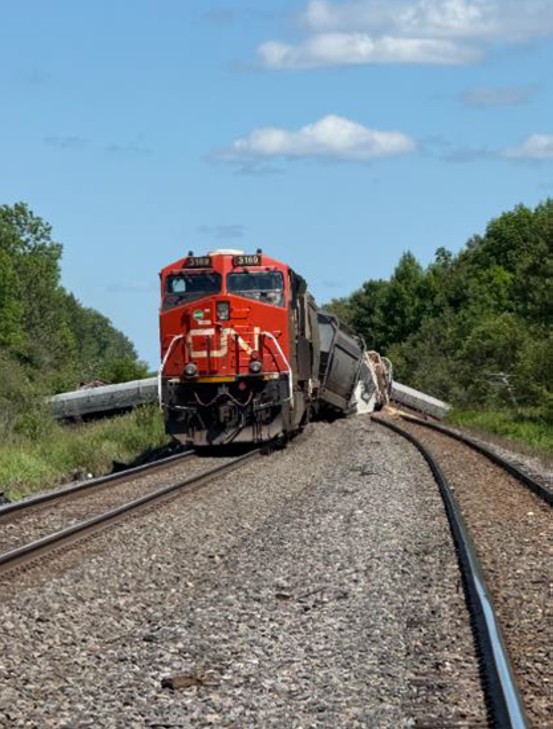
A Transportation Safety Board of Canada (TSB) investigation into a June 2025 derailment near Devlin, Ontario, is drawing fresh attention to how rail stress, track maintenance practices and heavy unidirectional traffic can combine to create derailment risks even on track that meets inspection standards.
On June 28, 2025, a Canadian National Railway (CN) unit grain train travelling east from Winnipeg to Thunder Bay derailed 13 loaded hopper cars near Mile 101.1 on the Fort Frances Subdivision. The 134‑car train, weighing more than 18,500 tons and stretching 7,853 feet, went into a train‑initiated emergency brake application while travelling at 41 mph in a right‑hand curve. The derailed cars, located toward the rear of the consist, were heavily damaged and spilled product, but no injuries were reported.
Rail creep and heat-driven stress set the stage
The TSB found that the derailment occurred in a context of prolonged compressive forces in the rail, amplified by hot weather and recent sharp temperature swings. At the time of the accident, the temperature was 28.6°C following several days of daytime highs above 21°C and nighttime lows dropping as far as 5.2°C.
Track examination in July 2025 revealed clear signs of rail creep in the derailment area and nearby siding, with anchors on the main track having been repositioned by up to four inches and some siding anchors displaced by as much as six inches, all in the eastward direction – the same direction as the heavy loaded traffic. Rail creep of this magnitude typically develops over months or years.
As the report notes, “rail creep is a sign of compressive stress in the rail,” which, if not relieved, can eventually lead to lateral deformation or buckling.
Track buckling at the rear of a long, heavy train
The derailment was consistent with a classic buckling scenario in long, heavy freight operations. Track buckling occurs when longitudinal compressive stresses exceed the lateral resistance of the track structure, creating a lateral misalignment that trains at normal speeds cannot safely negotiate. These events most often occur toward the rear of long heavy trains, where dynamic forces and train‑handling effects are different from the head end.
According to the TSB, three contributing elements aligned on the day of the occurrence:
- Elevated compressive rail forces driven by high ambient temperatures and recent temperature variation
- Train dynamic forces from a heavily loaded grain train moving through a curve
- Weakened track conditions associated with longstanding rail creep and anchor displacement
The fact that the derailed cars were near the tail end of the train supports the conclusion that buckling likely occurred as the rear portion passed over the stressed section of track.
Planned destressing work left a vulnerable gap
CN had already identified rail creep on the Fort Frances Subdivision and scheduled destressing work for 2025 between Mile 98.0 and Mile 135.0. Destressing was carried out between Mile 99.43 and Mile 100.42 on June 10–11, but further work was paused so the railway could prioritize repairs at another location. This left the section from Mile 100.42 to the Highway 613 crossing at Mile 101.46, including the point of derailment at Mile 101.1, without destressing – and, critically, without a protective slow order.
The TSB concluded that this unaddressed segment was “particularly vulnerable to track buckling,” given the heavy eastbound tonnage and existing signs of rail movement.
Inspections met standards but did not prevent the event
From a compliance standpoint, CN’s track inspections met or exceeded the minimum frequency requirements of both the federal Track Safety Rules and the company’s own Engineering Track Standards. The last hi‑rail inspection before the derailment took place on June 26, 2025, two days prior, and did not identify any defects.
For health and safety leaders, this underscores a familiar tension: adherence to inspection frequency and standards does not always equate to effective risk control in the face of evolving conditions, such as gradually increasing rail stress combined with heat and traffic patterns.
Anchor handling practices under scrutiny
Beyond the derailment itself, the investigation also raised concerns about how rail anchors were handled during post‑derailment repairs. CN’s standards specify that anchors must be applied uniformly and firmly against sound ties, and that anchors needing manual adjustment must be removed and reapplied rather than simply slid along the rail base.
The TSB determined that this procedure was not consistently followed at Mile 101.8, where some anchors were manually slid as much as four inches using a sledgehammer. For safety leaders, this points to the importance of ensuring that field repairs during incident recovery maintain – rather than degrade – long‑term track integrity.
Regulatory follow‑up and safety message
In October 2025, the TSB issued a Rail Transportation Safety Information Letter to Transport Canada, suggesting a review of CN’s inspection and maintenance practices on the Fort Frances Subdivision, particularly around rail destressing, securement and movement, “to ensure that rail is destressed in a timely fashion.” Transport Canada has indicated it will conduct a track inspection of the subdivision in 2026.
The Board’s safety message is directly relevant beyond the rail sector: “When excessive rail stress is observed, it is important that railway companies proactively implement track protection measures and carry out timely repairs to reduce the risk of derailments.”
For health and safety and asset‑management leaders, the Devlin derailment illustrates the need to treat early indicators of structural stress – whether in rail, roadways, or other critical infrastructure – as triggers for proactive controls, operational restrictions and timely repairs, rather than as issues to be deferred until after traffic or production priorities are addressed.