David Mills never set out to be a safety leader, but Newfoundland Power's culture made him one
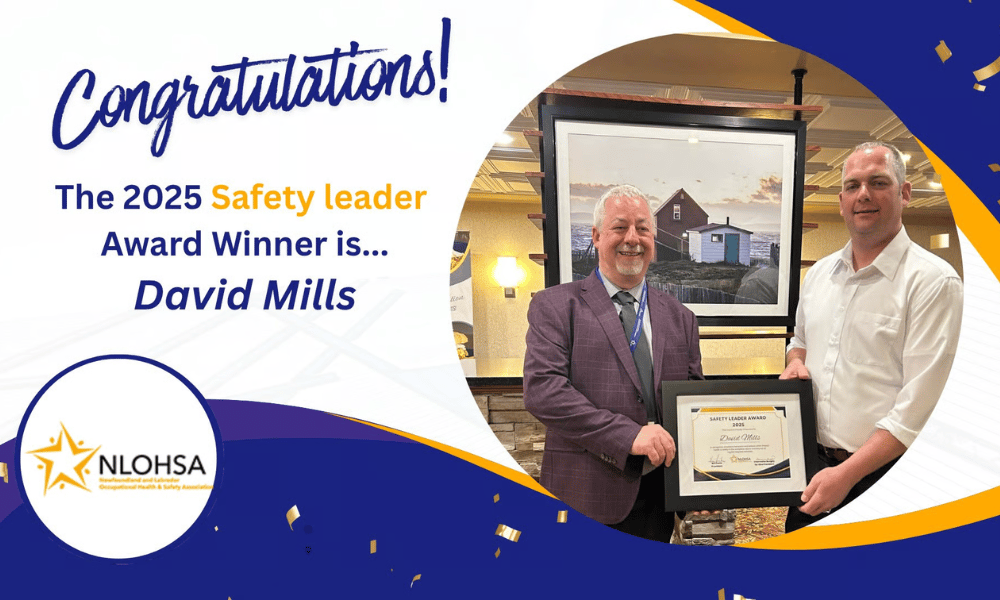
David Mills does not work in a safety office. He does not hold a safety designation or carry a safety title. He is a powerline technician lead hand at Newfoundland Power in Newfoundland and Labrador, a tradesperson who climbs trucks, works in the woods in all weather, and deals with one of the most unforgiving hazards in the skilled trades: electricity.
Yet in May 2026, Mills stood on stage at the Newfoundland and Labrador Occupational Health and Safety Association's (NLOHSA) annual health and safety conference and trade show in Gander, N.L., and accepted the organization's Safety Leader Award. Days later, his name was read into the province's House of Assembly by Minister of Government Services Mike Goosney.
"I feel pretty awesome," Mills said. "You get people like Alex Newhook and Dawson Mercer being mentioned in the House of Assembly, and then you hear that your name was mentioned. It was just like, wow." Newhook and Mercer are a couple of NHLers.
A culture that shaped him
Mills joined Newfoundland Power in 2004 at the age of 20, arriving during a significant generational shift. The company had not hired in roughly 14 years, and a wave of senior employees was approaching retirement. Mills was among the first of a new cohort brought in to carry the organization forward.
What those senior workers passed on had nothing to do with paperwork.
"The older crowd, or the more senior people, really took me under their wing and never let me go astray," Mills said. "They showed me what it meant to work at Newfoundland Power, what it meant to have pride. I had some really incredible people in my life that were giving me advice and I took it for face value. I'm starting to see that pay off now."
That mentorship embedded a view of the company as a family with mutual obligations. "You need to value the company as much as the company values you," Mills said. "At 20 years old, they took a chance on me. And now the company is relying on me, with all the training and the safety culture, to keep that at a high level."
Mills was not assigned to be a safety advocate. He grew into one, shaped by the environment around him. Building a strong safety culture at the frontline level depends on exactly this kind of top-down modelling that becomes bottom-up practice.
The hazards are real, and so is the stress
Working on powerlines is not abstract risk. Mills describes three distinct categories of danger he and his crew navigate every day.
"Electricity is the main one for sure," he said. "You don't get any second chances with electricity."
Physical hazards follow closely: strains, slips and falls, and the cumulative toll of working in and out of trucks across varied terrain in all seasons. But it is the third category that Mills speaks about with particular weight, the psychological toll.
"You work in an industry where you're dealing with customers all day," he said. "You get to see them face to face, and a lot of times you can see their struggles. When rates go up, we're at the face of that. You see the single mother, and you're fixing a light, and she's crying at the door."
The psychological dimension intensifies during major storm responses. Mills described arriving at hurricane-affected communities where customers have lost homes, while his crew is well-fed, housed and earning overtime. In small communities where workers know residents personally, the emotional weight is considerable.
"You're walking into an atmosphere where people have had their lives totally destroyed," he said. "You've got to deal with those emotions."
This dimension of the job, psychological safety as an inseparable part of occupational health and safety, has become central to Mills's own advocacy work. After opening up about his personal experiences with anxiety and depression, what he assumed would be a one-time local presentation grew into something far larger.
"I thought it was going to be like a one-and-done presentation with the people I work with every day," he said. "That's just completely expanded beyond my wildest dreams."
His mental health advocacy work is believed to have contributed to his award nomination. NLOHSA invited him to speak not at the awards dinner, where he had prepared a speech, but at the organization's 70th anniversary event, offering him a larger platform to share his story.
Work as designed versus work as done
As a lead hand, Mills supervises two-to-three-person crews and is responsible for ensuring adherence to the company's written operational procedures, called OPRs, that outline how tasks are to be performed safely. He is candid about the gap that can exist between procedures on paper and conditions in the field.
"Different people's understanding of how a job is to be done can vary," he said. "The procedure says one thing. We know from experience that this procedure is not going to work in this certain instance."
What matters, he says, is that Newfoundland Power's culture allows that conversation to happen. "I have never been in a situation where I felt that I had to go do something unsafe without talking about it. I'm not saying you always get the answer you want, but you do have that ability to talk to people."
That psychological safety, the ability to raise concerns without fear of reprisal, is a foundational element of high-functioning safety cultures, and it is something research and frontline experience consistently affirm matters most.
Mills is also quick to check any suggestion that Newfoundland Power is without its struggles. "I don't want to say this is a perfect place. We're a family, and families have their struggles. But we collaborate, we talk it out, and if we're still not satisfied, we're going to keep talking."
The second in two years
When Mills first learned he had been nominated, his reaction was telling.
"I didn't think too much of it," he admitted. "I work in a place where hundreds of people could have been called and told, 'we're putting your name forward.' That just goes to the testament of the culture I work in."
The significance settled in slowly, through the multi-day NLOHSA conference, the speakers, the focus on mental health, and finally the award dinner itself. "When I accepted the award, it was an extremely proud moment to walk up on that stage," he said.
Mills is also the second Newfoundland Power employee in consecutive years to receive the NLOHSA Safety Leader Award. That pattern is not coincidence.
"I'm not making this stuff up," Mills said. "This is a culture."
Minister Goosney reinforced that view in his May 19, 2026 statement to the House of Assembly, describing Mills as someone who "consistently puts safety first, plans work carefully, and supports others to do the same," qualities the minister noted "set the standard for responsible and safe work."
For Mills, none of this changes who he is or what he does each morning when he reports to work. He goes out in all weather. He works around live wires. He leads his crew and watches for the hazards that do not always announce themselves.
He just also happens to be the kind of person that Newfoundland's safety community thought deserved a stage.
This article is part of our Monthly Spotlight series, which in May focuses on safety culture.