
Passenger was killed and pilot suffered a serious head injury
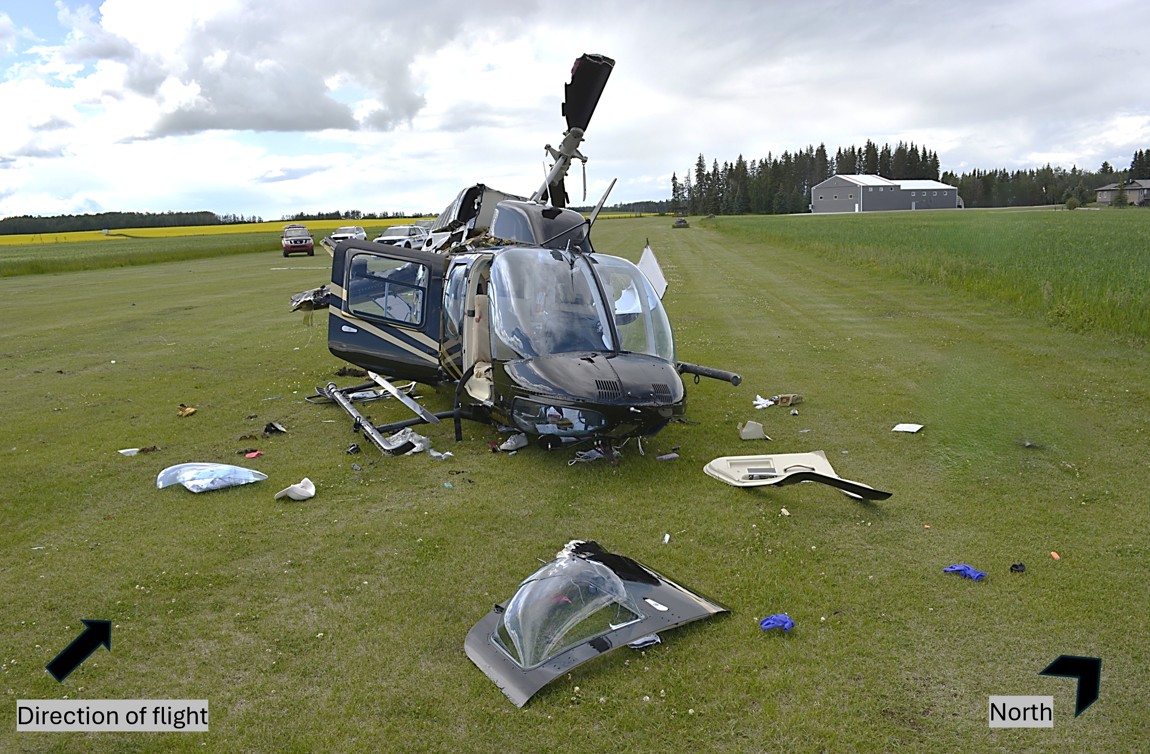
A routine sightseeing trip in central Alberta turned deadly when a Bell 206L-4 helicopter crashed during what investigators say appeared to be practice emergency manoeuvres with a passenger on board.
The Transportation Safety Board of Canada (TSB) report into the 06 July 2025 crash near the Hespero/Safron Residence Heliport describes a sequence of low‑level, high‑risk manoeuvres that ended in a hard landing, killing the passenger and seriously injuring the pilot.
The privately conducted visual flight from The Lodge at Panther River to the heliport was uneventful for the first 34 minutes. As the helicopter approached its destination, however, the pilot began flying as if simulating engine‑out emergencies known as autorotations.
From roughly 700 feet above the ground, the pilot entered a turning descent with a steep rate of drop, then pulled in power to recover and landed in the middle of the grass strip. He then took off again along the strip, climbed to about 300 feet, and began another turning descent that investigators say was again consistent with autorotation practice.
In that second manoeuvre, onboard data showed the helicopter descending rapidly at low height before the final attempt to arrest the sink rate. Within seconds, the machine struck the ground, the skids collapsed, and the helicopter spun to a stop facing the opposite direction. One main rotor blade hit the tail boom, and the tail rotor was torn away. There was no post‑impact fire.
The passenger died at the scene. The pilot survived with serious injuries.
A trained, current pilot – but a narrow margin for error
From a competency standpoint, the pilot ticked all the boxes. He held both commercial helicopter and private aeroplane licences with valid instrument ratings. He had about 3500 hours of helicopter time, including 1800 hours on this specific aircraft, and had completed a pilot proficiency check on the same type just weeks before the crash. The investigation found no evidence that fatigue, health, or medical issues affected his performance.
Weather was not a factor. Conditions at the nearest reporting airport and data from the helicopter’s own avionics both showed suitable visual conditions with moderate winds.
Nor did investigators find any mechanical defect that could explain the crash. The airframe, flight controls, systems, and engine all appeared capable of normal operation, and the helicopter was within its weight and balance limits.
What the report does highlight, however, is how unforgiving low‑level training manoeuvres can be when something goes wrong.
Canadian helicopter training guidance encourages pilots to practise autorotations under different conditions so they can reach a safe landing area if the engine fails. But that guidance also stresses the need to get back to a minimum rate of descent by around 200 feet above ground, and warns that turning autorotations can drive descent rates above 2500 feet per minute if they are mishandled. The TSB notes that instructors are told that the judgement needed to manage these variables “will only come from frequent practice.”
Passengers, practice emergencies, and acceptable risk
For health and safety professionals, one of the report’s key messages is about who should be on board when pilots practise higher‑risk manoeuvres.
The Board points out that while autorotations are essential for helicopter safety, “conducting practice autorotations can introduce risks that are higher than regular flight.” It adds that exposing passengers to those elevated risks “should be carefully considered before pilots commence this exercise.”
Canadian regulations limit emergency training with passengers in commercial operations, but those restrictions don’t apply in the same way to privately conducted flights. That regulatory gap places more responsibility on individual pilots and operators to think through whether non‑essential passengers should be present during simulated emergencies.
Head protection and survivability
The report also adds to a growing body of evidence on head protection in rotorcraft accidents.
Both front seats were fitted with lap belts and shoulder harnesses. The passenger was properly strapped in, but the impact forces and direction meant the crash was not survivable for them. Investigators could not confirm whether the pilot used his shoulder harness.
Neither occupant wore a helmet, and none was required by regulation. The pilot suffered a serious head injury. The TSB notes it has documented several accidents where helmets either helped people survive or likely would have reduced injuries, and reminds readers that the “role of helmet use in preventing serious injury in helicopter accidents has been well documented.” That message echoes a 2024 Transport Canada safety article encouraging helmet use in all helicopter operations.
The helicopter’s 406 MHz emergency locator transmitter activated as designed, and search and rescue authorities quickly confirmed that local responders were already on scene.
While the TSB does not assign blame or liability, its findings carry clear implications for safety leaders: treat simulated emergencies as high‑risk work, be cautious about carrying passengers during such manoeuvres, and view helmets and robust restraint use as critical controls for reducing the severity of inevitable accidents.