Company accused of failing to report the incident to a director of inspection as soon as possible following a serious injury or fatality
Alberta Occupational Health and Safety has charged a Calgary-based company and one of its supervisors over a 2024 workplace fall that killed a worker cleaning gutters at a Cochrane residence, with three of the four counts alleging failures in fall-protection planning, training and reporting.
OHS laid the charges against Katalyst Corporation – which operates as Gutter Doctor – and against supervisor James Hodges. Both were each charged with one count of failing to ensure a worker was protected from falling from a temporary or permanent work area where the worker could fall three metres or more. That count alleges a contravention of Section 139(1)(a) of Alberta's Occupational Health and Safety Code.
Katalyst Corporation faces three additional counts, according to a report from Cochrane Today. The company is charged under Section 33(1) of the OHS Act with failing to report the incident to a director of inspection as soon as possible following a serious injury or fatality.
The company is also charged under Section 140(1) of the OHS Code with failing to develop fall-protection procedures that complied with provincial requirements at a work site where a worker could fall three metres or more and was not protected by guardrails. A further count under Section 141(1) alleges the company failed to ensure a worker was trained in the safe use of a fall-protection system before being permitted to work in an area where such a system was required.
Worker died after fall from upper ladder
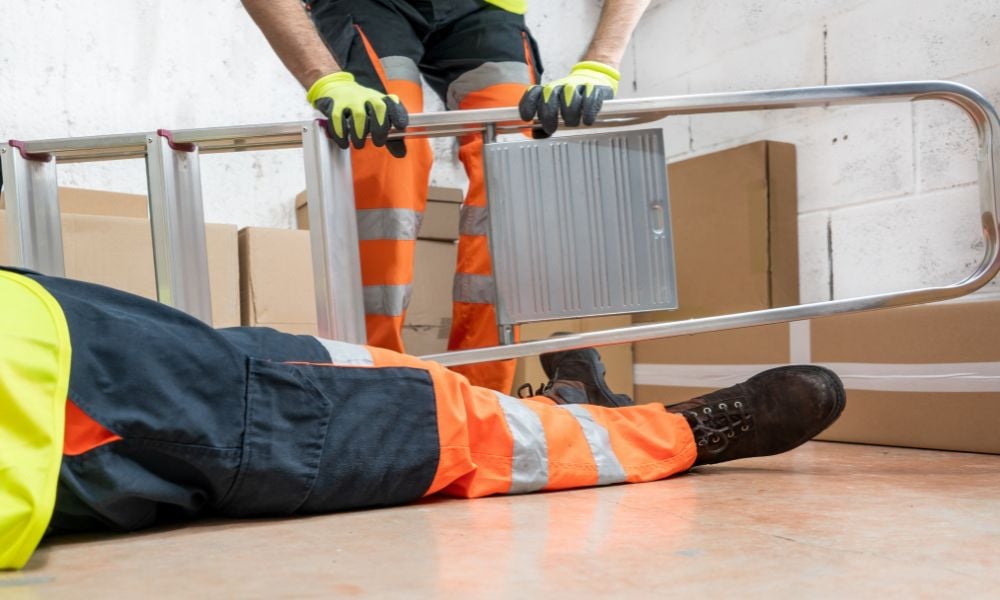
The charges stem from an incident on Aug. 23, 2024. According to OHS, a worker was cleaning the gutters of a residence in Cochrane when the worker fell from an upper ladder onto a lower roof and then dropped to the concrete front entrance below.
The worker died of the injuries. Available reporting did not identify the worker by name.
OHS laid the charges on June 9, roughly 10 weeks before the second anniversary of the incident. Under Alberta's framework, prosecutors must lay OHS charges within two years of an incident, according to the Government of Alberta's published guidance on its OHS legislation.
Penalties and court status
None of the allegations has been proven in court. No court date was available at the time of the most recent reporting.
A first offence under Section 48 of Alberta's OHS Act carries a maximum fine of $500,000, plus a further fine of up to $30,000 for each day a continuing offence persists, and the possibility of imprisonment for up to six months, according to the consolidated Act published through Alberta's OHS legislation database. All fines are subject to a 20 per cent victim surcharge.
The province's OHS legislation also permits courts to impose creative sentencing, which directs funds toward safety education or other purposes rather than general revenue, according to the Government of Alberta. The Government of Alberta publishes lists of charges and convictions under its OHS laws on its website.
What can employers do to protect workers from falling from ladders?
Here are some things that employers can do to ensure the safety from fall of workers working on ladders, according to the Canadian Centre for Occupational Health and Safety (CCOHS):
- Plan the job before work begins. CCOHS advises employers to decide how the job will be done, what tasks are involved and what safety equipment each task requires, and to make sure all necessary equipment is available at the work site. In some cases a written fall-protection plan is required, and requirements vary by jurisdiction.
- Select the right ladder for the task. Use a ladder designed for the job, considering its strength, type, length and Canadian Standards Association (CSA) approval, and follow all labels and markings. CCOHS points to the CSA Z11-18 (R2022) Portable Ladders standard, or the most current version, for detailed requirements. Choose non-conductive material such as fibreglass when work is near electrical sources, and confirm the load rating covers the worker plus tools.
- Conduct a risk assessment for work at heights and determine whether fall-protection equipment is needed for the specific ladder task.
- Provide fall protection and the right equipment. Employers must provide fall protection and the appropriate ladders, scaffolds and safety gear for the job. Fall protection is generally required when a worker could fall about three metres (10 feet) or more, and also below that height where the surface or hazard below could cause a greater injury. Where personal fall arrest systems are used, provide a properly fitted harness for each worker who must tie off.
- Inspect and maintain all equipment. Regularly inspect fall-protection equipment to confirm it is in good condition and safe to use. Keep ladders, guardrails and scaffolding stable and in good repair. Remove defective ladders from service.
- Train every worker before they are exposed to a fall risk. Before a worker is allowed into an area where a risk of falling exists, employers must ensure the worker is trained to know which fall-protection equipment to use and how to use it safely. Training should include hazard recognition and the safe use of the specific equipment, and some Canadian jurisdictions have specific training requirements.
- Involve workers in fall-protection planning. CCOHS recommends developing the plan with the supervisors and workers whose work involves fall hazards, and involving the joint health and safety committee or representative.
- Control the work area. Clear the base and top of the ladder of debris and tools, set ladders on a firm, level, non-slip surface, secure or tie off the ladder, and use barricades, warning signs or locked doors so other workers do not bump into it.
- Have a rescue plan. After a fall is arrested a worker may be left suspended and need rescue, so the plan should detail how to return a fallen worker to safety while keeping rescuers safe.
- Know and follow the applicable law and standards. Standards become enforceable when adopted into law, so employers should check the legislation in their own jurisdiction to confirm which CSA standards apply.
- Act on worker safety concerns, including reports of broken, defective or missing equipment.