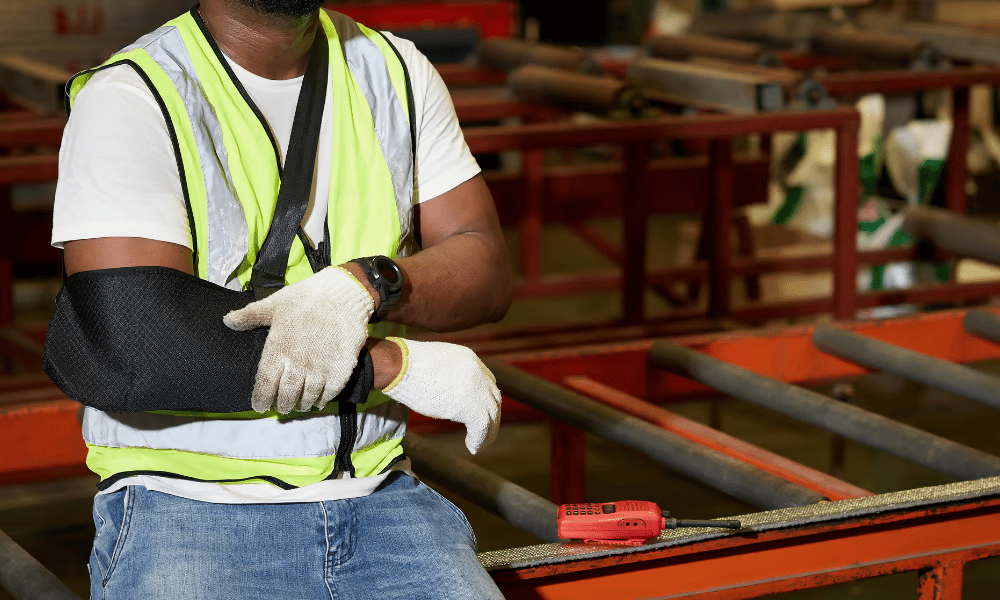
Employer 'failed to ensure that the conveyor was securely blocked to prevent it from tipping while undergoing maintenance'

A Leamington-area steel fabrication and assembly company has been fined $50,000 after a worker was critically injured when a mobile roller conveyor collapsed during a maintenance task — a case with direct implications for how OHS professionals manage equipment stability and pre-task hazard controls in Ontario industrial facilities.
Essex Weld Solutions Ltd., headquartered at 340 Allen Avenue in Essex, Ontario, pleaded guilty in Windsor Provincial Offences Court and was sentenced on September 25, 2026. Justice of the Peace Susan Whelan imposed the fine. The Ontario government also applied a 25% victim fine surcharge as required by the Provincial Offences Act, with proceeds directed to a special provincial fund to assist victims of crime. Crown Counsel was Wes Wilson.
The conviction, entered July 20, 2026, followed an offence that occurred more than 15 months earlier.
The incident
On March 17, 2025, a worker at Essex Weld Solutions' facility at 50 Victoria Avenue North in Leamington was directed by a supervisor to adjust a mobile roller conveyor — a piece of equipment routinely reconfigured to accommodate different production orders. The conveyor consisted of four sections fastened together, with each section weighing approximately 430 pounds.
Working alone, the worker began loosening bolts on the brackets connecting the conveyor sections. As bolts on a middle section were loosened, the conveyor collapsed, critically injuring the worker.
The Ontario government's court bulletin states the company "failed, as an employer, to ensure that the conveyor was securely blocked to prevent it from tipping while undergoing maintenance." No detail on the worker's current condition was disclosed in the source document.
The Ontario Regulation 851 violation
An investigation by the Ministry of Labour, Immigration, Training and Skills Development determined that the conveyor had not been secured against tipping before maintenance began. The company was convicted under Section 46 of Ontario Regulation 851 — Industrial Establishments. According to the Ontario government's e-Laws database, Section 46 states that "machinery, equipment or material that may tip or fall and endanger any worker shall be secured against tipping or falling."
The provision applies to industrial equipment whether fixed or mobile, and the Ontario government's investigation concluded that blocking the conveyor sections before disassembly was both practicable and required. The Ontario government's own sector compliance documentation identifies Section 46 as among the most commonly cited provisions issued by Ministry of Labour inspectors during industrial establishment inspections.
That enforcement history makes this case a useful reference point for OHS professionals reviewing how their own pre-maintenance procedures stack up against regulatory expectations.
OHS implications for fabrication and industrial workplaces
For OHS professionals working in fabrication, manufacturing or any Ontario industrial setting, the Essex Weld conviction underscores a straightforward but persistently enforced obligation: under Section 46, equipment that may tip or fall must be physically secured before work begins. The court bulletin notes the worker was working alone when the conveyor collapsed — a detail that points to the value of pre-task hazard assessments that account for the weight and configuration of each equipment component before disassembly is authorised.
The supervisory dimension of this case is equally important. The worker was acting under a supervisor's direction when the task was assigned, yet the Ministry's investigation found no adequate blocking procedure had been implemented. OHS professionals reviewing similar operations can find guidance in five-star safety cultures and the management practices that prevent injuries like this one.
For those benchmarking their organisation's vendors, the readers' choice awards recognising Canada's best safety suppliers vetted by OHS professionals offer a practical starting point for sourcing equipment and machine-securing products. Professionals seeking a broader view of enforcement trends can follow OHS law and legislation news covering Ontario court decisions and regulatory compliance.