Employer pleaded guilty to ‘failing to ensure the health and safety of a worker’
LX Hausys Canada Inc., a building and interior materials supplier, has been penalized $350,000 in connection with a workplace fatality at its Calgary operation, the Government of Alberta announced.
The company pleaded guilty on May 28 in the Calgary Court of Justice to one count under the Occupational Health and Safety (OHS) Act for "failing to ensure the health and safety of a worker."
As part of the resolution, the Crown withdrew 14 other counts that had been laid against the company.
The fatal incident
The charges stem from an incident that occurred at the company's Calgary warehouse on Sept. 19, 2023, according to the province.
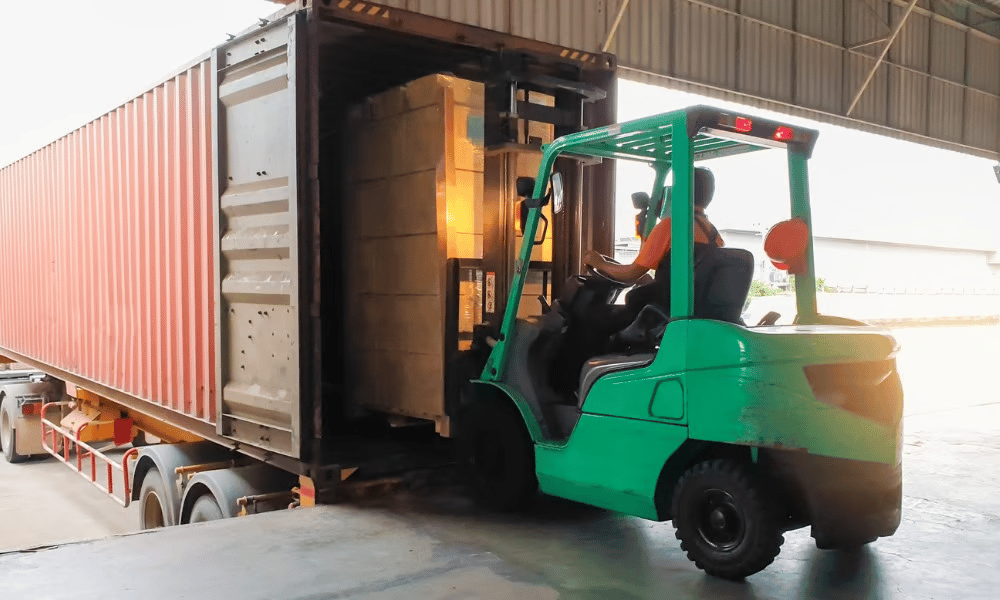
The province reported that a worker was helping to move marble slabs with a forklift at the time of the incident.
During that work, the slabs dislodged, struck the worker and caused fatal injuries.
The creative sentence
Under a creative sentence, the court ordered the company to pay the full $350,000 to the Manufacturers' Health & Safety Association.
The province said the funds are to be used to develop portable virtual reality forklift simulators intended to enhance operator training.
The association will also partner with Alberta Workforce Essential Skills to develop and provide workplace safety training for English language learners.
A creative sentence is an option under the OHS Act in which funds that would otherwise be paid as fines are directed to an organization or project that improves or promotes workplace health and safety.
The company and the Crown each have up to 30 days to appeal the conviction or the penalty.
Here’s how employers can ensure the safety of workers who perform work around moving heavy equipment using forklifts, according to the Canadian Centre for Occupational Health and Safety (CCOHS):
|
# |
Safety measure |
Description |
|
1 |
Operator training and certification |
Assign forklifts only to workers who are trained, certified or licensed; some jurisdictions require a "competent" or "authorized" person and a minimum age (e.g., 18). |
|
2 |
Lift-truck safety program (CSA B335-15) |
Build the program on CSA B335-15 (R2020), covering program implementation, operator training, trainer qualifications, and maintenance and repair practices. |
|
3 |
Load weight assessment and capacity limits |
Ensure operators know the rated load limit and never exceed it, and can assess load weight before lifting — critical given how easily dense stone slabs are underestimated. |
|
4 |
Load stability and securing |
Prevent unstable loads; CCOHS flags poorly stacked or piled loads. For slabs this points to proper A-frames, racks, blocking and restraint (applied principle). |
|
5 |
Pallet and supporting equipment condition |
Keep pallets and load-supports in good repair, since pallets in poor repair are a recognized load hazard. |
|
6 |
Safe load carriage |
Travel with the load low (no more than about 10 centimetres / 4 inches off the floor) and avoid lifting above the load backrest unless the load cannot slide back toward the operator. |
|
7 |
Daily pre-use inspection and restraints |
Require a visual and operational check at the start of each shift, and use of any seat belt or operator restraint fitted to the truck. |
|
8 |
Mechanical maintenance |
Maintain the truck to prevent failures linked to incidents — brakes, steering, mast assembly, and hydraulic systems — and bar unauthorized repairs. |
|
9 |
Pedestrian separation and workplace design |
Separate foot and forklift traffic with designated walkways, restrict access to operating areas, fix narrow or cluttered aisles and poor lighting, and keep workers from under raised loads. |
|
10 |
Safe operating procedures and reporting |
Enforce safe speed and smooth operation, clear travel routes, worker communication, and immediate reporting of collisions, damage or near-misses. |