Expert says "there's going to be a lot of deaths" in multi-billion-dollar industry
Engineered stone silicosis has reached Ontario workers for the first time in a published case series, as pressure builds on the province to tighten a crystalline silica exposure limit that occupational hygienists say is already out of step with other Canadian jurisdictions. The case series, published in October, documents 20 fabrication workers diagnosed with the irreversible lung disease since 2015. It was led by Dr. Susan M. Tarlo, a respiratory physician at University Health Network and professor of medicine at the University of Toronto, making it the first such series published in Canada.
What the Ontario case series found
Dr. Kevin Hedges, an occupational hygienist with the Occupational Health Clinics for Ontario Workers (OHCOW) and a board member of Workplace Health Without Borders (WHWB) International, has been tracking the Ontario cases as they surfaced. "There's going to be a lot of deaths," Hedges said. "Some people won't survive. It's really alarming."
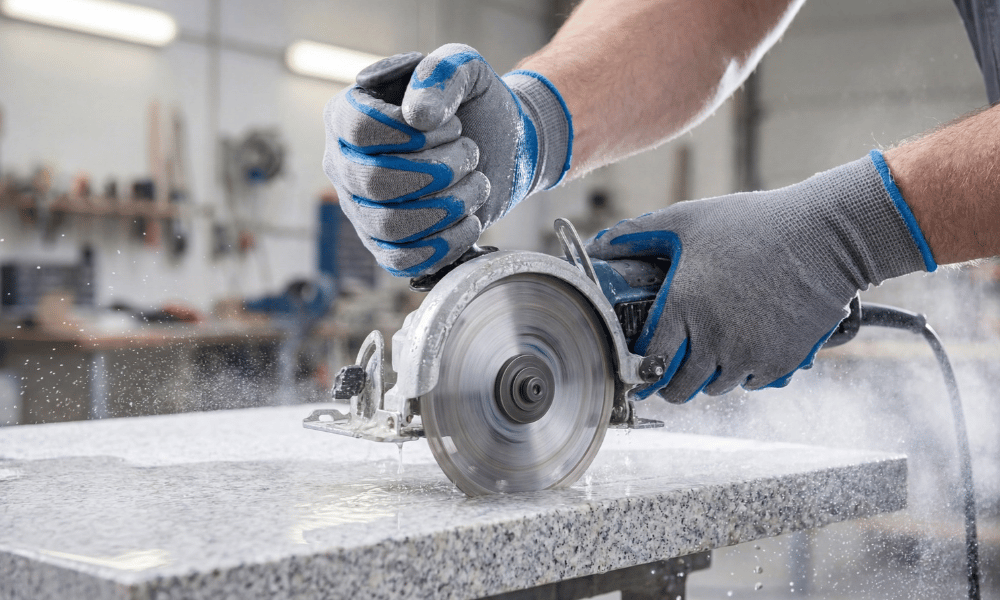
Engineered, or artificial, stone is a manufactured countertop material that can contain up to 95 percent crystalline silica and releases extremely fine, inhalable dust when cut or ground, according to the Canadian Centre for Occupational Health and Safety.
Hedges says the hazard profile of engineered stone makes it unusually dangerous even compared with other silica sources. "Even with wet cutting and ventilation," he said, "the research is showing that the exposure limits are being exceeded."
The Ontario case series, covering patients diagnosed between November 2015 and September 2025, found a median patient age of 52 and a median occupational silica exposure of 19 years. Thirty percent of patients had progressive massive fibrosis, the most advanced form of the disease, at diagnosis. Thirty-five percent developed chronic hypoxemia. Thirty percent were referred for lung transplantation, and 15 percent had died, at a median age of 43.
Hedges, who has worked as an occupational hygienist for 35 years, including as a regulator in Australia and in Newfoundland and Labrador, called the trend among the most serious he has encountered. "We've known for some years now that this is an emerging risk, and we're going to see quite a number of silicosis cases here from working with engineered stone," he said. "You're thinking about younger workers, immigrants, smaller fabrication shops. It's very difficult to provide governance and regulate them because they're under the radar." He added: "I'd say this is probably one of the most serious issues that I've come across in my working life."
Ontario's exposure limit is four times British Columbia's
Hedges points to Ontario's occupational exposure limit for respirable crystalline silica as a central part of the problem. "The problem in Ontario especially is the exposure limit for respirable crystalline silica is four times the limit in British Columbia," he said. "In British Columbia, their exposure limit is 0.025 milligrams per cubic metre, a time-weighted average over eight hours. But in Ontario, it's 0.1 milligrams per cubic metre. And we know that 0.1 isn't protective enough."
That assessment draws on Hedges's own doctoral research. Before moving to Canada roughly 15 years ago, he worked as a regulator in Queensland, Australia's mining sector, where he measured worker exposure to respirable crystalline silica alongside spirometry testing for lung function. "What I was seeing was a loss of lung function which was significant at 0.1 milligrams per cubic metre, the Ontario occupational exposure limit," Hedges said. "So even the exposure limit's too high here, in my opinion."
The gap echoes a parallel campaign pushing Ontario to lower its diesel particulate exposure limit for miners, where unions and researchers have also argued the province lags other jurisdictions on occupational exposure standards.
Why wet cutting and respirators alone aren't enough
Even where fabrication shops use recommended controls, Hedges said the evidence suggests silica exposure limits are still routinely exceeded. Full compliance with wet-cutting methods requires a continuous water supply fed directly into cutting and grinding tools, plus portable extraction hoods positioned over the job. "It's quite costly," Hedges said. "Thinking about these smaller fabrication shops having the infrastructure to set this up, it's quite difficult. And whether they'd be compliant, I doubt it."
Respiratory protection carries its own barriers. Under the Canadian standard CSA Z94.4, for which Hedges sits on the technical committee, an effective respirator program requires training, fit testing and proper selection, not just supplying a mask. Tight-fitting, negative-pressure respirators also require the wearer to be clean-shaven. "It's very hard to get compliance in place for that," he said. Australia accredits respirator fit testers through a program called Respfit; Canada has no equivalent.
"Respiratory protective equipment is always the last resort," Hedges said. "You need to have these higher order controls. Scanning through all the literature, it's very, very difficult to control the exposure to below the limit."
A global fight over banning the material
Ontario's case series arrives years after Australia and California began tracking their own outbreaks. Australia banned the manufacture, supply and installation of engineered stone containing crystalline silica above 1 percent in July 2024. A 2025 study led by respiratory physician Dr. Ryan Hoy of Monash University found that silicosis compensation claims in the state of Victoria alone rose 27-fold between earlier decades and the 2015-2022 period, with 97 percent of cases linked to stone benchtop work. California's public health department had confirmed 592 cases of engineered stone silicosis between January 2019 and June 2026, including 65 lung transplants and 31 deaths, and the state's Occupational Safety and Health Standards Board voted in May 2026 to begin emergency rulemaking toward a similar ban.
Federal OSHA pushed back. In a letter sent to California's Division of Occupational Safety and Health on November 16, 2026, the agency called a categorical prohibition "excessive and unnecessary," arguing it would punish compliant operations alongside non-compliant ones and could push unregulated shops further underground. OSHA pointed instead to an enforcement gap: California had inspected only about 10 percent of its roughly 1,342 known fabrication shops, yet 94 percent of closed inspections resulted in citations and one in five required an emergency shutdown order.
Hedges takes the opposite view. Given how difficult higher-order controls are to implement and verify in small shops, he said a ban is "the most defensible regulatory response." He also pointed to industry resistance as a factor slowing policy change in multiple jurisdictions. "A significant proportion of the market for kitchen countertops is engineered artificial stone," Hedges said. "It's a billion-dollar industry. There's a powerful industry group there as well." Dr. David Michaels, an epidemiologist at George Washington University who served as U.S. assistant secretary of labour for OSHA under President Obama, has separately and publicly pressed federal OSHA to move faster on a ban.
No one tracks how many Canadian workers are exposed
Unlike Australia, Canada has no national surveillance system tracking the number of engineered stone fabrication facilities or the size of the exposed workforce, a gap the Ontario case series authors note explicitly.
The closest available proxy, Statistics Canada's broader "concrete, clay and stone forming operators" occupational category, puts roughly 2,250 people in that line of work in Ontario, though the figure includes natural stone, concrete and clay workers with no connection to engineered stone. A similar gap has shaped debate over provincial funding for occupational disease research into exposures such as silica, where Ontario researchers have likewise pointed to thin baseline data as an obstacle to prevention. Ontario issued a hazard alert on silica exposure during countertop manufacturing in October 2023, but Hedges characterized the response as insufficient given the scale of the risk now emerging in the province's own clinical data.
For employers, that gap may not stay open for long. Ontario launched a first-in-Canada Occupational Exposure Registry in February 2026, letting workers voluntarily self-track exposure to 11 designated hazardous substances, including silica, over their careers. Participation is voluntary and the data is not currently used for enforcement, but WSIB president Jeff Lang has said the information could help "lead to faster access to WSIB services and supports for people with occupational disease claims." As Ontario's own clinical data accumulates, fabrication shops, and the builders and renovators who specify engineered stone, may find voluntary promotion of the registry becoming an expectation rather than an option.
This article is part of our monthly spotlight series, which in November focuses on industrial hygiene & occupational health.