
A recent global fatality report ranks Canada fourth most dangerous in the world. Experts say the data doesn’t add up
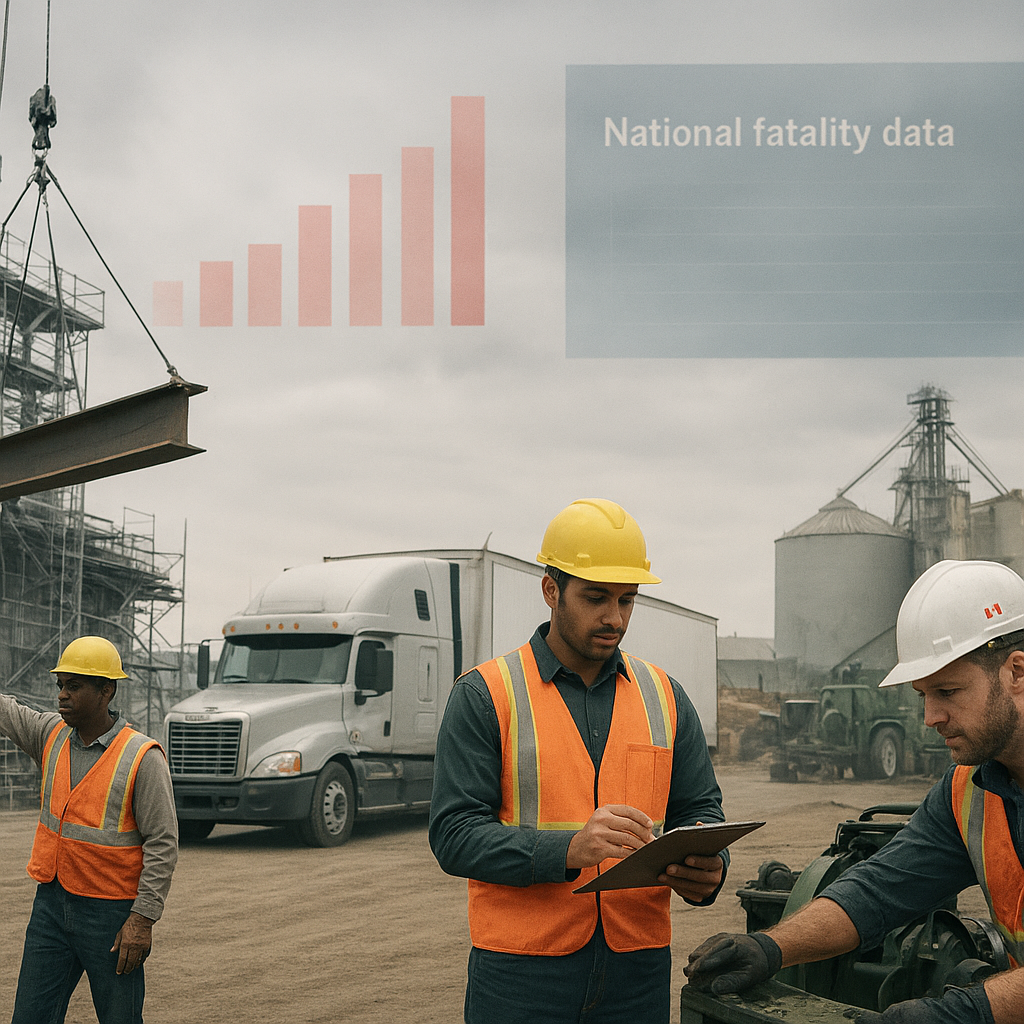
A report from an American safety equipment retailer has ranked Canada among the most dangerous countries in the world for workers – a claim that occupational health and safety experts say is built on unreliable data, inconsistent definitions, and a methodology that obscures more than it reveals.
The report, published in April 2026 by TRADESAFE, a Las Vegas-based company that sells lockout tagout devices and workplace safety products, drew on data from the International Labour Organization’s ILOSTAT database to rank 38 countries across four sectors: agriculture, construction, transportation, and manufacturing. It placed Canada fourth overall, with 16.02 fatal occupational injuries per 100,000 workers. That figure would put Canada ahead of countries such as Thailand and Moldova in terms of workplace danger.
Sean Hennessy, President of TRADESAFE, said the figures were drawn directly from the ILO’s ILOSTAT database and from each country’s own national reporting statistics, and that the company presented what it found.
“They were drawn from each country’s own national reporting statistics. We aggregated and compared. We didn’t editorialize it,” Hennessy said.
Canadian safety professionals who reviewed the report said the numbers do not reflect the reality of Canadian workplaces, and the ILO data is poorly suited to cross-country comparison.
The problem with the underlying data
Sean Tucker, a professor of occupational health and safety in the Faculty of Business Administration at the University of Regina, was unequivocal about the ILO figures at the core of the TRADESAFE report.
“The ILO stats aren’t reliable for making fair comparisons among countries,” Tucker said.
He suspects the ILO figures attributed to Canada include occupational disease fatalities, which are not counted the same way in every country. In Canada, roughly two-thirds of all recorded occupational fatalities are disease-related. If those are folded into Canada’s rate while excluded from others, the comparison becomes meaningless.
He also raised a structural issue that runs deeper than any single data point: the apparent fatality rate of a country in the ILO data may say more about the strength of its workers’ compensation reporting system than about actual workplace danger.
“The rates are very likely a function of how well a country’s workers’ compensation or related injury claims systems are. Some countries from the Global South officially have very low rates and, by comparison, are much lower than Canada’s. In relative terms, Canada’s WCB systems likely receive and accept more claims than other countries,” Tucker said.
Tucker also flagged a jurisdictional problem the TRADESAFE report does not acknowledge: the definition of what counts as a work-related fatality varies from province to province within Canada alone.
“The policies related to what constitutes work-related injuries and fatalities vary from one jurisdiction to another in Canada. Now multiply those differences 38 times and then add in differences in injury and fatality reporting. I don’t think we should put much stock in the reliability of these comparisons,” Tucker said.
When Tucker applied 2023 national-level injury-only fatality data – excluding occupational disease – Canada’s rate fell to 1.9 deaths per 100,000 workers, below the United States at 3.5, and comparable to Australia at 1.4. The TRADESAFE report attributed a rate more than eight times higher to Canada.
Agriculture: a case study in mislabelling
Nowhere is the gap between the report’s claims and Canadian data more stark than in agriculture, where TRADESAFE ranked Canada first in the world with a fatality rate of 43.36 deaths per 100,000 workers.
Robin Anderson, director of programs and communications with the Canadian Agricultural Safety Association, traced that number to the ILO’s ILOSTAT database, where she found it sits under a combined category: Agriculture, Hunting and Forestry. Fishing is folded in as well. The TRADESAFE report acknowledges this in fine print but labels the headline figure simply as “agriculture.”
“If they would have included agriculture, forestry and fishing at that top number, that could have made more sense, as opposed to just putting agriculture in bold. It does look very jarring when you see agriculture,” Anderson said.
The distinction is significant. Fishing is consistently ranked among the most dangerous occupations in the world.
“If you look at the 2023 fatalities in forestry, just even doing a quick Google search, there were a lot because of the wildfire season. So them saying agriculture in Canada is that high, I don’t think is completely accurate,” Anderson said.
The Canadian Agriculture Injury Reporting (CAIR) program, coordinated by the Injury Prevention Centre at the University of Alberta and funded by CASA, collects fatality data directly from provincial coroners’ offices and cross-references it against multiple sources. Anderson described it as the gold standard for Canadian agricultural fatality data.
“We have our CAIR cohort that goes to the coroner’s offices and gathers that data in person, and then it is verified through the Injury Prevention Centre in Alberta. We’re really confident in that data,” Anderson said.
That data tells a very different story. According to the most recent CAIR report, covering 2011 to 2020, the average agricultural fatality rate in Canada was 10.7 deaths per 100,000 farm population per year – roughly four times lower than what TRADESAFE attributed to agriculture alone.
A warning about complacency in developed nations
Hennessy said the study covered 38 countries over the period 2018 to 2024, selected based on data availability and completeness, and that each country’s overall fatality rate was calculated as an unweighted average across the four sectors. He acknowledged that agriculture stands out in the data but attributed that to what the source data showed.
On the broader message, Hennessy said the report reflects a reality that Canadian safety leaders should not overlook.
“More developed countries, with all the technology available, doesn’t necessarily mean that we’re able to automatically improve our safety environments in these workplaces. That, to me, is the big story when we compare the data,” he said.
The report contains no discussion of data limitations. Tucker said that omission alone is reason for caution. For safety professionals looking to benchmark Canada’s performance against global peers, the experts consulted for this story recommend turning to national datasets – where definitions, coverage, and reporting standards are at least internally consistent.