
Investigators found rail anchor deficiencies after a 49-car CN freight train derailment in Repentigny, Quebec
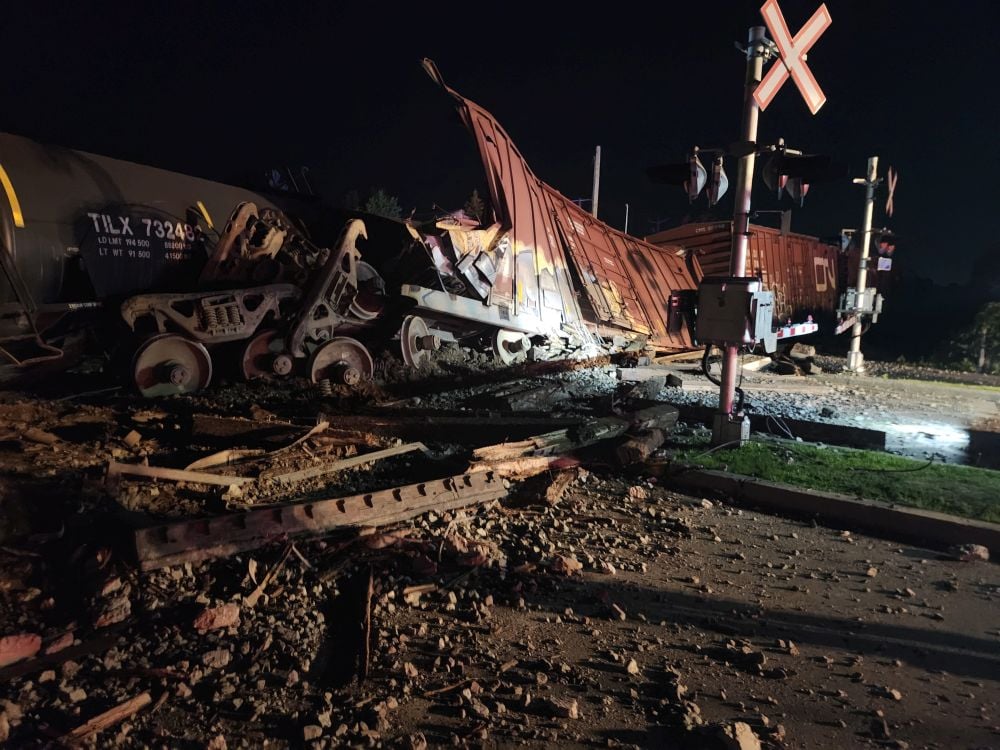
The Transportation Safety Board of Canada (TSB) has issued a rail safety advisory after preliminary findings from its ongoing investigation into a July 5 Canadian National Railway Company (CN) freight train derailment in Repentigny, Quebec identified deficiencies in the condition of rail anchors along the affected line.
The advisory, sent to Transport Canada on July 10, follows a field investigation in which TSB investigators examined the derailment site alongside eight other sections of track that were not affected by the accident, as outlined in the [board's rail safety oversight and regulatory response to Canadian incidents]. The investigation remains active and no findings on cause have been finalized.
What happened in the Repentigny derailment
CN freight train A46121-05 was travelling southward at 48 miles per hour on the main track of CN's Joliette Subdivision on the afternoon of July 5. The train consisted of two head-end locomotives, a mid-train remote-controlled distributed power locomotive, and 172 rail cars, 13 of which were tank cars containing dangerous goods residue. The train weighed 19,862 tons and measured 11,449 feet long, according to the TSB.
At about 4:30 p.m., shortly after the head-end locomotives crossed the public grade crossing on Boulevard Le Bourg-Neuf, located at Mile 120.68, a train-initiated emergency brake application occurred. Once the train came to a stop, the crew found that several cars had derailed. The TSB's preliminary estimate puts the number of derailed cars at 49, scattered on both sides of the right-of-way near residences.
No one was injured, and there was no release of dangerous goods, the TSB confirmed.
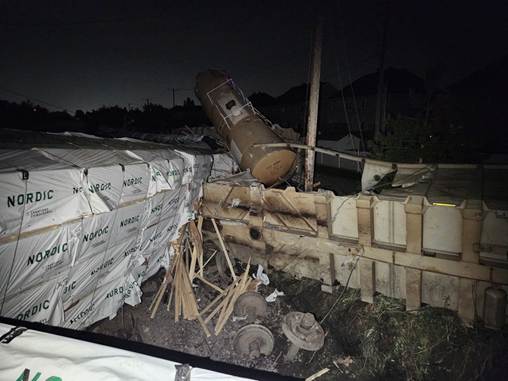
The CN freight train following the derailment on July 5, 2026 in Repentigny, Quebec (Source: Transportation Safety Board of Canada)
TSB identifies track deficiencies, issues safety advisory
Following the accident, a TSB team attended the site to assess the occurrence and collect data related to train operation, the condition of the rolling stock, and the condition of the track and infrastructure. "According to initial observations, several deficiencies were identified in relation to the track," the TSB said in its July 2026 investigation update.
Given the risks identified, the TSB advisory, Rail Safety Advisory 02/26, addresses the condition of rail anchors on CN's Joliette Subdivision. The advisory is "intended to inform the regulator of safety deficiencies identified that could pose a risk," according to the TSB. Rail anchors are fittings that hold rail in place against a railway tie to prevent longitudinal movement, and their condition is a recognized factor in track stability under heavy freight loads.
For safety professionals tracking infrastructure risk across Canadian industry, the advisory is a reminder that [proactive hazard identification through routine inspection can prevent] cascading failures long before an incident occurs, a principle that applies as much to fixed rail infrastructure as it does to workplace equipment and site conditions more broadly.
What's next in the class 3 rail investigation
The TSB has classified the Repentigny occurrence as a class 3 investigation, described by the board as "a detailed investigation conducted when there is significant potential to yield lessons and advance transportation safety." Class 3 investigations are generally completed within 450 days, per the [TSB's Policy on Occurrence Classification for Canadian transportation incidents].
The investigation is currently in the examination and analysis phase, the second of three stages in a TSB probe. In the field phase, investigators examine the occurrence site and wreckage, interview witnesses, and collect pertinent information. In the examination and analysis phase, the TSB reviews records, tests components of the wreckage in a lab, determines the sequence of events, and identifies safety deficiencies, advising regulators without waiting for a final report when deficiencies are suspected or confirmed. The final report phase involves a confidential draft that concerned parties may dispute or correct before the Board approves and releases the report publicly.
The TSB noted that its sole aim is the advancement of transportation safety. "It is not the function of the Board to assign fault or determine civil or criminal liability," the agency said.
The TSB said it will continue analyzing the information gathered to identify contributing factors and any additional safety deficiencies requiring corrective measures and will provide further updates as the investigation progresses.