Two real jobsite incidents show why Milwaukee Tool built comfort — not just certification — into its head protection platform, says Brent Neilly, Director, Product Marketing – Safety & PPE
For Brent Neilly, Director, Product Marketing- Safety & PPE – at Milwaukee Tool Canada, two incidents involving the same customer sum up what has changed in Canadian head protection over the past several years.
"There are several real-world examples where the right protective equipment has helped prevent serious injuries for our customers," Neilly said. "One that stands out occurred just a couple of weeks after a customer transitioned its workforce to Type 2 safety helmets with chin straps in January 2025. A worker was struck on the head by a piece of concrete that fell from above. The Type 2 helmet and chin strap helped protect the worker during the initial impact and kept the helmet securely in place as the worker made contact with the ground below."
Two incidents, one lesson
Weeks later, a second worker from the same company slipped on ice while climbing into a truck. "The worker didn't realize the running board of his truck had become covered in ice," Neilly said. "As he stepped up, he slipped and fell backward, striking the back of his helmet on the concrete. Because he was wearing a Type 2 safety helmet with a chin strap, the helmet remained securely in place and provided protection when he hit the ground. Fortunately, the worker walked away with only a sore neck."
Neilly said what made the first incident particularly striking was the timing. "Just two weeks earlier, that same worker would have been wearing Type 1 head protection without the same level of impact protection and retention," he said. Canada's shift toward Type 2 helmets has accelerated over the past year, moving from individual employer policy toward an industry wide standard.
Comfort is what makes compliance stick
Milwaukee entered the personal protective equipment category in 2008 and launched its first safety helmet soon after, combining a Lexan shell, foam cradle suspension and chin strap at a time when those features were still unfamiliar to many users. That investment was validated in 2025, Neilly said, when Virginia Tech introduced North America’s first independent five-star rating system for construction head protection. Milwaukee’s ANSI-certified BOLT™ Safety Helmet w/ IMPACT ARMOR™ Liner earned the #1 spot in the inaugural 2025 ratings, the standard ANSI-certified BOLT™ Safety Helmet. “The market may not have been fully ready for Type 2 head protection, chin straps and the safety helmet style, but we saw where the industry was heading and made the decision to get ahead of it,” Neilly said.
Neilly said the biggest misconception organizations make when specifying protective gear is treating it as a paper exercise instead of a field problem. “Our job is first to demonstrate the innovation and technology that goes into the product, but it can’t stop there,” he said. “We need to put that product in the hands of real users and allow it to prove itself on their jobsites and projects.” Understanding the difference between Type 1 and Type 2 hard hats is only the starting point, he added; fit and comfort are what determine whether a worker keeps the helmet on for a full shift — and for Neilly, that emphasis on real-world performance over a checklist is what makes Milwaukee’s approach disruptive rather than incremental.
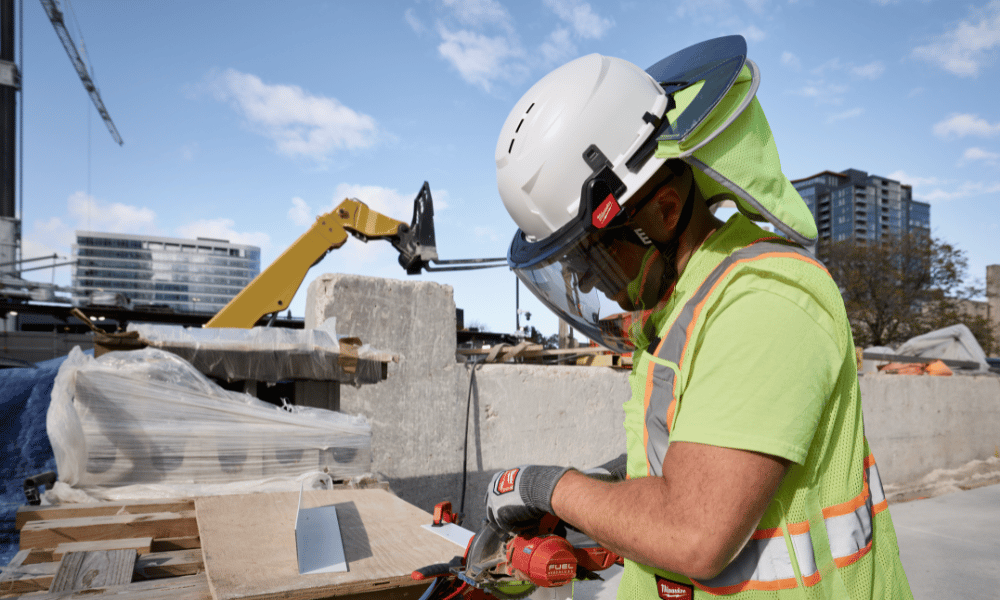
That is the thinking behind Milwaukee's BOLT™ system, which lets users attach up to eight accessories, including lights, earmuffs and voltage detectors, to a single hard hat. "In construction, comfort drives compliance," Neilly said. "If a product is comfortable and works with the user rather than against them, they are more likely to keep it on throughout the day." The same principle shaped Milwaukee's Wear Defence gloves, engineered using coreless technology to outlast traditional dipped gloves and deliver a stronger return on investment over time.
Closing the fit gap for a diverse workforce
Neilly framed the fit gap as part of a pattern he’s seen across Milwaukee’s history: where the industry accepts a partial fix, the company tends to go back to first principles instead — the same instinct that shaped its early safety tools and its move into PPE. That mindset carries directly into one of the biggest opportunities left in Canadian PPE, he said: designing properly for women, rather than resizing men’s gear. “Historically, some of the industry has taken what’s often referred to as a pink it and shrink it approach, taking PPE designed for men, making it smaller and, in some cases, changing the colour,” he said. “That doesn’t address the real issue, which is fit. Proper fit isn’t simply about comfort, it can be an important part of safety. Ill-fitting garments can create additional hazards around tools, equipment and machinery.”
Milwaukee's approach, he said, is to design products around the person who will actually wear them (with comfort in mind), whether male or female, rather than treating one design as a universal solution.
Looking ahead, Neilly said Milwaukee is exploring smart and AI enabled technologies for future generations of its helmet platform, alongside solutions for heat stress, extreme cold and hazard communication on increasingly complex jobsites. "Understand where risk exists today, anticipate where the industry is going next, and develop solutions that help workers stay safer without getting in the way of the work they need to do," he said.
This article was produced in collaboration with Milwaukee Tool.