Taxiway landing nearly struck a maintenance worker
A risk of collision between a landing aircraft and a ground maintenance worker at a Winnipeg-area airport has exposed a gap in Canada's aviation training requirements — one that left a sweeper operator with no way to protect himself.
The Transportation Safety Board of Canada (TSB) released investigation report A24C0015 on Nov. 26, 2026, examining a January 2024 incident at Winnipeg/St. Andrews Airport (CYAV) in which a Beech 200 operated by Missinippi Airways landed on a taxiway instead of a runway.
At approximately 12:38 on Jan. 27 that year, the aircraft departed Winnipeg on a solo repositioning flight to CYAV, 19 kilometres north of the city. The pilot — the sole occupant — held an airline transport pilot licence with roughly 13,000 hours of total flight time, including 5,000 hours on type.
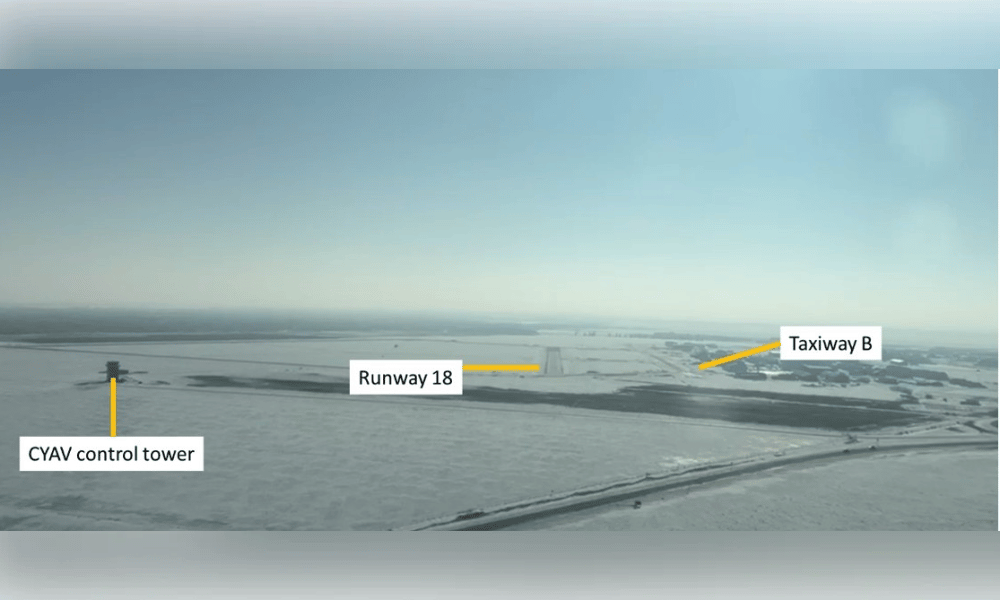
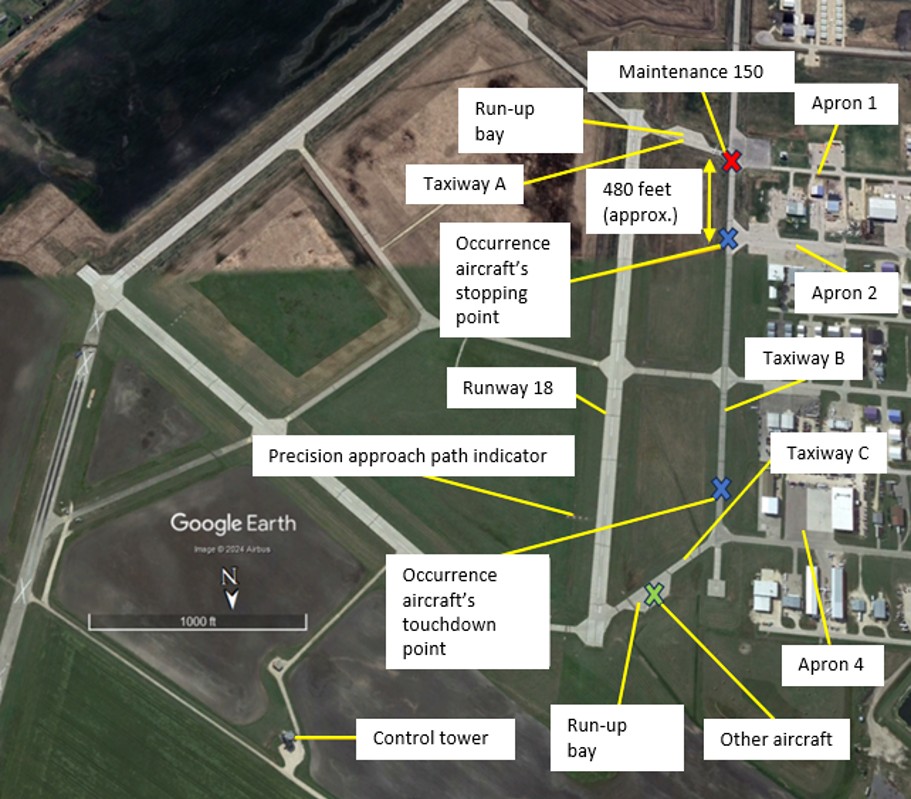
Cleared to land on Runway 18, the pilot instead touched down on Taxiway B, a parallel strip measuring 3,702 feet long by 30 feet wide. The aircraft stopped at the intersection of Apron 2 and Taxiway B.
A maintenance sweeper designated Maintenance 150 was working on the taxiway at that moment. As COS has reported, airport workers face many hazards outside and inside the terminal, including collision risks largely outside their direct control. By the time the aircraft stopped, the gap between the two had closed to roughly 480 feet. The driver contacted the ground controller, who confirmed the aircraft had landed there inadvertently.
Contributing factors in the single-pilot error
The TSB identified compounding visual and workload hazards. Snow-covered ground and wet pavement produced sun glare that obscured approach cues. While flying a visual circuit, the pilot had simultaneously configured navigation systems for an instrument approach and was managing multiple autopilot and flight-director selections.
In a single-pilot environment, every task falls to one person — a burden that grows acute during landing, when cognitive capacity is most stretched. The report states the pilot's "ability to process information can be negatively affected, particularly when ambiguous visual cues are present."
COS's guide on incident prevention using analytics and AI in Canadian workplaces examines how data-driven tools are helping safety leaders anticipate risk before harm occurs.
Training gap and safety response
The investigation found the pilot's recurrent training included crew resource management (CRM) but no single-pilot resource management (SRM) component — nor was one required by regulation. Transport Canada defines SRM as an adaptation of CRM covering situational awareness, workload management, automation management, and threat and error management.
The TSB's safety message is direct: "It is important that pilots who conduct single-pilot operations apply SRM concepts to mitigate the absence of an additional pilot to help manage in-flight duties, particularly in high-workload situations." The finding is relevant to the contractor risk frameworks covered in COS's guide on delivering responsible sourcing and worker safety programs: a ground worker's exposure can hinge on whether a co-worksite operator has received training not yet required by law.
Missinippi Airways responded four days after the incident: "Effective immediately all aircraft going in and out of Winnipeg St. Andrews airport (CYAV) will be 2 crew only."